
Warfarin INR Stability Calculator
Find Out if Vitamin K Supplementation Could Help You
This calculator helps determine if low-dose vitamin K might be beneficial based on your INR stability. Remember: this is for informational purposes only. Always consult your healthcare provider before making changes to your medication.
INR Stability Assessment
Results
When you're on warfarin, your life revolves around your INR. That number - the International Normalized Ratio - tells your doctor if your blood is clotting at the right speed. Too low, and you're at risk for a stroke or clot. Too high, and you could bleed internally from a simple fall. For many, this balance is a constant struggle. Even with careful dosing, weekly blood tests, and strict diet rules, INR values keep jumping up and down. This isn't just annoying - it's dangerous. And that’s where vitamin K supplements come in.
Why Your INR Keeps Fluctuating
Warfarin works by blocking vitamin K, which your body needs to make clotting factors. But vitamin K isn’t just in your pill - it’s in your food. Spinach, kale, broccoli, and even some oils contain it. One day you eat a big salad, your INR drops. The next day you skip greens, your INR spikes. That’s why people on warfarin are told to eat the same amount of vitamin K every day. But how many of us really do that? Life happens. You travel. You eat out. You get sick. Your body absorbs nutrients differently. And that’s when your INR goes wild.Studies show that about 30% to 50% of people on warfarin have unstable INR levels. That means they spend too much time outside the safe range - usually 2.0 to 3.0. For someone with a mechanical heart valve, the target is even higher: 2.5 to 3.5. Every time your INR goes above 4.0, your risk of bleeding jumps. Below 2.0? Clots become more likely. And these swings aren’t rare. One study found patients had an average of 11 dangerous INR readings in just six months.
How Low-Dose Vitamin K Changes the Game
Here’s the twist: instead of avoiding vitamin K, some doctors are now giving patients a tiny, steady dose - 150 micrograms (mcg) every day. That’s about 1.5 times the daily recommendation for women and a little less than for men. It sounds backwards. Why give someone on a blood thinner a vitamin that helps blood clot?The answer is consistency. Think of it like filling a bucket with a leaky hose. If you turn the water on and off randomly, the level jumps. But if you keep the flow steady, the level stays even. Vitamin K supplements do the same thing. By giving a fixed amount every day, your body doesn’t have to react to wild swings in your diet. Your warfarin dose becomes more predictable.
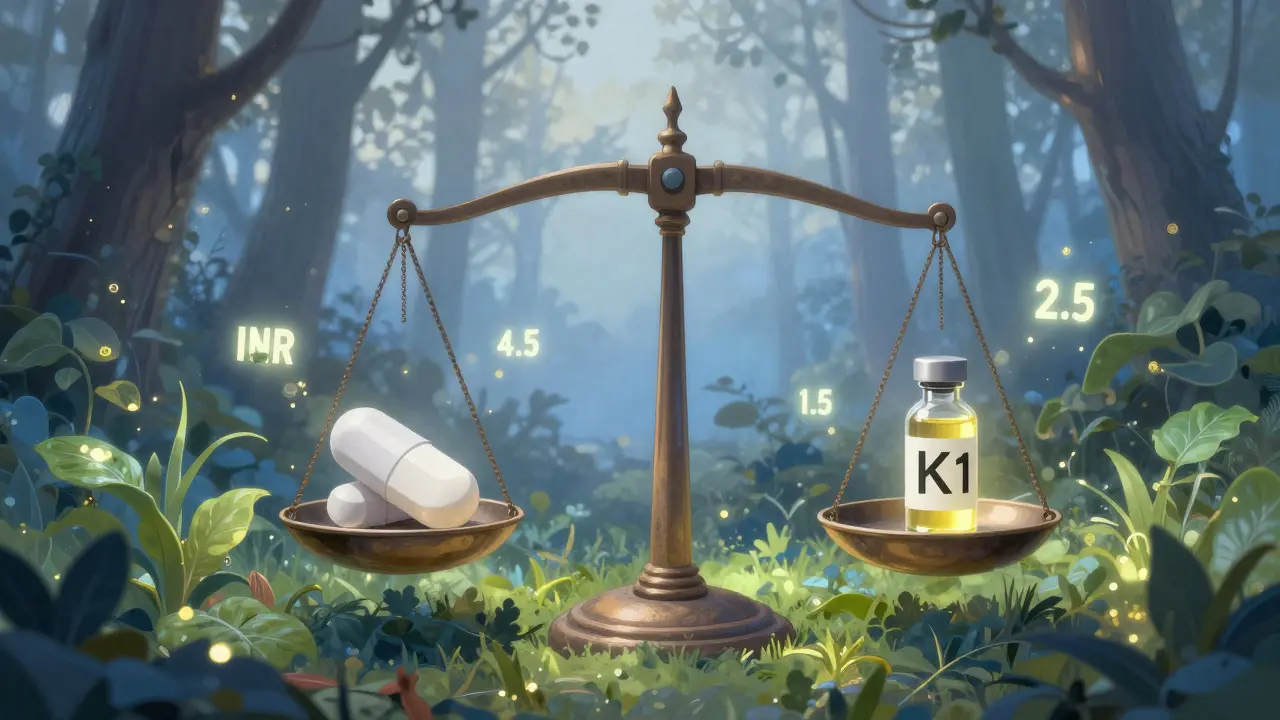
A major 2016 study in the journal Thrombosis and Haemostasis followed 150 patients on warfarin. Half took 150 mcg of vitamin K daily. The other half took a placebo. After six months, the vitamin K group had 4% fewer dangerous INR spikes (above 4.5 or below 1.5). That might sound small, but in real life, it means 15 fewer risky INR readings per year per person. That’s a lot of hospital visits avoided.
What the Research Really Says
Not all studies agree. One early trial in 2007 showed a big jump in time spent in the target range - from 15% to 28%. But later trials didn’t always replicate that. The reason? It depends on who you are. If you’ve been struggling with unstable INR for years despite diet changes and consistent dosing, vitamin K helps. If your INR swings are caused by missing pills, drinking alcohol, or taking antibiotics, vitamin K won’t fix that. It only works when the problem is dietary inconsistency.And here’s something important: vitamin K doesn’t make warfarin stronger. It makes it more predictable. Many patients end up needing a slightly higher warfarin dose after starting vitamin K - sometimes 0.5 to 1.5 mg more per day. That’s because your body now has a steady supply of vitamin K, so warfarin has to work harder to block it. Your doctor will adjust your warfarin dose based on your INR. You still need weekly blood tests - at least at first.
Who Should Consider It - And Who Shouldn’t
This isn’t for everyone. You’re a good candidate if:- You’ve been on warfarin for more than six months
- Your INR has been unstable (less than 65% of readings in range)
- You’ve tried to eat the same amount of vitamin K every day and still have wild swings
- You’re not on a DOAC like apixaban or rivaroxaban (these don’t need INR monitoring)
You should avoid it if:
- You have a mechanical heart valve in the mitral position (your target INR is higher, and vitamin K may not help enough)
- You’ve had a recent clot or stroke
- You’re eating more than 500 mcg of vitamin K daily from food (think huge amounts of kale or spinach)
- You can’t commit to regular INR testing
How It Works - And What to Expect
The supplement is usually phylloquinone - that’s vitamin K1. You take one 150 mcg pill daily. It’s absorbed in your gut and lasts long enough to smooth out your body’s vitamin K levels. You won’t feel anything. No energy boost. No side effects. That’s because 150 mcg is far below the level that could cause problems. The safety threshold is over 10,000 mcg per day.But here’s the catch: it takes time. Most people don’t see improvement until 4 to 8 weeks. Some take 3 months. That’s why many doctors stop it too soon. If your INR hasn’t stabilized after 6 weeks, don’t quit. Give it time. The first month might even be worse - your INR might dip lower than usual as your body adjusts. That’s normal. Your doctor will likely increase your warfarin dose during this time.
One patient, a 68-year-old man with a mechanical aortic valve, had TTR (time in therapeutic range) of only 42% over 18 months. After starting 150 mcg of vitamin K daily, his TTR jumped to 71% in six months. He went from 17 warfarin dose changes to just two. That’s the kind of difference this can make.
The Cost and Accessibility
This is one of the cheapest interventions in anticoagulation care. A 100-tablet bottle of 1 mg vitamin K1 costs about $8 at Walgreens. Each daily dose is 150 mcg - so you’re using less than 2% of the bottle per month. That’s less than a penny a day. Compare that to a CoaguChek home monitor, which costs $500 to $1,000, or to switching to a DOAC, which can cost $300 to $500 per month. Vitamin K is affordable, accessible, and doesn’t require special equipment.What Doctors Are Saying
There’s no official guideline yet that says “everyone on warfarin should take vitamin K.” The American College of Chest Physicians calls the evidence “promising but not definitive.” But more clinics are offering it. In 2019, only 15% of anticoagulation clinics in the U.S. offered it. By 2023, that number jumped to 28%. Why? Because patients are asking for it. And because the data keeps showing real benefits - not in every case, but in enough to make a difference.Dr. Elaine Hylek from Boston University says this is one of the most promising tools we have for stabilizing warfarin. Dr. Jacob Siegel at Johns Hopkins points out that reducing extreme INR excursions by 4% could prevent thousands of bleeding events each year. Even the European Heart Rhythm Association says it’s worth considering for patients with documented instability.

What to Do Next
If you’re on warfarin and your INR is all over the place:- Track your diet for a month. Are you eating wildly different amounts of leafy greens?
- Review your warfarin adherence. Are you ever skipping doses?
- Ask your anticoagulation clinic if they offer low-dose vitamin K supplementation.
- If they say yes, ask for the 150 mcg daily dose - not more.
- Be patient. Give it 8 weeks before deciding if it’s working.
- Keep your INR checks. Don’t stop monitoring.
It’s not a magic bullet. But for people stuck in the warfarin rollercoaster, it’s one of the few tools that actually helps - without cost, without side effects, and without needing to change your whole life.

Ashley Paashuis
February 20, 2026 AT 23:04For years, I thought avoiding vitamin K was the only way to stay safe on warfarin. I ate the same bland salad every day, measured my kale down to the gram, and still my INR was a rollercoaster. When my doctor suggested 150 mcg of vitamin K daily, I was skeptical. But after eight weeks, my TTR jumped from 51% to 78%. No more panic calls before blood tests. No more guessing if I’d had too much spinach. It’s not magic - it’s physiology. And it’s cheap. Seriously, try it if you’re stuck in the cycle.
Oana Iordachescu
February 21, 2026 AT 10:34Let me be perfectly clear: this is not science. It’s pharmaceutical manipulation disguised as nutrition. Vitamin K supplementation? On a blood thinner? Who funded this study? Big Pharma? The FDA? The WHO? There’s no long-term data on vascular calcification, no peer-reviewed meta-analysis beyond 2 years, and yet we’re being told to swallow a pill that directly counteracts the mechanism of our medication? I’m not buying it. And neither should you.
Michaela Jorstad
February 22, 2026 AT 08:59I’ve been on warfarin for 12 years. My INR used to swing from 1.8 to 4.9 in a week. I cried in the clinic parking lot more times than I can count. Then my nurse practitioner mentioned the vitamin K trick. I thought she was joking. I started it. I didn’t believe it. I didn’t feel anything. But after six weeks, my numbers were stable. For the first time ever. I still get tested weekly. I still track my greens. But now? I sleep. I travel. I eat kale. And I don’t panic. Thank you, science. Thank you, nurse. Thank you, tiny pill.
Chris Beeley
February 22, 2026 AT 19:23Oh, so now we’re just gonna hand out vitamin K like candy? Let me guess - the next thing they’ll tell us is to take aspirin with Eliquis to ‘balance’ it. This is peak reductionist medicine. You’re not treating the patient; you’re treating a lab number. You ignore the root causes - poor sleep, chronic inflammation, gut dysbiosis, erratic meal timing - and instead, you slap on a synthetic band-aid. And you call it innovation? I’ve seen patients on warfarin for decades who never needed this. They ate consistently, slept well, and didn’t treat their body like a chemistry set. This isn’t progress - it’s surrender to chaos.
Arshdeep Singh
February 23, 2026 AT 11:37Bro, you're telling people to take vitamin K because they can't control their diet? That's like giving insulin to someone who eats too much sugar. You're not fixing the problem - you're just making the drug work around it. Meanwhile, real solutions like better nutrition education, home INR monitors, or even switching to DOACs get ignored. This is band-aid medicine for lazy healthcare systems. I get it - it's cheap. But cheap doesn't mean smart. You're trading long-term safety for short-term convenience. And that's not healthcare. That's damage control.
James Roberts
February 24, 2026 AT 00:28Ohhhhh, so the solution to ‘I can’t stick to a diet’ is… to take a pill? Genius. Truly. I mean, why bother learning how to cook, why bother planning meals, why bother understanding your own body - when you can just pop a $0.02 pill and call it a day? This is the American healthcare system in a nutshell: overcomplicate the problem, then undercomplicate the solution. I love it. Next up: a pill that makes you stop yelling at your kids. Or one that fixes your credit score. I’ll take ten.
Danielle Gerrish
February 25, 2026 AT 16:28Oh my god. I just started this. I’m on day 12. My INR was 4.2 last week - I was terrified. I thought I was going to bleed out in my sleep. I started the vitamin K. Today, my INR was 2.7. I cried. I literally cried in the bathroom. My husband thought I was having a stroke. I said, ‘It’s not a stroke - it’s science!’ I’ve been on warfarin for seven years. Seven years of fear. Seven years of ‘don’t eat that,’ ‘don’t go out,’ ‘don’t travel,’ ‘don’t even sneeze too hard.’ And now? I ate a whole spinach salad last night. And I didn’t die. I’m not just stable - I’m free. I’m not sure how to feel. But I’m alive. And I’m not scared anymore.
Jeremy Williams
February 27, 2026 AT 13:46In Nigeria, we don’t have access to these supplements. But we do have moringa leaves - naturally high in vitamin K1. We’ve used them for generations in soups. Our elders never heard of INR, but they knew: eat the same greens, every day. No fancy pills. No lab tests. Just consistency. Maybe the real lesson here isn’t the supplement - it’s the rhythm. The ritual. The quiet discipline of eating the same thing, every day. That’s what stabilized generations before we had warfarin. Maybe we lost something when we outsourced health to labs and pills.
Freddy King
February 28, 2026 AT 15:05Let’s quantify the ROI on this. 4% reduction in dangerous INR excursions? That’s 15 fewer events per year per patient? Cool. But let’s run the math: if 100k patients on warfarin take this, that’s 1.5M fewer events annually. Assuming 10% of those are major bleeds, that’s 150k avoided hospitalizations. At $15k per admission? That’s $2.25B saved. Meanwhile, the cost of vitamin K? $0.01/day. The cost of a DOAC? $12k/year. This isn’t just effective - it’s the most cost-effective intervention in anticoagulation since the invention of the INR itself. The data isn’t just promising - it’s economically undeniable. Why aren’t insurers covering this? Because they don’t want to fix systemic inefficiencies - they want to sell more expensive drugs.
Laura B
March 1, 2026 AT 07:03My mom’s been on warfarin since her mitral valve replacement. She’s 82. She eats a ton of kale. She forgets her pills. She travels. She’s been in and out of the hospital. I begged her to try the vitamin K. She said no. Said it was ‘too unnatural.’ I got her a bottle. Put it in her pill organizer. Didn’t say a word. Three months later, she said, ‘I don’t know what you did, but I haven’t had a blood test in two months.’ She’s been stable for 11 months now. She still eats kale. She still forgets pills. But now? She’s not scared. I didn’t change her diet. I didn’t change her habits. I just gave her a little help. Sometimes, stability doesn’t come from discipline. It comes from grace.