When you pick up a prescription, do you ever wonder why the pill looks different from the last time? Maybe it’s a different color, shape, or even the name on the bottle. If you’ve ever thought, "This doesn’t feel right," you’re not alone. Thousands of patients have shared similar concerns online-often in forums, Reddit threads, or review sites like PatientsLikeMe. These aren’t just random complaints. They’re shaping how people see generic medications, even when science says they should work the same.
Same Drug, Different Look
Generic drugs are legally required to contain the exact same active ingredient as their brand-name counterparts. That means if you’re taking generic sertraline, it’s chemically identical to Zoloft. The FDA demands proof of bioequivalence: the generic must deliver between 80% and 125% of the active ingredient into your bloodstream compared to the brand. That’s not a guess-it’s science, tested in controlled trials with blood samples, timing, and absorption rates. But here’s the catch: generics can look different. They can have different fillers, dyes, or coatings. That’s why your generic pill might be white and oval instead of blue and capsule-shaped. And that’s where problems start. People don’t trust what looks unfamiliar. A 2023 FDA survey found that only 27.3% of patients fully believed generic drugs were as effective as brand names-even though generics make up 90% of all prescriptions filled in the U.S.What Patients Are Saying Online
Look at Reddit’s r/chronicpain or r/generics. Scroll through posts from 2020 to 2023, and you’ll see the same patterns over and over. One of the most common complaints? "The generic isn’t working like the brand did." A study analyzing 6,012 patient posts found that 47.3% mentioned "different side effects," and 32.9% said the medication "just didn’t work as well." One user wrote: "I switched to generic Lyrica and my nerve pain came back harder than before. I’m convinced the generic is inferior." But not all stories are negative. Another user posted: "Three years on generic sertraline. Saved over $2,000. Zero side effects. Same as the brand." These positive experiences are real too-but they’re quieter. Negative experiences tend to get more attention online. That’s human nature. When something goes wrong, we talk about it. When things go fine? We just move on.Why Perception Matters More Than Science
Here’s the twist: your belief about a drug can change how it works. This isn’t magic-it’s called the nocebo effect. It’s the opposite of placebo. If you think a pill won’t work, your brain can actually make you feel worse. A 2018 study in the European Journal of Public Health showed this clearly. Patients were given the exact same tramadol (a painkiller), but one group got it labeled as generic, the other as brand-name. The group that thought they were taking the generic? They stopped taking it 22.7% sooner. They reported higher pain levels. They even took more over-the-counter pills to "make up" for the perceived weakness. That’s not about chemistry. That’s about psychology. And online reviews are feeding it. When someone says, "My generic made me sick," others read it and start expecting the same. Even if they’ve never tried the drug before.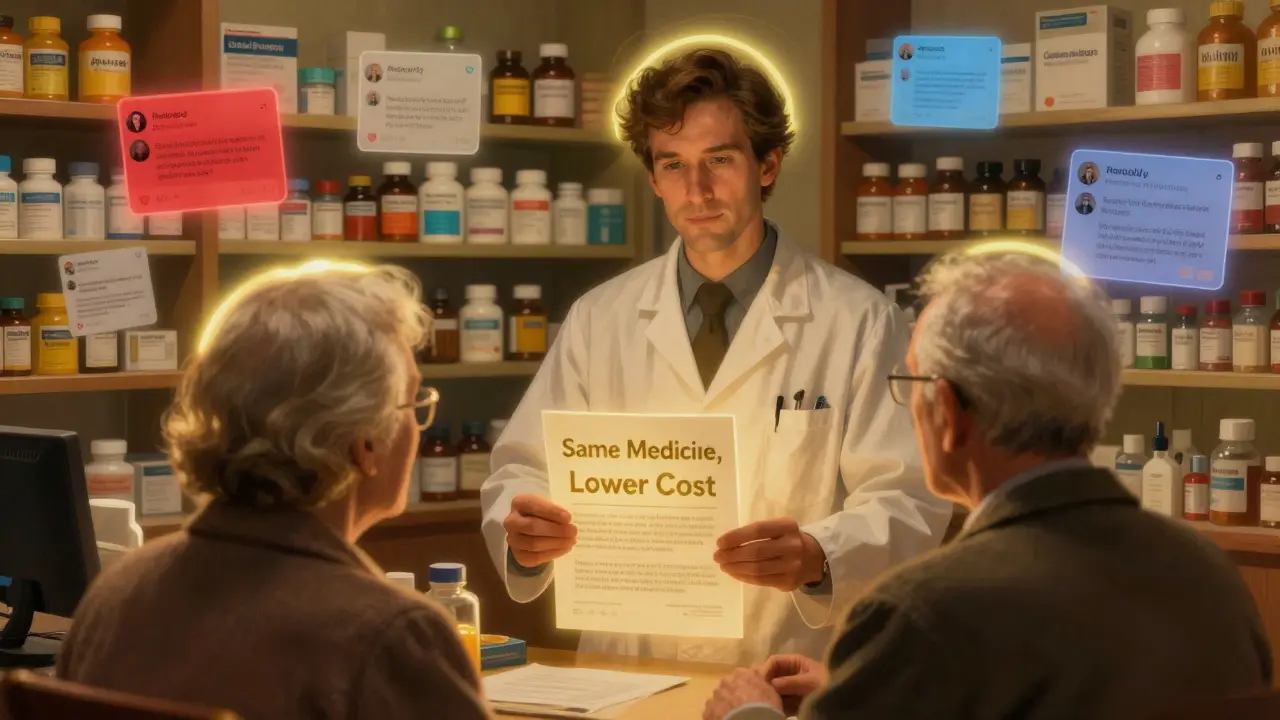
Who Influences Patients the Most?
You might think drug ads or online reviews sway people the most. But research says otherwise. The strongest influence? Your doctor or pharmacist. A 2024 study found that 69.8% of patients were more likely to accept a generic if their healthcare provider recommended it. That’s a huge number. But here’s the problem: most providers don’t talk about it. A 2023 American Medical Association report found that primary care doctors have, on average, just 1.7 minutes to discuss medications during a visit. That’s not enough time to explain bioequivalence, inactive ingredients, or how the FDA approves generics. So patients are left with silence-and their own fears. But when pharmacists take 90 seconds to explain, things change. One multi-pharmacy trial showed that when pharmacists used a simple script-"This is the same medicine, just cheaper. The FDA checks it just as closely as the brand."-patient acceptance jumped by 38.7%. That’s not a fluke. It’s proof that clear, calm communication works.Age, Education, and Trust
Not everyone reacts the same. Younger patients-those under 35-tend to be more accepting of generics. One study found 68.2% of them believe generics are just as good. But for patients over 65? Only 41.7% feel the same. Why? Older patients are more likely to have taken brand-name drugs for years. They know what those pills looked like. When the bottle changes, they assume something’s wrong. Education matters too. People with higher education levels are far more likely to understand how generics work. The correlation is strong: r = 0.73. That means if someone has a college degree, they’re nearly twice as likely to trust the science behind generics.

Rachele Tycksen
March 21, 2026 AT 16:48i switched to generic lexapro and now i feel like a zombie?? not sure if it's the pill or my life but hey at least it's cheaper lol
Pat Fur
March 22, 2026 AT 17:46the body doesn't care what's on the label. but the mind? oh it cares a lot. we're wired to distrust what looks different-even when it's identical. it's not science failing us. it's psychology winning.
Caroline Bonner
March 23, 2026 AT 14:04you know what really gets me? when people say "generic doesn't work"-but they never mention which generic, which batch, which pharmacy, or whether they took it consistently. it's like saying "my car broke down" and then refusing to say what make, model, or if you even filled the tank. we need context, not just emotion. i've been on generics for 12 years-no issues. but i also track my symptoms, sleep, and diet. maybe that's the real difference?
also-pharmacists who take 90 seconds to explain? holy grail. why don't more do that? it's not hard. it's just human.
Rama Rish
March 24, 2026 AT 12:42in india we use generics all the time. no one cares about color or shape. if it works, its good. simple.
Kevin Siewe
March 25, 2026 AT 08:47the nocebo effect is real. i’ve seen patients convinced their generic made them sick-only to switch back to brand, feel worse, and blame the brand. turns out they’d been skipping doses. the mind finds a story. science just sits there.
Chris Farley
March 27, 2026 AT 08:28the fda? please. they’re just big pharma’s puppets. you think they actually test these generics? nah. they rubber stamp it and call it a day. i’d rather pay extra for the real thing. no one’s gonna tell me my medicine is "just as good" when it looks like a baby’s first crayon.
Jacob Hessler
March 28, 2026 AT 13:35generic is for losers who cant afford the real thing. if you dont trust the brand name you got problems. america was built on quality not cheap knockoffs. also why do all these pills look like candy now? like someone at the fda was high on sugar.
Amber Gray
March 29, 2026 AT 06:41me: "my generic made me cry"
also me: 🤡💊😭
Danielle Arnold
March 30, 2026 AT 21:15oh wow a whole article about how people are dumb for trusting their gut instead of the fda? groundbreaking. next up: "how to convince people the sky is blue even when it looks gray."