
Mycophenolate Dose Adjustment Calculator
Up to half of people taking mycophenolate experience nausea or diarrhea. Research shows that lowering your dose by 30% can cut diarrhea in half without increasing rejection risk. This calculator helps you understand your potential dose adjustment.
Recommended Dose Adjustment
Current Dose: mg
30% Reduced Dose: mg
Equivalent Myfortic Dose: mg
Key Recommendations
- Study Data 78% of patients saw symptoms disappear within 72 hours at reduced doses
- Therapeutic Range MPA levels should stay between 1-3.5 μg/mL to minimize side effects
- Switching Option Myfortic (720 mg) = 1000 mg CellCept
Up to half of people taking mycophenolate - whether it's CellCept or Myfortic - will experience nausea or diarrhea. It’s not rare. It’s expected. And yet, many patients stop taking it because they think the side effects mean they’re doing something wrong. They’re not. These symptoms are a known, predictable part of how the drug works. The good news? You don’t have to live with them. There are real, proven ways to manage nausea and diarrhea so you can stay on the medication that’s protecting your transplant or controlling your autoimmune disease.
Why Mycophenolate Causes Nausea and Diarrhea
Mycophenolate doesn’t just target the immune system. It hits fast-dividing cells everywhere - including the lining of your stomach and intestines. That’s why nausea and diarrhea are so common. The drug blocks an enzyme called IMPDH, which immune cells need to multiply. But your gut lining also uses that same enzyme to renew itself every few days. When that renewal gets slowed down, the gut barrier weakens. Fluid leaks, inflammation follows, and your body responds with cramping, nausea, and loose stools.
It’s not an infection. It’s not food poisoning. It’s direct drug toxicity. That’s why antibiotics won’t help - and might even make it worse. A 2022 study found that 1 in 5 patients with mycophenolate-induced diarrhea were wrongly treated for C. diff or CMV, delaying proper management by weeks.
Dose Matters More Than You Think
Most people start on 1,000 mg twice a day. But that’s not a one-size-fits-all dose. In fact, research shows that lowering the dose by just 30% can cut diarrhea in half - without increasing rejection risk. A Johns Hopkins study of 89 transplant patients found that 78% saw their symptoms disappear within 72 hours after switching from 1,000 mg to 667 mg twice daily. Their mycophenolic acid (MPA) levels stayed in the safe, effective range: 1-3.5 μg/mL.
Don’t assume you need the full dose. Talk to your pharmacist or transplant team about checking your MPA trough levels. If you’re above 3.5 μg/mL, you’re likely overmedicated. Higher levels = more GI trouble. The European Renal Association found patients with levels over 3.5 had over three times the risk of severe diarrhea.
Switching from CellCept to Myfortic Can Help
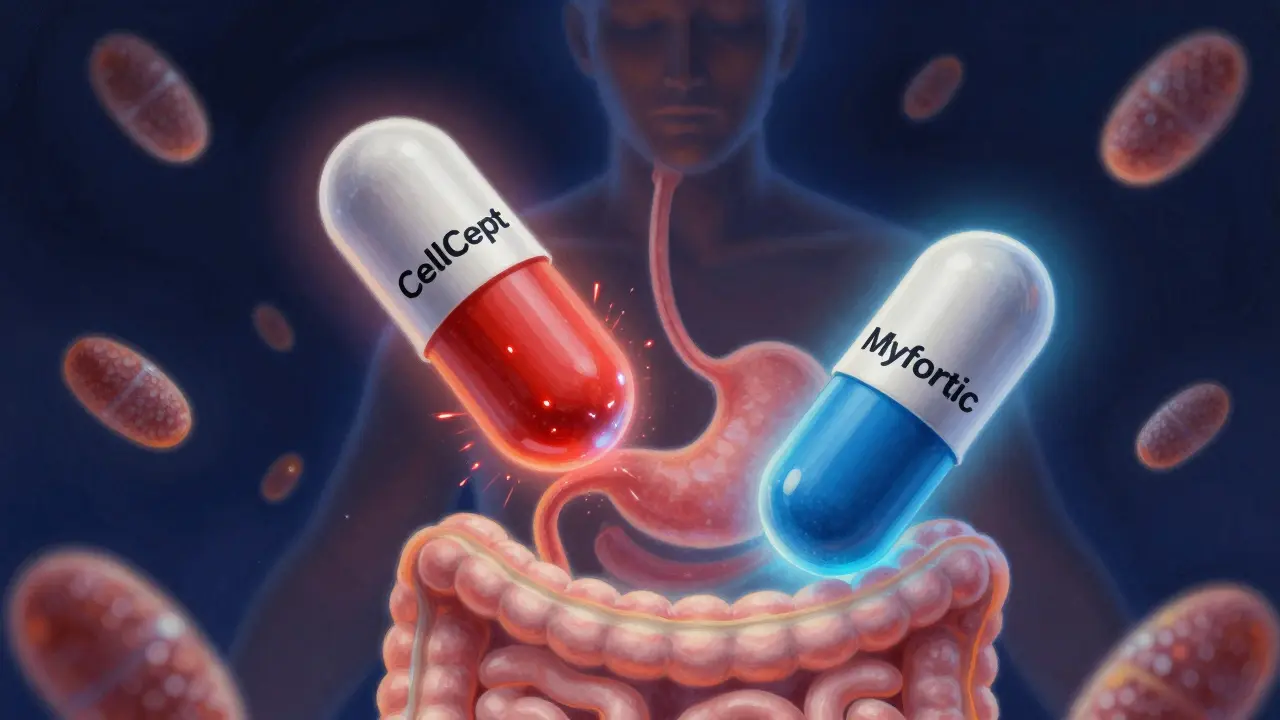
CellCept (mycophenolate mofetil) is the older version. It’s not coated, so it releases in your stomach - right where nausea starts. Myfortic (mycophenolate sodium) is enteric-coated. That means it doesn’t dissolve until it hits your small intestine. It’s not a magic fix, but it helps.
A 2022 trial with 120 kidney transplant patients showed that 65% of those who switched from CellCept to Myfortic had significant improvement in nausea and diarrhea. For people who couldn’t tolerate the original form, this was often the turning point. The dose is different - 720 mg of Myfortic equals 1,000 mg of CellCept - so your doctor will adjust it carefully.
When and How You Take It Makes a Big Difference
The Cleveland Clinic recommends taking mycophenolate on an empty stomach - at least one hour before or two hours after food. That’s because food can mess with absorption. But here’s the catch: if you’re already nauseated, an empty stomach makes it worse.
Many patients find relief by taking it with a small, bland snack. Think: a few crackers, a spoonful of applesauce, or a banana. A Reddit thread from March 2024 with nearly 300 comments showed that 62% of users who took mycophenolate with applesauce reported less nausea. It’s not science-backed in a formal trial, but it’s a practical trick that works for a lot of people.
Also, splitting your dose helps. Instead of two big pills, take one in the morning and one in the evening. Some people even take one with breakfast and one with dinner - not on an empty stomach, but with food. This keeps the drug’s peak effect spread out, reducing the sudden hit that triggers nausea.
Probiotics Might Be Your Secret Weapon
When your gut lining is damaged, the balance of good bacteria gets thrown off. That’s where probiotics come in. The strain Lactobacillus GG has been studied specifically in transplant patients on mycophenolate. In a University of Michigan survey, 49% of patients who took Lactobacillus GG daily reported less diarrhea and bloating.
Look for a capsule with at least 10 billion CFUs of Lactobacillus GG. Don’t waste money on fancy blends. Stick to this one strain - it’s the only one with data in this population. Take it at least two hours apart from your mycophenolate, so it doesn’t get washed away.
When It’s More Than Just Upset Stomach
If your diarrhea lasts more than seven days, gets bloody, or comes with fever or severe cramping, you need a colonoscopy. Mycophenolate can cause colitis - inflammation of the colon. It looks like Crohn’s disease under the microscope, with dead cells sloughing off the gut lining. But it’s not an infection. It’s drug damage.
Doctors often mistake it for C. diff or CMV because the symptoms overlap. But those infections need antibiotics or antivirals. Mycophenolate colitis needs the drug stopped - temporarily. A 2022 review found that 1.9% of kidney transplant patients developed this serious form of colitis. If you have it, your team will pause mycophenolate for 2-4 weeks, then restart at a lower dose. About 42% of patients who rechallenge have symptoms come back - so dose reduction is key.
What to Do When You Can’t Tolerate It Anymore
One in five patients stops mycophenolate within the first year because of GI side effects. For 14%, it’s permanent. That’s not failure - it’s survival. There are alternatives.
Azathioprine is older and less effective, but it’s gentler on the gut. Leflunomide is newer, with fewer GI issues in early trials. Sirolimus or everolimus are mTOR inhibitors that can replace antimetabolites in some cases. The trade-off? More mouth sores, swelling, or cholesterol issues - but no diarrhea.
If you’ve tried dose tweaks, timing changes, probiotics, and switching to Myfortic - and you’re still struggling - talk about alternatives. Your immune system still needs protection. But you don’t have to suffer to get it.

The New Hope: Extended-Release Mycophenolate
In March 2023, the FDA approved a new version: mycophenolic acid extended-release (MPA-ER). This isn’t just a new brand - it’s a new delivery system. Instead of releasing all at once, it slowly releases over 12 hours. In Phase III trials, patients on MPA-ER had 37% less diarrhea than those on standard mycophenolate mofetil.
It’s not widely available yet, but it’s coming. If you’re on mycophenolate and struggling, ask your pharmacist if MPA-ER is an option for you. It’s not covered by all insurance yet, but many are starting to approve it for patients with documented GI toxicity.
What to Track and When to Call Your Doctor
Keep a simple log for two weeks:
- Time you took your dose
- What you ate with it (or didn’t eat)
- How bad your nausea was (1-10 scale)
- Number of bowel movements per day
- Any blood, mucus, or cramping
Call your doctor if:
- Diarrhea lasts more than 7 days
- You lose more than 5% of your body weight in a month
- You feel dizzy, weak, or have dark urine (signs of dehydration)
- You develop a fever over 100.4°F
Don’t wait until you’re in the ER. Early intervention means you can stay on mycophenolate - and avoid rejection.
Bottom Line: You’re Not Alone, and It’s Manageable
Mycophenolate is the most used immunosuppressant in the world - because it works. But its GI side effects are real, common, and often avoidable. You don’t have to suffer through nausea and diarrhea to stay healthy. Dose reduction, timing adjustments, switching formulations, probiotics, and new extended-release versions are all tools in your toolbox.
Most patients who stick with the process - and work with their team - find relief within a few weeks. The goal isn’t to eliminate the drug. It’s to make it tolerable. And with the right approach, that’s absolutely possible.

Gregory Parschauer
January 13, 2026 AT 14:34Let me just say this: if you’re still taking the full 1000mg BID and complaining about nausea, you’re not being managed-you’re being negligent. The literature is crystal clear: MPA troughs above 3.5 μg/mL are a direct violation of therapeutic guidelines. You’re not ‘sensitive’-you’re overdosed. Stop blaming the drug and start demanding a level check. Your transplant team isn’t doing their job if they’re not monitoring this. And no, ‘I feel fine’ isn’t a lab value. Get your numbers. Now.
Avneet Singh
January 14, 2026 AT 07:25Interesting how the entire post reads like a pharmaceutical white paper with a side of Reddit anecdotal evidence. The applesauce thing? 62% of Reddit users? That’s not evidence-that’s confirmation bias masquerading as data. And Lactobacillus GG? Fine, but where’s the RCT with placebo control? This feels less like medicine and more like a marketing pamphlet disguised as patient education.
vishnu priyanka
January 14, 2026 AT 19:25Bro, I took mycophenolate for 3 years after my kidney transplant in Delhi. Nausea? Yeah. Diarrhea? Oh yeah. But I started taking it with a tiny bit of ripe banana and a spoon of ghee-yes, ghee. No fancy probiotics, no switching brands. Just slow, quiet, Indian-style adaptation. My gut adjusted. My levels stayed stable. Sometimes the answer isn’t in the lab-it’s in the kitchen. Also, chai helps. Not scientifically, but emotionally? Huge.
Angel Tiestos lopez
January 16, 2026 AT 10:42so like… i’ve been on this stuff for 5 years and i finally figured out that taking it with a peanut butter cracker at 7pm makes my stomach stop screaming?? 🤯 i used to cry in the bathroom every morning. now i just chill. also, MPA-ER is coming?? yessssssssssssss 🙌 i’ve been begging my doc for it since 2022
Alan Lin
January 18, 2026 AT 05:10While I appreciate the comprehensive nature of this summary, I must emphasize the critical importance of clinical vigilance. The data presented, though compelling, must be contextualized within the individual patient’s pharmacokinetic profile. It is not merely a matter of dose reduction-it is a recalibration of therapeutic intent. Furthermore, the suggestion to employ probiotics without documented strain-specific pharmacodynamic interaction studies risks introducing confounding variables into an already delicate immunological equilibrium. I urge all patients to engage in structured, longitudinal monitoring-not anecdotal experimentation.
Pankaj Singh
January 19, 2026 AT 19:58Wow. So you’re telling me people are dying because they didn’t read a Reddit post? Let me guess-next you’ll say ‘eating kale prevents rejection.’ This isn’t self-help. This is life-or-death immunosuppression. You can’t replace clinical judgment with ‘applesauce works for some people.’ You’re giving false hope to people who need real science, not folk remedies wrapped in jargon.
Kimberly Mitchell
January 20, 2026 AT 00:01Why is it always the patients who have to adapt? Why isn’t the pharmaceutical industry developing better formulations sooner? This is a 20-year-old drug with known GI toxicity, and we’re still telling people to eat crackers and take probiotics? This is systemic failure disguised as patient empowerment.
Vinaypriy Wane
January 20, 2026 AT 06:52I’ve been on mycophenolate for seven years. I switched to Myfortic. I split my dose. I take Lactobacillus GG at 10 a.m., and my pill at 8 p.m. I track everything. I’ve had zero diarrhea for 31 months. It’s not magic. It’s discipline. And yes, it’s exhausting. But I’m alive. And I’m grateful. If you’re struggling-you’re not broken. You’re just still figuring out your protocol. Keep going.
Diana Campos Ortiz
January 20, 2026 AT 07:34My doctor said I’d have to choose between rejection and nausea. I didn’t. I found MPA-ER. It’s not perfect, but my diarrhea went from 8 times a day to maybe once. I cried when I got the first prescription. Thank you for writing this. I didn’t know I wasn’t alone.