
Lithium-NSAID Interaction Risk Calculator
This tool helps you understand how NSAIDs can affect your lithium levels and kidney function. Based on clinical studies, specific NSAIDs can increase lithium levels by 20-60%, putting you at risk for toxicity. Enter your current lithium level and NSAID type to see your risk assessment.
For people taking lithium to manage bipolar disorder, a simple pain reliever like ibuprofen or naproxen can be deadly. This isn’t a rare edge case-it’s a well-documented, predictable, and often ignored danger that puts thousands at risk of kidney failure and life-threatening toxicity every year. The problem isn’t that these drugs are bad on their own. Lithium has been saving lives since the 1970s. NSAIDs are among the most common medications in the world. But together, they create a perfect storm for your kidneys-and most patients don’t even know it.
How Lithium and NSAIDs Work Together to Harm Your Kidneys
Lithium works by stabilizing mood, but it’s cleared from your body almost entirely by your kidneys. Every time you pee, your kidneys filter out excess lithium to keep levels in a safe range. NSAIDs, on the other hand, block enzymes called COX-1 and COX-2 that help produce prostaglandins-chemicals your kidneys need to maintain blood flow and filter waste efficiently. When NSAIDs shut down prostaglandin production, your kidneys slow down. And when they slow down, lithium doesn’t get flushed out.
Studies show that just one or two doses of an NSAID can reduce lithium clearance by 20% to 60%. That means if you’ve been taking your lithium dose safely for months, adding ibuprofen for a headache can cause your lithium blood levels to spike within 48 hours. The result? Tremors, confusion, nausea, blurred vision, and in severe cases, seizures or coma. One 2023 study found that people taking both drugs had a 3.2 times higher risk of acute kidney injury compared to those taking lithium alone. And the highest risk? The first 30 days after starting the NSAID.
Not All NSAIDs Are Created Equal
Some NSAIDs are far more dangerous than others when mixed with lithium. Indomethacin is the worst offender-it can push lithium levels up by 40% to 60%. Piroxicam and naproxen aren’t far behind, increasing levels by 25% to 35%. Even common over-the-counter drugs like ibuprofen can raise lithium by 20% to 30%. That’s enough to push someone from a safe level of 0.6 mmol/L into the toxic range of 1.5 mmol/L or higher.
Aspirin and celecoxib are less risky, but they’re not safe. Even celecoxib, often marketed as a “kidney-friendly” NSAID, still increases lithium levels by 10% to 15% in people with existing kidney issues. And here’s the kicker: the interaction doesn’t disappear when you stop taking the NSAID. Prostaglandin suppression can last 7 to 10 days, meaning lithium levels stay elevated long after the painkiller is gone.
Why This Interaction Is Worse Than Other Drug Risks
People often hear about lithium interacting with diuretics or ACE inhibitors. Those are serious too-but they’re not as bad. Diuretics might raise lithium by 15% to 25%. ACE inhibitors do the same. But NSAIDs? They’re in a league of their own. A 2022 study comparing over 12,000 lithium users found that those taking NSAIDs had nearly three times the rate of long-term kidney function decline compared to those using acetaminophen or opioids. In fact, the risk of losing 30% or more of kidney function over five years was nearly triple.
Acetaminophen, by contrast, doesn’t affect lithium levels at all. It’s the only common painkiller that’s considered safe for long-term use with lithium. Opioids can cause modest increases, but mostly through dehydration-not direct kidney interference. That’s why experts say acetaminophen should be the first choice for anyone on lithium who needs pain relief.
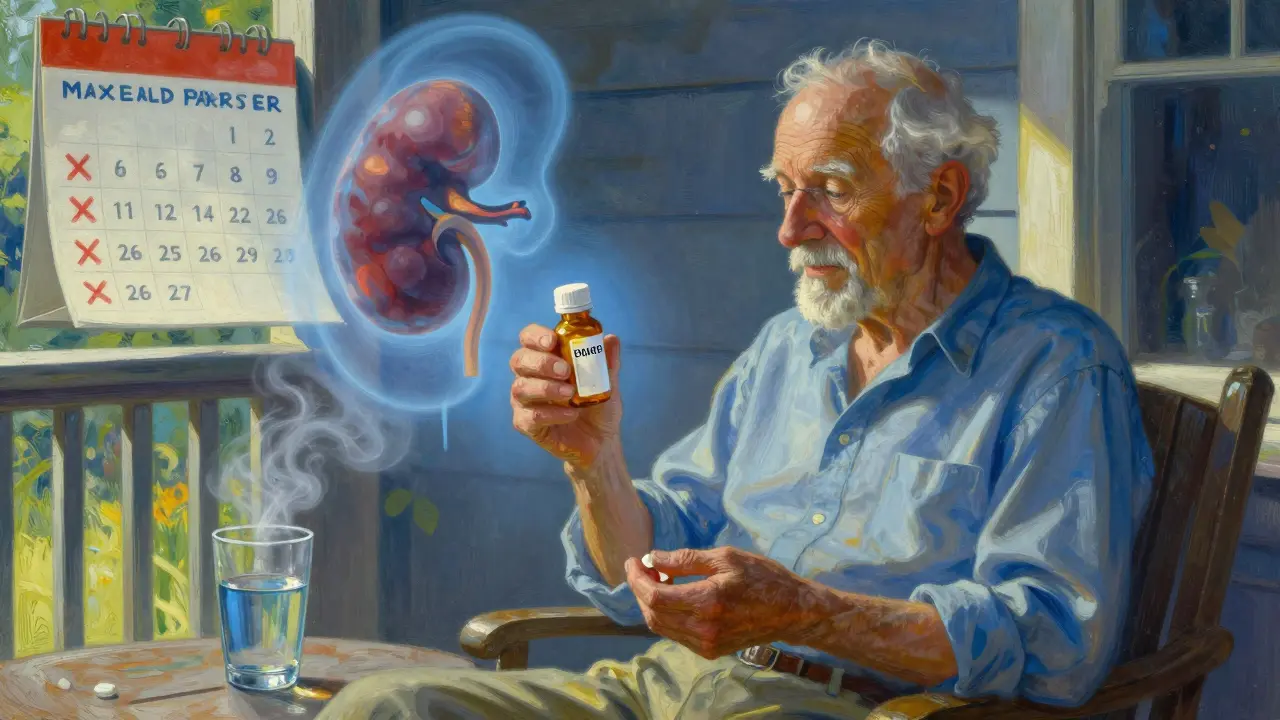
Who’s Most at Risk?
Age is the biggest factor. People over 65 are the most vulnerable. Their kidneys naturally filter slower. Add an NSAID, and lithium builds up fast. One study found that over half of all lithium-related kidney injuries in older adults were tied to NSAID use. But it’s not just the elderly. Anyone with preexisting kidney disease-even mild-is at extreme risk. If your eGFR (a measure of kidney function) is below 60 mL/min, even small increases in lithium can be dangerous.
People seeing multiple doctors are also at higher risk. A 2023 study showed that 48% of lithium users who got an NSAID prescription had three or more prescribers. Often, it’s the orthopedist, the primary care doctor, or the dentist who prescribes the NSAID without knowing the patient is on lithium. In one case series, 82% of hospitalizations for lithium toxicity were linked to NSAIDs-and most patients said no one warned them.
What Doctors Should Do (And Often Don’t)
Guidelines from the American Society of Nephrology and the American Psychiatric Association are clear: avoid combining lithium and NSAIDs whenever possible. If you absolutely must use one, you need twice-weekly lithium level checks and weekly kidney function tests for the first four weeks. Fluid intake should be increased to at least 3 liters per day. And lithium doses may need to be cut by 25% to 50%.
But in real life? Most doctors don’t follow this. A 2021 audit found that only 62% of lithium-prescribing clinicians included NSAID warnings in patient handouts. Compare that to 99% who warn about diuretics. Why the gap? Because the risk is underrecognized. Many providers still think, “It’s just a little ibuprofen.”
Electronic health records have alerts for this interaction-but they only reduce co-prescribing by 35%. That means 65% of the time, the warning is ignored, bypassed, or missed. The FDA added a boxed warning to lithium labels in 2021. The European Medicines Agency now recommends hard stops in prescribing systems unless a nephrologist signs off. But these rules aren’t universal. And patients? They’re still getting caught in the gap.
What You Should Do If You’re on Lithium
If you’re taking lithium and you need pain relief, here’s what to do:
- Never take an NSAID without talking to your psychiatrist or pharmacist first. This includes over-the-counter pills, gels, and even topical creams.
- Use acetaminophen (Tylenol) instead. Up to 3,000 mg per day is generally safe. Don’t exceed this-it can damage your liver.
- If you must use an NSAID, limit it to 3 to 7 days max. Even then, drink extra water (3 liters/day), avoid dehydration, and get your lithium level checked 48 to 72 hours after starting.
- Keep a list of all your medications. Give it to every doctor, dentist, or urgent care provider you see. Say clearly: “I’m on lithium. Don’t give me NSAIDs.”
- Know the signs of toxicity. Tremors, frequent urination, nausea, dizziness, confusion, or slurred speech? Go to the ER. Don’t wait.
The Bigger Picture: Why This Keeps Happening
This isn’t just about bad prescribing. It’s about how our healthcare system is built. Mental health and physical health are treated as separate worlds. A psychiatrist manages your mood. A rheumatologist handles your arthritis. They don’t always talk. And patients are left in the middle.
Meanwhile, the number of people on long-term lithium is growing. Sixty-five percent of users are now over 50. Most have other conditions-arthritis, back pain, headaches-that require pain meds. The demand for NSAIDs isn’t going away. But the risks are. And until prescribing habits change, patients will keep getting hurt.
Some systems are trying. Kaiser Permanente cut lithium-NSAID co-prescribing from 32% to under 12% by forcing provider education and real-time alerts. But most places haven’t done nearly enough. The cost? Nearly $50 million a year in hospital bills in the U.S. alone. And behind every dollar is a person who nearly died because someone didn’t know the risk.
What’s Next?
Researchers are working on solutions. A new drug in early trials mimics kidney-protecting prostaglandins without interfering with lithium clearance. Early results show it reduces lithium spikes by 87%. If it works, it could be a game-changer.
But until then, the safest option is simple: avoid NSAIDs. Use acetaminophen. Stay hydrated. Monitor your levels. And speak up-if your doctor prescribes an NSAID, ask: “Is this safe with lithium?” If they hesitate, get a second opinion. Your kidneys-and your life-depend on it.
