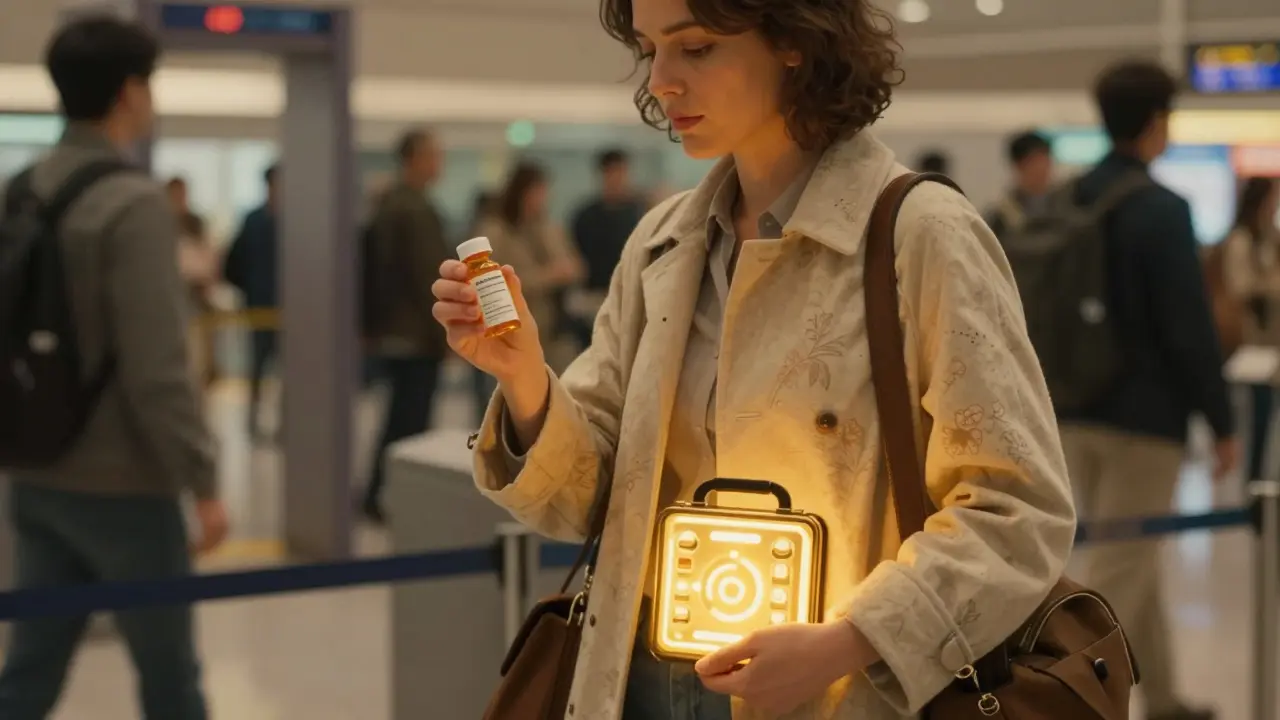
Traveling with controlled medications isn't just about packing a pill bottle-it’s about avoiding theft, legal trouble, and losing access to essential treatment. Whether you're flying to Tokyo, driving across the U.S., or hopping between European cities, the risk of your medication being stolen or confiscated is real. And it's not just about losing a few pills. For many, missing a dose can mean severe withdrawal, pain flare-ups, or even hospitalization. The good news? With the right steps, you can travel safely without becoming a target.
Know What You're Carrying and Why It Matters
Controlled medications are grouped into five schedules by the U.S. Drug Enforcement Administration (DEA), based on abuse risk and medical use. Schedule II drugs-like oxycodone, hydrocodone, and fentanyl-are the most tightly controlled because they have a high potential for addiction and are often stolen for resale. Schedule III-V drugs, such as certain benzodiazepines or low-dose opioids, are less risky but still require careful handling. If you're unsure which schedule your medication falls under, check the label or ask your pharmacist. Controlled medications are not treated like regular vitamins or supplements at airports or borders. They’re tracked, questioned, and sometimes seized if paperwork is missing.Always Keep Medications in Carry-On Luggage
Checked bags get lost, delayed, or left unattended in cargo holds. The Transportation Security Administration (TSA) and the International Narcotics Control Board both require that all medications, especially controlled substances, stay in your carry-on. According to SITA’s 2022 Baggage Report, about 25.5 bags per 1,000 passengers are mishandled. That means if you pack your pills in a suitcase, you’re gambling with your health. Keep your medication in a small, easy-to-reach pouch so you can grab it quickly at security checkpoints. Never let it out of your sight during transit.Use Original Prescription Containers
This is non-negotiable. Your medication must be in its original pharmacy-labeled container. That means the bottle with your name, the prescriber’s name, the drug name, strength, dosage instructions, and pharmacy stamp. A 2023 Cleveland Clinic study found that 78% of security issues at airports happened because travelers used pill organizers, ziplock bags, or unlabeled containers. Even if you’re carrying a 14-day supply for a short trip, the original container is your legal proof that the medication is yours. If you’re worried about privacy, ask your pharmacist for a smaller, discreet vial with the same labeling. Many pharmacies now offer this service.Bring a Doctor’s Letter-Especially for International Travel
If you’re crossing borders, a simple letter from your doctor can save hours-or even prevent arrest. The CDC recommends a standardized letter that includes: your full name, diagnosis, medication name, dosage, quantity, and the reason it’s medically necessary. It should be printed on official letterhead and signed. Some countries, like Japan and Saudi Arabia, require this even for tiny amounts of certain drugs. Japan alone turned away over 2,000 travelers in 2022 for carrying pseudoephedrine (common in cold meds) without proper documentation. Canada’s travel site reports a 98.7% success rate for travelers who followed this rule. Don’t skip it. Print two copies-one in your carry-on, one in your wallet.
Limit Your Supply
Carry only what you need. For a 7-day trip, bring no more than a 14-day supply, plus 2-3 extra doses. Why? Because carrying too much raises red flags. DEA regulations don’t allow pharmacies to refill Schedule II prescriptions more than 5 days early without special approval. If your meds are stolen, you’ll need to contact your doctor and possibly file a police report to get a replacement. Overpacking makes this harder. Plus, international customs officers often assume excess quantities are for resale. Stick to the 14-day rule-even if your doctor says you can carry more.Use a Secure, RFID-Blocking Medication Case
A simple pill organizer won’t cut it. Invest in a travel case designed for controlled substances. Look for one with RFID-blocking material-it prevents digital scanning of your prescription data-and a lockable compartment. These cases are small, fit in a purse or jacket pocket, and are used by thousands of travelers. A 2023 survey on PackPoint’s blog showed that users who combined RFID-blocking cases with hotel safes reduced theft incidents by 76%. Some cases even have tamper-evident seals that show if someone tried to open them. These aren’t luxury items-they’re essential tools.Store Medications in Hotel Safes, Not Nightstands
Thieves don’t just target airports. According to TripAdvisor, 317 cases of medication theft from hotel rooms were reported between January 2022 and June 2023. In 89% of those cases, the traveler left pills on a dresser, in a bathroom cabinet, or in a checked bag. Always use the hotel safe. If the safe doesn’t hold your medication case, ask the front desk to store it. Many hotels have a secure lockbox for guests. Never leave your meds unattended-even for an hour. A 2023 Cleveland Clinic study found that 92% of thefts happened when medications were left alone in rental cars, hotel rooms, or public areas.Know the Rules in Your Destination Country
Not all countries treat your prescription the same way. Saudi Arabia bans 147 controlled substances outright-even with a prescription. Japan restricts pseudoephedrine, codeine, and many ADHD medications. Australia allows most U.S. prescriptions but requires declaration at customs. The International Narcotics Control Board’s 2024 guidelines list 41 countries that require advance authorization for Schedule III-V drugs. Check their interactive portal before you book your trip. If you’re unsure, email the embassy of your destination country with your medication list. It takes 24 hours to get a reply-but it could save you from being turned away at the border.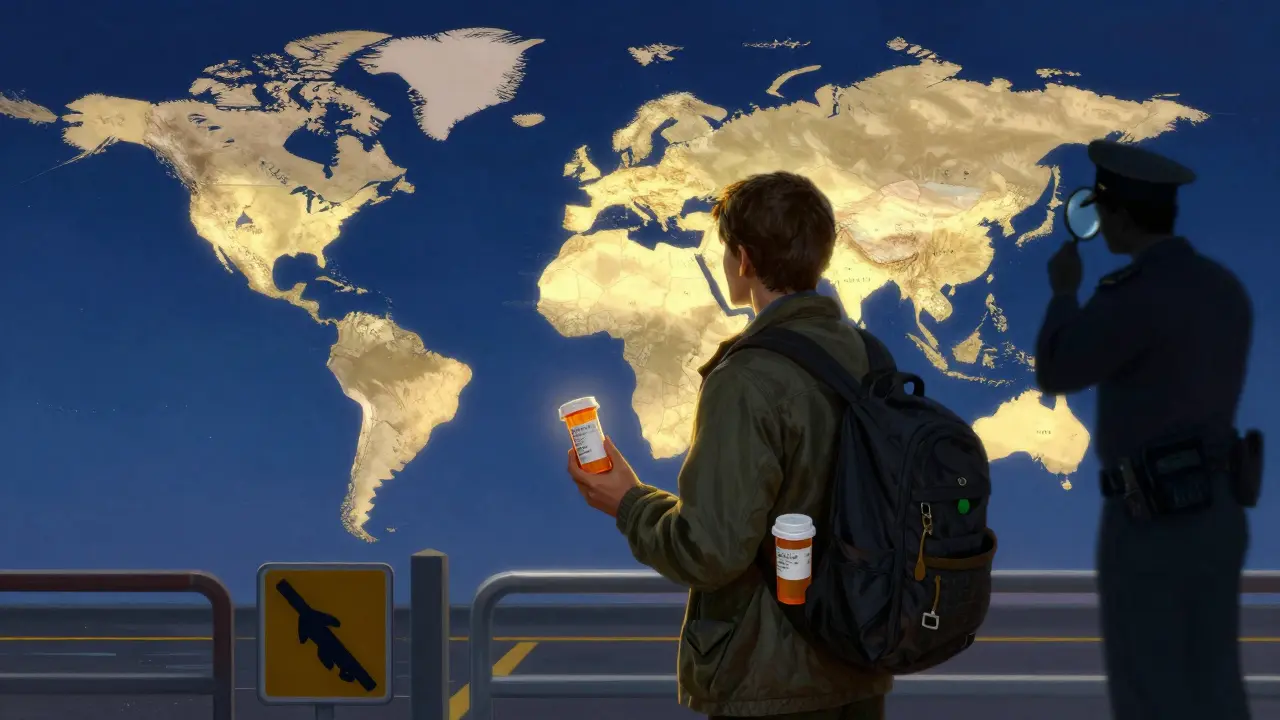
What to Do If Your Medication Is Stolen
If your pills are stolen, act fast. File a police report within 24 hours. Many insurance companies, including UnitedHealthcare, require this to cover replacement costs. Without it, only 17% of claims are approved. Then contact your prescribing doctor. For Schedule II drugs, they’ll need to submit a new prescription to a pharmacy near you. If you’re overseas, your embassy can help you locate a local pharmacy that accepts U.S. prescriptions. The DEA’s 2024 pilot program now allows electronic verification at over 1,200 pharmacies in 17 states, cutting replacement time from 72 hours to under 4. But this only works if you have documentation. Don’t wait.Prevent Theft Before It Happens
Don’t talk about your meds in public. Don’t show your bottle at security unless asked. Don’t leave it on the airplane tray table. Thieves target people who seem unaware. A 2023 American Academy of Family Physicians report found that medication diversion spikes during peak travel seasons because thieves look for visible pill bottles or hear travelers mention their condition. Be discreet. Use a plain case. Keep your medication out of sight. If someone asks what’s in your bag, say “prescription meds” and move on. You don’t owe anyone details.What About Refills While Traveling?
Refilling a controlled prescription abroad is nearly impossible. Most countries don’t recognize foreign prescriptions, especially for Schedule II drugs. Even if you find a pharmacy willing to fill it, they’ll need to verify your doctor’s license and DEA number-which takes days. That’s why carrying extra doses is critical. If you’re traveling for more than 30 days, plan ahead: ask your doctor for a letter authorizing a refill at a U.S. pharmacy upon return, or consider switching to a non-controlled alternative if medically safe. Always check with your pharmacist before you leave.Technology Is Changing How We Travel With Meds
New systems are emerging. The European Union is testing blockchain-based digital prescriptions that let travelers access their medication records securely via smartphone. Pilot programs there have cut travel-related medication incidents by 92%. The U.S. is watching closely, but HIPAA rules make adoption slow. For now, stick to physical documentation. But keep an eye out-digital verification may become standard within the next five years. Until then, your original container, doctor’s letter, and hotel safe are your best defenses.Can I put my controlled medication in a pill organizer when traveling?
No, not alone. Pill organizers are not legally recognized as proof of prescription. TSA and international customs require medications to be in original, labeled containers. You can use a pill organizer for convenience, but only if you also carry the original bottle with you. Otherwise, you risk being detained, fined, or having your meds confiscated.
How much of my controlled medication can I bring on an international flight?
For most countries, bring no more than a 30-day supply for Schedule III-V medications and a 14-day supply plus 2-3 extra doses for Schedule II drugs. Always check the destination country’s rules-some, like Japan and Saudi Arabia, have stricter limits. Carrying more than needed raises suspicion and increases the chance of confiscation.
Do I need a doctor’s letter for domestic U.S. travel?
TSA doesn’t require a letter for domestic flights, but 32 states-including California, Texas, and Florida-require original pharmacy labels. A doctor’s letter isn’t mandatory, but it’s a smart backup if security questions arise. It also helps if you’re stopped by local law enforcement during a road trip.
What happens if my medication is stolen while I’m abroad?
File a police report immediately. Contact your embassy-they can help you find a local pharmacy or doctor who can assist. Then call your U.S. prescriber. For Schedule II drugs, replacement is difficult overseas. You may need to return home or switch to an alternative treatment. Insurance claims for stolen meds require a police report filed within 24 hours.
Are there special rules for flying with injectable controlled medications?
Yes. Injectable medications must be in original containers with labels. Bring syringes in a clear plastic bag. A doctor’s letter explaining medical necessity is strongly advised. TSA allows needles and syringes for medical use, but you may be asked to demonstrate how they’re used. Never pack them in checked luggage.

Betty Kirby
February 15, 2026 AT 00:23Traveling with controlled meds is like carrying a live grenade in your carry-on. One misstep and you’re in a federal nightmare. Original containers? Non-negotiable. Pill organizers? Use them if you must, but never as proof. I’ve seen people get detained over ziplock bags of oxycodone. No drama. No excuses. Just follow the rules or suffer the consequences.
And don’t even think about bringing more than 14 days’ supply. Customs isn’t asking for your medical history-they’re looking for dealers. Be invisible. Be precise. Be disciplined.
Erica Banatao Darilag
February 16, 2026 AT 04:28i just want to say how important this is. i have a chronic pain condition and i’ve had my meds stolen twice while traveling. once in a hotel room, once on a train. the fear of withdrawal is real. i always carry two copies of my doctor’s letter now. one in my wallet, one in my bag. it’s not glamorous, but it saved me.
also, i use a tiny discreet vial from my pharmacy. no labels, just my name and the med. it’s so much easier than lugging around a big bottle. thanks for sharing this.
Michael Page
February 16, 2026 AT 13:03There’s a deeper layer here that no one talks about. Controlled substances aren’t just medications-they’re symbols of societal control over bodily autonomy. The fact that we must prove our medical legitimacy to strangers at checkpoints reflects a system that distrusts illness. We’re treated like criminals until we produce paperwork.
Yet we comply. Not because we believe in the system, but because survival requires it. The real tragedy isn’t theft-it’s the normalization of this humiliation.
Josiah Demara
February 17, 2026 AT 13:33Let me be crystal clear: if you’re using a pill organizer without the original bottle, you’re not just careless-you’re a liability. You’re the reason TSA agents have to pull 12 people aside every hour. You’re the reason some countries ban entire classes of meds. You think you’re being discreet? You’re being stupid.
And don’t get me started on people who say ‘my doctor said I could bring more.’ Your doctor doesn’t work for customs. Your doctor doesn’t get arrested when you get caught. You do. So stop being entitled and start being responsible.
Also, RFID-blocking cases? Yes. But don’t buy the $80 ones. Buy the $15 ones. You don’t need a luxury item to survive a flight.
Kaye Alcaraz
February 17, 2026 AT 17:51You’ve got this. Seriously. Every single step you take to protect your meds is an act of self-care. Carrying the original bottle? That’s self-respect. Using the hotel safe? That’s wisdom. Writing a doctor’s letter? That’s advocacy.
Traveling with chronic illness is hard. But you’re not alone. You’re doing everything right. Keep going. You’re stronger than the system tries to make you feel.
Charlotte Dacre
February 19, 2026 AT 13:34Oh wow, a whole 14-day rule? How quaint. I guess in the UK we just chuck our oxycodone in a sock and hope for the best. /s
Actually, yeah-this is spot on. I flew to Germany last year with my benzodiazepines. Had the letter, original bottle, and a tiny case. Got waved through. The guy at customs even smiled. Turns out, being organized makes you look less like a drug runner and more like a person with a medical condition.
Who knew?
Esha Pathak
February 20, 2026 AT 08:17As someone from India who travels to the US often, I can say this: the fear of losing meds is real. I once lost my prescription bottle in Delhi and had to wait 5 days for a new one. My anxiety spiked. I couldn’t sleep. I couldn’t function.
Now I carry two bottles-one in my bag, one in my underwear pocket. Yes, really. It sounds extreme, but I’ve seen people get turned away at JFK for having no paperwork. Don’t be that person.
Also, use a lockable case. I bought one from Amazon for $12. Game changer.
Mike Hammer
February 22, 2026 AT 05:17biggest thing i learned? never say ‘i’m on pain meds’ out loud. not at security, not at the hotel front desk, not even to your buddy who’s ‘just curious.’
once i was at a coffee shop and some guy asked what was in my bag. i just said ‘meds’ and looked away. he didn’t ask again. simple. done.
also, hotel safes are trash. i always ask for the front desk lockbox. way more secure. no one’s gonna steal from behind the counter.
Daniel Dover
February 22, 2026 AT 08:52Original container. Carry-on. Doctor’s letter. Hotel safe.
That’s it.
Chiruvella Pardha Krishna
February 23, 2026 AT 02:01There is a quiet war being waged against those who need pain relief. We are not addicts. We are not criminals. We are patients forced to perform obedience rituals to prove our humanity. The original bottle is not medicine-it is a badge of submission.
And yet, we wear it. Because the alternative is suffering.
But someday, we will demand better. Not because we want permission, but because we deserve dignity.
Kapil Verma
February 23, 2026 AT 09:16Why are Americans so weak? You can’t even carry your own meds without a 10-page manual? In India, we just take what we need. No letters. No RFID cases. No hotel safes. We don’t live in fear. We live in control.
Stop acting like your pills are gold. They’re just medicine. Carry them like a man. Stop overcomplicating everything. You’re making yourselves look guilty.
Mandeep Singh
February 24, 2026 AT 02:32Let me tell you what happens when you ignore these rules. I had a friend-yes, a friend-who brought her hydrocodone in a plastic bag. She thought she was being smart. TSA found it. She was detained for 8 hours. Her flight was canceled. Her insurance denied her claim because she didn’t have the original container. She had to fly back home without meds. Withdrawal hit her hard. She ended up in the ER.
Now she’s a cautionary tale. And you? You’re next. Don’t be the person who thinks ‘it won’t happen to me.’ It already happened to someone you know. It will happen to you. The system doesn’t care about your story. It cares about paperwork. So get your paperwork. Now.
Sarah Barrett
February 24, 2026 AT 08:11One thing no one mentions: the emotional toll. Carrying your life-saving medication like contraband changes how you move through the world. You tense up at security. You check your bag every 10 minutes. You avoid eye contact. You stop talking about your condition. You become a ghost in your own body.
These rules aren’t just logistical-they’re psychological. And that’s why the smallest act of preparation-a discreet vial, a printed letter, a locked case-isn’t just practical. It’s a quiet act of resistance. You’re not just protecting pills. You’re protecting your right to exist without shame.