More than 10% of people in U.S. hospitals say they’re allergic to penicillin. But here’s the truth: over 95% of them aren’t. That label-written down after a childhood rash or a stomach ache decades ago-isn’t just outdated. It’s dangerous. It’s leading to worse infections, longer hospital stays, and stronger superbugs. And it’s entirely avoidable.
Why Your Penicillin Allergy Label Might Be Wrong
Most people don’t know that a drug allergy label isn’t like a food allergy. You don’t get tested once and it’s set in stone. Many labels stick because no one ever questioned them. Maybe you broke out in a rash at age six after taking amoxicillin for an ear infection. Maybe your mom said you were allergic, and it got copied into your chart and never reviewed again. The problem? That rash was probably a viral reaction, not an immune response. True penicillin allergies-where your body makes IgE antibodies that trigger anaphylaxis-are rare. Only 1 to 2% of people who think they’re allergic actually are. Yet, in hospitals, up to 15% of patients carry that label. That’s millions of people being denied the best, safest, cheapest antibiotics on the planet. When you’re labeled allergic to penicillin, doctors reach for alternatives like vancomycin, clindamycin, or fluoroquinolones. These drugs are broader, harsher on your gut, and more likely to cause deadly infections like C. diff. In fact, false penicillin allergy labels contribute to over 50,000 extra C. diff cases every year in the U.S. alone. And they’re driving antibiotic resistance. Patients with that label are 69% more likely to get clindamycin and 28% more likely to get fluoroquinolones-drugs that fuel MRSA and drug-resistant E. coli.How Testing Works: Skin Tests, Challenges, and Safety
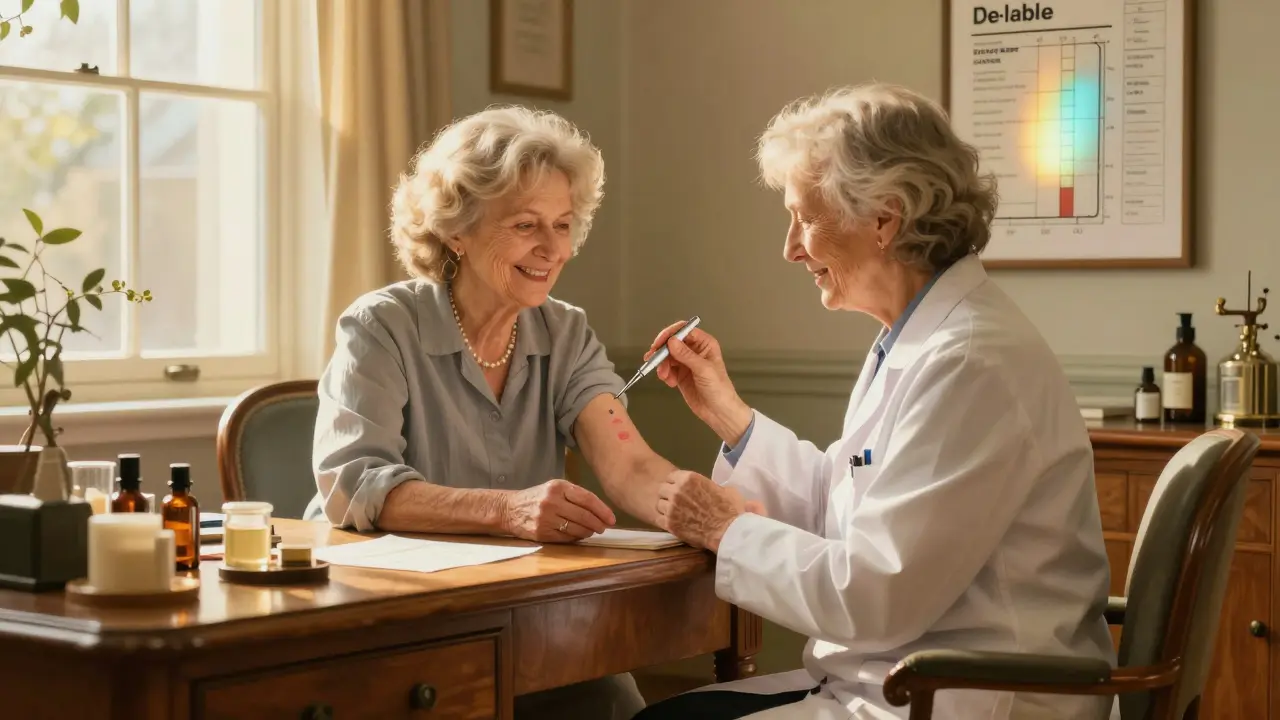
Getting tested isn’t complicated. It’s not a single shot or a blood test. It’s a step-by-step process designed to be safe, even if you’ve had a reaction before. For most people, the first step is skin testing. A tiny amount of penicillin is placed on your skin, then gently pricked. If there’s no reaction after 15 minutes, a slightly stronger dose is injected just under the skin. Both steps are quick, nearly painless, and carry almost no risk. If both tests are negative, you move to the next phase: the oral challenge. The oral challenge is where the magic happens. You swallow a small dose of amoxicillin-usually 250 mg-and wait. Then, after an hour with no reaction, you take a full therapeutic dose. You’re monitored the whole time. Most people feel nothing. A few get a mild rash or stomach upset. Severe reactions? Less than 2% of cases. And even those are usually treatable with antihistamines. Some hospitals skip skin testing and go straight to the oral challenge if your history is low-risk. That’s right-if your reaction was a rash years ago, no swelling, no breathing trouble, no anaphylaxis, you’re likely safe. Tools like PEN-FAST help doctors decide. It’s a simple five-question checklist: Was the reaction 10+ years ago? Was it not anaphylactic? Was it not severe? Did you take it recently? Was there a better alternative? If you answer no to all five, you’re low-risk. No skin test needed.What Happens After You’re De-Labelled
Once you’re cleared, your allergy status changes. Not just in your chart. In your life. You can now take amoxicillin for a sinus infection instead of a Z-Pak (azithromycin), which often gives you diarrhea and doesn’t work as well. You can get treated for a UTI with cephalexin instead of a stronger, more expensive drug that wipes out your good gut bacteria. You’re less likely to be hospitalized again. One 68-year-old woman in Massachusetts had four hospitalizations over 10 years for complicated UTIs because she was labeled allergic. After de-labeling, she took amoxicillin for her next infection-and stayed home. The cost savings are real. Studies show de-labeling saves about $1,000 per patient per year. Multiply that by millions of people, and you’re talking billions saved in healthcare costs. Plus, you’re helping fight antibiotic resistance. Every time you take the right antibiotic, you’re slowing the spread of superbugs.
Why So Few People Get Tested
If it’s so safe and so helpful, why aren’t more people getting tested? One reason: access. Allergists are hard to find. In rural areas, there’s often one allergist for every 500,000 people. Another reason: fear. Patients worry they’ll have a reaction during testing. But the risk is tiny-far lower than the risk of getting a bad infection from the wrong antibiotic. Then there’s the system. Many hospitals don’t have protocols in place. Electronic health records don’t make it easy to update allergy status. Pharmacists can’t override a label without a doctor’s note. And many primary care doctors don’t feel trained to do it. But that’s changing. In 2021, Epic Systems-a major EHR vendor-built an automated tool that flags patients with penicillin allergy labels and suggests de-labeling pathways. Since then, over 227,000 assessments have been done, and nearly 200,000 false labels have been removed. That’s 87% of cases corrected. The CDC and CMS are pushing too. Starting in 2025, hospitals in the U.S. will be scored on how well they reduce inappropriate antibiotic use in patients with penicillin allergy labels. No more ignoring it.What You Can Do Right Now
If you’ve been told you’re allergic to penicillin-or any beta-lactam antibiotic-here’s what to do:- Check your medical records. Is it listed as "penicillin allergy" or "allergic to amoxicillin"? Broad labels are often wrong.
- Ask your doctor: "Was this reaction confirmed by testing?" If not, ask about de-labeling.
- Use the PEN-FAST tool yourself. If your reaction was mild, happened more than 10 years ago, and didn’t involve breathing trouble or swelling, you’re likely low-risk.
- Request a referral to an allergist or ask if your clinic offers direct oral challenge.
- If you’ve never been tested, don’t assume the label is true. You might be safe.
What’s Next for Drug Allergy Testing
The future is moving fast. Telemedicine now allows low-risk patients to complete de-labeling at home with video check-ins and mailed doses. A study in the Netherlands showed 96% success with zero severe reactions. New tech is helping too. The FDA-cleared Xreactbase database uses machine learning to predict cross-reactivity between antibiotics based on millions of patient records. It tells doctors: "This patient had a rash to amoxicillin-here’s which other drugs are safe." By 2028, most penicillin allergy assessments will be triggered automatically by your EHR. You’ll get a pop-up: "You’re flagged for penicillin allergy. Would you like to schedule a de-labeling assessment?" It’s not science fiction. It’s happening now.Final Thought: Your Label Doesn’t Define You
A drug allergy label is not a life sentence. It’s a guess. And most guesses are wrong. You deserve the best treatment-not the safest guess. You deserve to take the antibiotic that works, not the one that’s just available. You deserve to avoid unnecessary side effects, hospitalizations, and antibiotic resistance. If you’ve been told you’re allergic to penicillin, don’t accept it without question. Ask for testing. Get it done. Your next infection might be the one that could’ve been treated in 24 hours-if only the label had been cleared.Can I outgrow a penicillin allergy?
Yes. Most people who think they’re allergic to penicillin were mislabeled as children. Even if you had a true reaction once, the immune system often forgets it over time. Studies show that 80% of people who had a penicillin allergy 10+ years ago lose it naturally. That’s why testing is critical-your allergy status isn’t permanent.
Is skin testing painful?
It’s not. Skin prick testing feels like a quick scratch. Intradermal testing is like a tiny pinprick-less painful than a flu shot. Most people describe it as barely noticeable. The real discomfort comes from worrying about it. The actual procedure is quick, safe, and over in under 30 minutes.
What if I have a reaction during testing?
Reactions during testing are rare-and handled immediately. Clinics that do this testing always have epinephrine, antihistamines, and staff trained in emergency care. Most reactions are mild: a small rash or itching. Severe reactions like anaphylaxis are extremely uncommon. If you do react, it’s a controlled setting, not an emergency at home. You’ll be treated right away and properly labeled if needed.
Can I be allergic to one penicillin but not another?
Absolutely. Penicillin is a family of drugs. Being allergic to amoxicillin doesn’t mean you’re allergic to ampicillin, cephalexin, or even other beta-lactams like ceftriaxone. Cross-reactivity is lower than most people think-only about 10% for cephalosporins, and even less for newer drugs. That’s why labels should specify the exact drug, not just "penicillin allergy." Testing helps clarify exactly what you’re reacting to.
How long does the whole process take?
It depends. Skin testing and oral challenge can be done in one visit-usually 2 to 3 hours. Some clinics spread it over two days for extra safety. If you’re low-risk and doing a direct challenge, you might be done in under an hour. The wait time for an appointment is often the biggest hurdle-some places have waitlists of 8 to 14 weeks. But many hospitals are now offering same-day or next-day testing for low-risk patients.
Will my insurance cover it?
Most insurance plans in the U.S. cover drug allergy testing, especially if it’s ordered by a doctor to improve treatment. Medicare and Medicaid now include de-labeling in value-based care programs, so hospitals are incentivized to offer it. Check with your provider, but in most cases, the cost is minimal or fully covered. The savings from avoiding unnecessary antibiotics usually far outweigh the test cost.
Can my primary care doctor do this, or do I need an allergist?
You don’t always need an allergist. Studies show primary care doctors can safely perform direct oral challenges for low-risk patients after just 10 supervised cases. Many clinics now use standardized protocols and checklists. If your history is simple-mild rash, no breathing issues-you can often be tested in your doctor’s office. For complex cases or high-risk histories, an allergist is still best.

franklin hillary
January 31, 2026 AT 17:29Let me tell you something - I was labeled penicillin allergic at 8 because I got a rash after amoxicillin. Turned out it was a virus. Ten years later I got tested and it was like getting my freedom back. Now I take amoxicillin like it’s candy. No more Z-paks. No more C. diff scares. Just clean, cheap, effective treatment. Why are we still letting outdated labels dictate our health?
Doctors need to stop assuming. Patients need to ask. And hospitals? They need to automate this. The tech exists. The data is clear. This isn’t science fiction - it’s basic medicine.
June Richards
January 31, 2026 AT 19:42Ugh. I’ve been saying this for years. People think they’re allergic because they got a rash as a kid and now they’re stuck with vancomycin like it’s some kind of penalty box. I had a cousin who got C. diff three times because of this. She’s fine now after testing. But why does it take a near-death experience to fix something so simple?
Also - why is this even a debate? We test for food allergies. Why not drugs?
Ishmael brown
February 1, 2026 AT 16:54LOL so now we’re gonna test everyone for penicillin allergies? Next thing you know we’ll be doing DNA scans before giving out ibuprofen.
What about the 5% who actually are allergic? Are we just gonna ignore them because the other 95% are ‘mislabelled’? 😏
Also - I got anaphylaxis once. I don’t care if your ‘PEN-FAST’ checklist says I’m low-risk. I’m not swallowing amoxicillin just because some algorithm says I’m fine.
Bryan Coleman
February 3, 2026 AT 03:41I work in a rural clinic. We don’t have an allergist within 90 miles. But we started doing oral challenges in-office last year. Trained staff, checklist, 1-hour wait. 32 patients so far. Zero severe reactions. One guy cried because he hadn’t had a normal sinus infection treatment in 20 years.
It’s not magic. It’s just common sense. And it works.
Also - insurance covered it. No surprise bills. Just… relief.
Naresh L
February 4, 2026 AT 19:55There’s something deeply human here - the way we cling to labels even when they no longer serve us. We’re not just talking about antibiotics. We’re talking about identity. That label became part of my story - ‘I’m the one who can’t take penicillin.’ And letting go of it? That’s not just medical. It’s existential.
What if we applied this to other things? The labels we carry about ourselves - ‘I’m bad with money,’ ‘I’m not a morning person,’ ‘I’m just anxious’ - are they facts? Or just old stories we never bothered to retest?
vivian papadatu
February 4, 2026 AT 23:51I’m from India and we have this problem too - but worse. People get labeled allergic after one stomach upset and then they’re stuck with expensive, toxic alternatives. My aunt was given levofloxacin for a UTI for 12 years. She developed resistant E. coli. We finally got her tested here in the U.S. - turned out she was fine. Now she takes amoxicillin and feels like a new person.
This isn’t just an American issue. It’s a global failure of systems. We need global awareness. And better access.
Also - if you’re reading this and you’re labeled allergic? Please, please, please get tested. You might be surprised.
Lu Gao
February 5, 2026 AT 08:38Technically speaking, the term "penicillin allergy" is misleading. Penicillin is a class. Amoxicillin, ampicillin, cephalexin - they’re all structurally different. Cross-reactivity with cephalosporins is less than 10%, not the 10% myth that’s been repeated for decades.
And yes, the PEN-FAST tool is validated in multiple peer-reviewed studies. It’s not some random Reddit heuristic. It’s evidence-based. The CDC endorses it. The AAOAI endorses it. Even the FDA’s Xreactbase uses similar logic.
So when someone says "I’m allergic to penicillin" - ask which one. And then ask if they’ve ever been tested. Because most haven’t.
Chris & Kara Cutler
February 6, 2026 AT 10:48Just got tested last week. 250 mg amoxicillin. Waited an hour. Then 750 mg. Felt nothing. No rash. No itch. No drama.
Now I can finally take the antibiotic my doctor actually wants to give me.
Also - my insurance paid for it. No copay. No hassle.
Stop overthinking it. Just do it.
Deep Rank
February 6, 2026 AT 11:51Okay but let’s be real - this whole thing is just Big Pharma’s way of selling more tests, right? Who benefits? The allergists. The EHR companies. The hospitals. Not the patient. You think they care about your C. diff? Nah. They care about billing codes.
And don’t even get me started on the ‘automated EHR pop-up’ nonsense. That’s just surveillance dressed up as healthcare.
Also - what if you test negative and then get a reaction later? Who’s liable? You? The doctor? The algorithm?
It’s all a distraction. The real problem is overprescribing antibiotics. Not labels.
Also - my cousin’s friend’s sister had a reaction after testing. So… yeah. I’m not doing it.
Lilliana Lowe
February 6, 2026 AT 22:35It’s fascinating how the medical establishment has institutionalized ignorance. A label written by a nurse in 1987 becomes gospel. No one questions it. No one updates it. It’s like a medieval curse, digitized.
And yet, we have the tools to fix it. Machine learning. Standardized protocols. Automated alerts. But we don’t implement them because it requires systemic change - and systemic change is inconvenient for bureaucrats.
Meanwhile, patients die from C. diff because no one had the courage to ask: "Are you sure?"
It’s not just a medical failure. It’s a moral one.
Rachel Liew
February 8, 2026 AT 08:13i just wanted to say thank you for this post. my mom got tested last year after 40 years of thinking she was allergic. she cried. she said she finally felt like she could trust her own body again. she’s been fine since. i just wish more people knew this was possible. it’s not scary. it’s just… healing.
Melissa Melville
February 9, 2026 AT 14:33So… you’re telling me I don’t have to take clindamycin anymore? 😏
Wait - I just remembered I have a Z-Pak in my cabinet from 2018. Should I keep it? Or just burn it as a ritual of liberation?
Also - can I get a t-shirt that says "I’m not allergic. I’m just lazy."?
franklin hillary
February 10, 2026 AT 14:00Hey - just read your comment about the Z-Pak. I’ve got one too. Same year. I’m throwing mine out tonight. And I’m telling my doctor to write amoxicillin next time. No more "safe" antibiotics that aren’t safe at all.
Thanks for the nudge.