You walk into a doctor's office feeling bloated, tired, and unsure if your stomach pain is just stress or something worse. You've heard terms like IBS and IBD tossed around in support groups, and frankly, they sound terrifyingly similar. Many people think they are just variations of the same problem, but medically speaking, they sit at opposite ends of the spectrum. One causes physical damage to your bowels, while the other doesn't. Knowing which one you have changes everything-from the tests you need to the lifestyle adjustments you must make. Let's clear up the confusion by looking exactly at what sets these two conditions apart.
The Fundamental Difference: Structure vs. Function
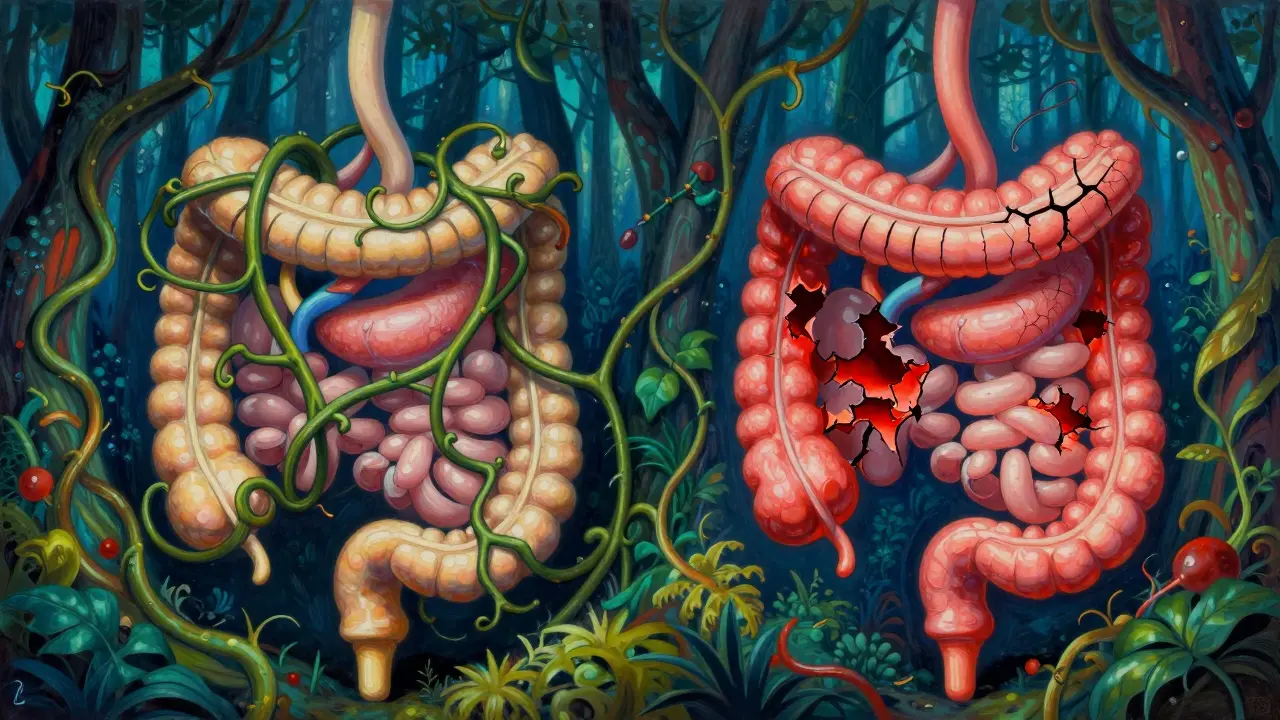
Inflammatory Bowel Disease (IBD) is a structural disease. It involves visible inflammation and damage to the lining of the digestive tract.. When you have IBD, a doctor can literally see ulcers, swelling, and scarring during a colonoscopy. It includes two main types: Crohn's Disease and Ulcerative Colitis. In contrast, Irritable Bowel Syndrome (IBS) is a functional disorder. Your gut looks physically normal under a microscope, but it does not function correctly.. Think of it like a car engine that idles roughly even though there is no broken part visible on the surface. According to Dr. Marion Vetter of Johnson & Johnson Innovative Medicine, patients experience GI-related symptoms without a clear inflammatory component. This distinction is the single most critical factor for your diagnosis and long-term health.
Symptom Overlap and the Red Flags
Both conditions share symptoms that make them easy to mix up in daily life. Abdominal cramping, gas, bloating, and changes in bowel habits are common complaints for everyone reading this. However, the intensity and accompanying signs tell a different story. With IBS, the pain often improves after you have a bowel movement, and you might notice mucus in your stool, which occurs in 45% of cases. But here is where you need to be vigilant: blood in your stool is almost never a sign of IBS.
If you see blood-either bright red (hematochezia) or black and tarry (melena)-that is a major alarm feature pointing toward IBD. Studies show that bloody stools appear in 92% of ulcerative colitis cases. Additionally, IBD often comes with systemic issues that affect your whole body, not just your gut. Unexplained weight loss happens in 65% of IBD patients during flares, and nearly 40% develop a fever. Joint pain, eye inflammation (uveitis), and skin lesions like erythema nodosum are also tied to the autoimmune nature of IBD, whereas IBS typically stays within the realm of digestive discomfort.
| Feature | IBS (Irritable Bowel Syndrome) | IBD (Inflammatory Bowel Disease) |
|---|---|---|
| Bowel Damage | None visible | Visible inflammation/ulcers |
| Blood in Stool | Rare/Never | Common (92% in UC) |
| Weight Loss | Uncommon | Common (65% in flares) |
| Inflammatory Markers | Normal | Elevated (CRP >5 mg/L) |
| Fever | No | Yes (40% of moderate cases) |

The Diagnostic Path: How Doctors Tell Them Apart
You cannot diagnose yourself based on online forums because the overlap is too high. A proper diagnosis relies on proving what isn't there. For IBS, doctors often follow the Rome IV criteria published in 2016. This requires chronic abdominal pain occurring at least one day per week for three months, along with altered bowel habits. Crucially, a diagnosis of exclusion means ruling out IBD first. If your blood tests for C-reactive protein (CRP) are elevated above 5 mg/L, or your fecal calprotectin levels exceed 250 µg/g, it signals active inflammation typical of IBD.
Imaging plays a huge role too. While IBS usually yields normal results on CT scans and ultrasounds, IBD patients frequently show abnormalities on MRI enterography, which detects complications in 92% of cases. Biopsies taken during a colonoscopy provide the final confirmation. A pathologist will look for tissue samples that show histopathology, which confirms the structural damage present in 98% of IBD cases. As noted by Dr. Baidoo, "Doctors look for inflammation... using blood and stool tests and rely on endoscopy... to assess intestinal tissue." If your gut shows nothing on the inside despite how bad you feel, the diagnosis leans heavily toward IBS.
Treatment Strategies for Each Condition
Because the root cause differs, the medications differ drastically. You wouldn't give someone treating IBS the powerful immunosuppressants used for IBD. For IBD, the goal is remission-stopping the immune system from attacking the bowel. Drugs like infliximab achieve clinical remission in 50-60% of Crohn's patients within 14 weeks. Other biologics like vedolizumab induce remission in nearly half of ulcerative colitis patients. Corticosteroids help manage acute flares effectively, though they aren't meant for long-term use due to side effects.
On the flip side, IBS treatment focuses on calming the nervous system and adjusting diet rather than stopping inflammation. Dietary modifications like the low-FODMAP diet reduce symptoms in 76% of patients according to systematic reviews. Medications for IBS often target pain perception; low-dose tricyclic antidepressants can reduce pain by 50% in many patients. There are also drugs like eluxadoline that specifically target diarrhea-predominant IBS. Remember, IBS treatments aim to improve quality of life by managing symptoms, whereas IBD treatments are necessary to prevent permanent tissue damage and cancer risk.

Myths and Reality About Progression
A persistent rumor suggests that untreated IBS might evolve into IBD. Medical consensus dispels this completely. The CDC states clearly that "IBS does not develop into IBD." They are distinct pathways. However, having both simultaneously is possible. Research indicates that 22-35% of IBD patients who are currently in remission meet the criteria for IBS, meaning they have lingering functional symptoms even when the inflammation has subsided. It is vital to understand the risks of IBD though. Unlike IBS, IBD carries a risk of colorectal cancer, with an annual risk of 2% after 10 years of extensive colitis. Toxic megacolon is another severe complication affecting severe ulcerative colitis cases.
The impact on daily living varies. Both conditions affect quality of life significantly, but in different ways. Patients often report being willing to sacrifice essential pleasures to avoid symptoms. Yet, only IBD patients face the anxiety of needing surgery or managing fistulas, which affect 17% of Crohn's patients. Understanding these risks helps set realistic expectations with your healthcare team.
FAQ
Can I have both IBS and IBD?
Yes, it is possible to have both. Studies show that between 22-35% of IBD patients in remission still meet the Rome IV criteria for IBS, often experiencing functional symptoms even when their inflammation is controlled.
What tests distinguish IBS from IBD?
Key tests include measuring C-reactive protein (CRP) and fecal calprotectin in stool. Normal levels suggest IBS, while elevated markers (CRP >5 mg/L, calprotectin >250 µg/g) indicate IBD inflammation. Colonoscopy with biopsy also confirms structural damage seen in IBD.
Does IBS turn into IBD over time?
No, IBS does not develop into IBD. They are separate conditions with different mechanisms. IBS is functional without tissue damage, while IBD is autoimmune and causes structural injury to the bowel wall.
Is blood in stool a sign of IBS?
Blood in stool is not a symptom of IBS. Seeing blood (hematochezia or melena) is a significant alarm feature strongly associated with IBD, particularly ulcerative colitis, and requires immediate medical attention.
How do treatments differ for each condition?
IBD treatments focus on suppressing inflammation using biologics (like infliximab) and steroids to prevent damage. IBS treatment focuses on symptom management through diet (low-FODMAP), nerve calming medications, and fiber adjustments, as there is no inflammation to stop.

kendra 0712
March 29, 2026 AT 09:11It is so refreshing to see such a clear breakdown of the differences between these conditions! Finally someone is explaining the mechanics instead of just listing symptoms! The distinction regarding structural versus functional really makes sense now!
Aaron Olney
March 30, 2026 AT 12:49scared i have the wronh one because i saw blood sometime ago but maybe its just stress
walker texaxsranger
April 1, 2026 AT 04:14doctors only care about money. ignore tests until it fails.
Jordan Marx
April 2, 2026 AT 10:10The biomarker differentiation really stands out when you analyze the clinical pathway properly. Fecal calprotectin levels exceeding two hundred fifty micrograms per gram serve as a critical threshold for inflammation detection. C-reactive protein elevation above five milligrams per liter further supports structural pathology rather than functional dysregulation. Patients often confuse transient spikes with chronic inflammatory states without proper longitudinal tracking. Histopathology remains the gold standard despite non-invasive screening availability. Biopsies taken during endoscopic procedures provide definitive tissue architecture confirmation. The absence of granulomas helps distinguish Crohn's disease from other mimics effectively. Ulcerative colitis presents continuous mucosal involvement unlike the skip lesions seen elsewhere. Diagnostic accuracy improves significantly when combining serological and endoscopic findings simultaneously. Rome IV criteria require pain frequency alignment over three months minimum duration. Functional disorders lack the tangible evidence found in autoimmune intestinal injury cases. Systemic symptoms like weight loss point towards metabolic impacts beyond bowel motility alone. Blood presence in stool mandates immediate investigation regardless of symptom severity perception. Treatment protocols diverge sharply once the underlying etiology becomes confirmed through testing. Ignoring these distinctions risks inappropriate medication usage leading to potential complications.
Ultimately precision medicine dictates management strategies for optimal long term outcomes.
Sophie Hallam
April 3, 2026 AT 23:35This detailed breakdown helps clarify why waiting for lab results is necessary before jumping to conclusions about treatment plans.
Philip Wynkoop
April 4, 2026 AT 15:07Glad the confusion is finally sorted out :)
Monique Ball
April 4, 2026 AT 23:57I totally agree and adding to that diet plays a HUGE role! 😊 I switched to low-FODMAP and felt so much better immediately! 🥗 It is amazing how food affects your gut health! Some people think meds fix everything but nutrition is key! 🍎 You really have to listen to your body signals! 😄 Eating fermented foods helped my digestion tremendously! 🌱 Stay positive and keep experimenting with what works! 💖 Health is wealth and gut happiness is essential! 👍
gina macabuhay
April 6, 2026 AT 08:11Obiously diet works for everyone except the ones with actual damage. Stop giving bad advice to people with ulcers.
Monique Louise Hill
April 7, 2026 AT 09:14I had this exact confusion for years until my specialist ran the full panel 🙏 Thank goodness for modern diagnostics! It changed my entire treatment plan instantly! 🏥 Now i understand the importance of testing early! 🩺 Misdiagnosis leads to so much unnecessary suffering honestly! 😓 Please get checked if you have red flags! ❤️ Your health matters and you deserve answers! 🌟
Sabrina Herciu
April 7, 2026 AT 12:50Yes! And remember that elevated calprotectin is the key indicator for active inflammation! Do not ignore that marker in your lab results!
Eva Maes
April 8, 2026 AT 03:04The gut-brain axis is wild when you consider how stress manifests physically in the digestive tract. Most folks blame food when it is actually nerves firing wildly. The nervous system talks directly to the smooth muscle layers constantly.
Debra Brigman
April 9, 2026 AT 00:18That psychological link explains why anxiety seems to trigger every flare up I experience sometimes. We need to treat the mind alongside the physical symptoms for real healing.
tyler lamarre
April 9, 2026 AT 05:26You are missing the statistical significance there obviously. Not every case involves neural regulation primarily.
Tony Yorke
April 10, 2026 AT 04:26Clean explanation thanks.