
Why Compounded Medications Are Risky Without Proper Protocols
Customized medications aren’t just niche products-they’re lifelines for patients who can’t take standard pills. Maybe they’re allergic to dyes, need a liquid form because they can’t swallow tablets, or require a dose so small it’s impossible to split a commercial pill. But here’s the problem: when these meds are made wrong, the consequences aren’t theoretical. In 2012, a contaminated steroid injection from one compounding pharmacy caused over 60 deaths. That’s not a rare outlier. Studies show 3% to 15% of compounded prescriptions have dangerous deviations in strength or purity. And unlike factory-made drugs, these aren’t tested by the FDA before they reach patients. The margin for error is razor-thin.
The Core Rules That Keep Compounding Safe
There’s one non-negotiable truth: if you’re making customized meds, you follow USP standards. That means USP <795> for non-sterile mixes (like creams, liquids, or capsules) and USP <797> for sterile ones (injections, IV bags). These aren’t suggestions-they’re the baseline. USP <795> requires a clean room with air quality no worse than ISO Class 8. That’s like a hospital operating room, but for ointments. USP <797> demands an ISO Class 5 environment for sterile prep-think laminar airflow hoods, strict gowning, and zero airborne particles. Skip these, and you’re gambling with lives.
Dual-Check Systems Are Non-Negotiable
One pharmacist calculating a dose? That’s not enough. The American Society of Health-System Pharmacists says every single calculation must be verified by a second qualified person. Not just a quick glance. A full redo. If the formula calls for 0.5 mg of a potent hormone, the second person doesn’t just nod-they recalculate from scratch, check the ingredient label, confirm the balance reading, and sign off. This isn’t bureaucracy. It’s survival. A 2022 study found that dual checks cut calculation errors by over 60%. And when it comes to high-risk drugs like fentanyl or thyroid hormones, even a 10% mistake can be fatal.
Ingredient Verification: Don’t Trust the Label
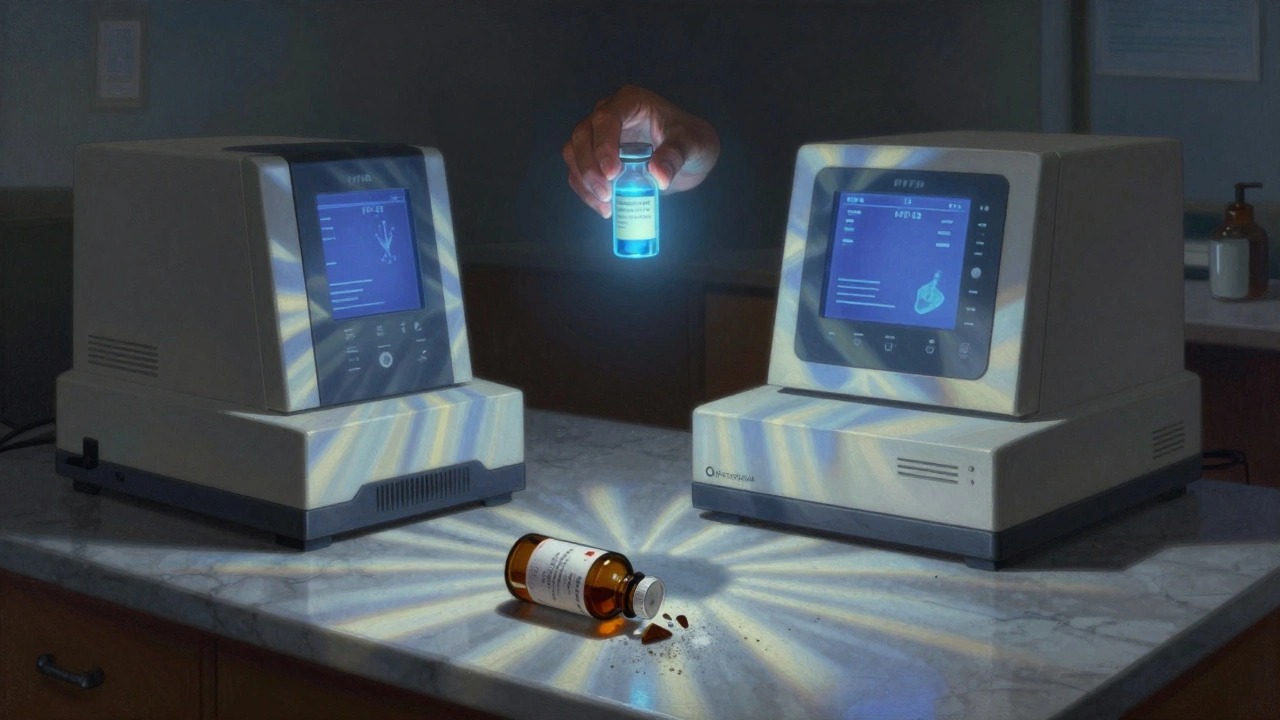
Active ingredients don’t always come labeled correctly. A batch of API (active pharmaceutical ingredient) powder might be mislabeled as 100 mg/g when it’s really 500 mg/g. That’s not rare. That’s why you verify every ingredient with two independent methods. Use FTIR (Fourier-transform infrared spectroscopy) to confirm chemical identity. Run HPLC (high-performance liquid chromatography) to measure potency. Don’t rely on the supplier’s certificate. Test it yourself. One pharmacy in Ohio saved a child from a lethal overdose when their HPLC test caught a 300% overdose in a compounded thyroid med. The supplier had swapped the bottle. The dual verification caught it.
Technology Is Your Best Ally
Manual entry is a recipe for mistakes. Software like Compounding.io or PharmScript isn’t a luxury-it’s a safety net. These tools auto-calculate doses, flag impossible ratios, cross-check ingredient availability, and lock in batch records electronically. A 2022 study in the Journal of the American Pharmacists Association showed pharmacies using these systems reduced human error by 40%. Even better? New AI tools like CompoundingGuard AI are cutting calculation errors by 87%. They don’t replace pharmacists-they make pharmacists smarter. If your pharmacy still uses paper logs and calculators, you’re operating in the 1990s.
Labeling Errors Are Silent Killers
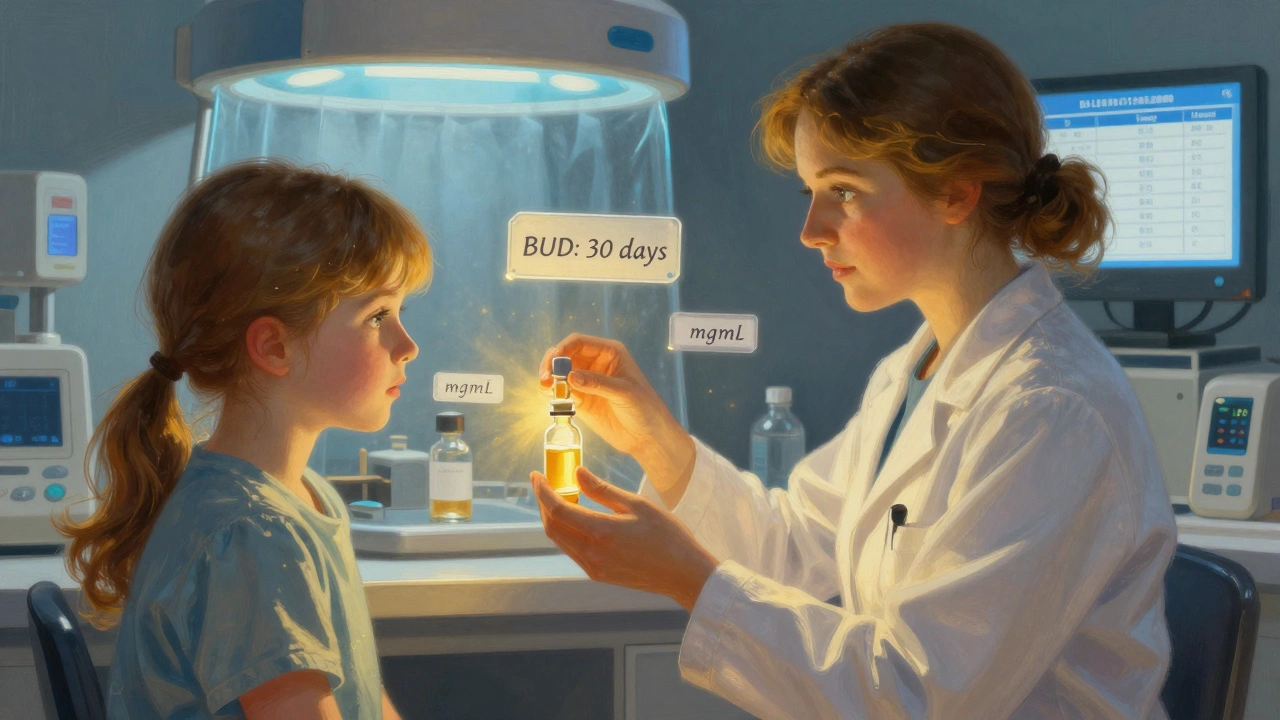
One of the biggest causes of harm? Bad labeling. Between 2018 and 2022, the FDA logged 27 cases of fentanyl overdoses because labels said ‘50 mg per container’ instead of ‘50 mg/mL’. A nurse gave the whole container, thinking it was one dose. It was 10 doses. The FDA’s 2023 draft guidance now demands all compounded meds use ‘mg/mL’ or ‘mcg/mL’-no exceptions. No ‘per dose’, no ‘per vial’, no vague terms. Every label must say exactly how much drug is in every milliliter. And the beyond-use date? It can’t be guessed. It’s based on stability testing. A liquid might last 30 days. An IV bag? Maybe 6 hours. Write it clearly. Put it in bold. If the label’s unclear, the patient dies.
Training Isn’t a One-Time Event
Compounding isn’t something you learn in pharmacy school and forget. Staff need 40+ hours of initial training, then 8-12 hours every year. And it’s not just theory-competency assessments are mandatory. Can they properly clean a laminar flow hood? Can they calculate a pediatric dose down to the microgram? Can they identify contamination risks in real time? Quarterly drills, simulated errors, and surprise audits keep skills sharp. Dr. Henry Cohen, former president of the International Academy of Compounding Pharmacists, says quarterly competency checks are the single most effective way to prevent errors. If your staff hasn’t been tested in the last 90 days, you’re at risk.
Accreditation Makes a Real Difference
Not all compounding pharmacies are equal. The Pharmacy Compounding Accreditation Board (PCAB) sets the gold standard. Pharmacies with PCAB accreditation have 22% fewer errors than non-accredited ones, according to the National Association of Boards of Pharmacy. The process takes 12-18 months and costs $15,000-$25,000. But it’s worth it. Accredited pharmacies have documented procedures for every step, from ingredient receipt to final packaging. They audit themselves monthly. They track every error, no matter how small. And patients? They’re 91% more likely to get a safe, accurate dose.
What Happens When You Skip the Rules
Let’s be clear: cutting corners doesn’t save time-it saves money, and that’s dangerous. A 2022 study in JAMA Internal Medicine found error rates in non-accredited pharmacies ranged from 2% to 25%. That’s not a typo. Twenty-five percent. One in four prescriptions is wrong. Compare that to accredited labs, where error rates are under 1%. The difference? Systems. Documentation. Training. Accountability. When a geriatric patient in Texas was admitted to the ICU after a compounded tramadol solution was mislabeled, the investigation found the pharmacy had no dual-check policy, no software, and no staff training records. They were operating on instinct. That’s not pharmacy. That’s negligence.
How to Know If Your Compounded Med Is Safe
If you’re a patient or caregiver, here’s what to ask:
- Is this pharmacy PCAB-accredited?
- Do they use dual verification for every dose?
- Can I see the label? Is the concentration written as ‘mg/mL’?
- Do they use software to track batches?
- How often do staff get trained?
If they hesitate, look elsewhere. Your life depends on it. And if you’re a pharmacist? Don’t wait for a tragedy to change. Start today. Audit your process. Install software. Train your team. Follow USP. Because when you make customized meds, you’re not just filling a prescription-you’re holding someone’s life in your hands.
What’s the biggest cause of compounding errors?
The biggest cause is skipping the dual-check system. Pharmacists often rely on memory or single calculations, especially under time pressure. Studies show that 70% of serious errors happen because no second person verified the dose. Even experienced pharmacists make mistakes-fatigue, distraction, and routine blind spots are real. A second set of eyes isn’t a formality. It’s the last line of defense.
Are compounded medications FDA-approved?
No. Unlike mass-produced drugs, compounded medications don’t go through FDA clinical trials. The FDA doesn’t review their safety or effectiveness before they’re made. That’s why the responsibility falls entirely on the compounding pharmacy to follow USP standards, verify ingredients, and test stability. This is why accreditation and strict internal protocols are so critical-they’re the only safety net patients have.
How long do compounded medications last?
It depends on the type. Non-sterile compounds like creams or oral liquids usually last 30 to 180 days, based on stability testing. Sterile compounds, like injections, have much shorter shelf lives-anywhere from 3 hours to 45 days. The beyond-use date (BUD) isn’t guessed. It’s determined through lab testing under controlled conditions. Always check the label. If there’s no BUD, or it’s written vaguely, don’t use it.
Can I trust a compounding pharmacy that doesn’t use software?
It’s risky. Manual systems rely entirely on human accuracy, and humans make mistakes-especially with complex calculations or similar-looking ingredients. Pharmacies using software reduce errors by 40% or more. If a pharmacy still uses paper logs, handwritten formulas, or basic calculators, they’re operating at a much higher risk level. Ask if they use Compounding.io, PharmScript, or similar systems. If not, consider finding one that does.
What should I look for on the label of a compounded medication?
The label must clearly state the concentration in ‘mg/mL’ or ‘mcg/mL’-never ‘per dose’ or ‘per container’. It must include the beyond-use date, ingredients with their strengths, the pharmacy’s name and contact info, and a batch number. If the label looks messy, handwritten, or vague, ask for clarification. A clear label isn’t just good practice-it’s a legal requirement under the FDA’s 2023 draft guidance.

Rupa DasGupta
December 4, 2025 AT 18:45Marvin Gordon
December 6, 2025 AT 07:48ashlie perry
December 7, 2025 AT 07:50Juliet Morgan
December 8, 2025 AT 19:18Norene Fulwiler
December 9, 2025 AT 18:14William Chin
December 10, 2025 AT 02:45Katie Allan
December 11, 2025 AT 04:43Deborah Jacobs
December 12, 2025 AT 18:13James Moore
December 13, 2025 AT 07:47Kylee Gregory
December 13, 2025 AT 11:22