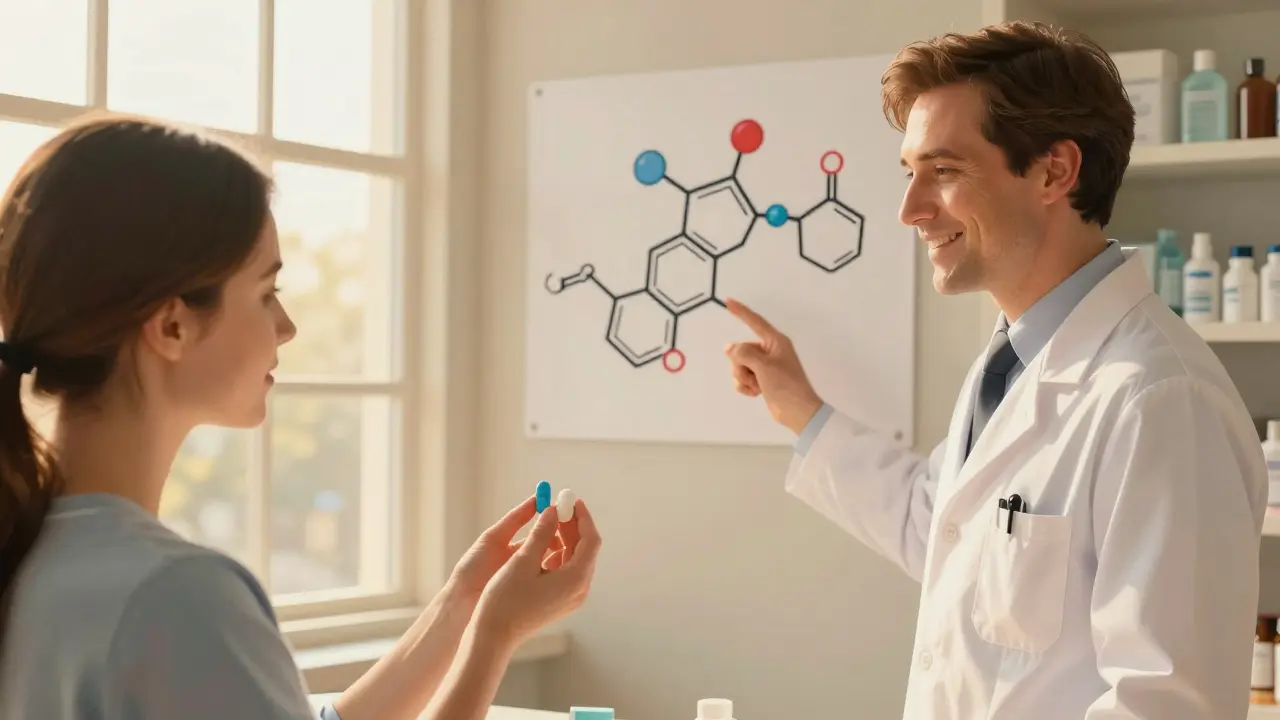
You’ve been prescribed a medication. The pharmacist hands you a bottle with a different name than what your doctor wrote. It’s cheaper. But you’re confused. Is this the same thing? Should you be worried? You’re not alone. Most people don’t know the difference between generic and brand-name drugs-and that’s okay. The real question isn’t whether they’re different. It’s whether you should be asking your doctor about it.
They’re Not Different in What Matters Most
Generic drugs aren’t cheap copies. They’re exact chemical twins. The FDA requires them to have the same active ingredient, strength, dosage form, and route of administration as the brand-name version. That means if your doctor prescribed 10 mg of lisinopril, the generic you get will contain exactly 10 mg of lisinopril. No more, no less. The FDA also requires that generics work the same way in your body. They must be bioequivalent-meaning they’re absorbed at the same rate and to the same extent as the brand-name drug, within a 20% margin. In practice, studies show the average difference is just 3.5%. That’s less than the natural variation your body has from day to day.
Think of it like two identical cars. One is a Honda Civic built in Ohio. The other is a Honda Civic built in Alabama. Same engine. Same safety rating. Same fuel efficiency. One costs $25,000. The other costs $5,000. The only differences? The paint color, the logo on the hood, and the price tag. That’s generic vs. brand-name.
Why Do They Look So Different?
Ever notice how generic pills are a different color or shape? That’s not a mistake. U.S. trademark laws forbid generic manufacturers from copying the exact appearance of brand-name drugs. So if your brand-name pill is a blue oval, the generic might be a white round tablet. Same medicine. Different look. Same effect. Different packaging. Sometimes, the flavor in liquid versions changes too. That’s why people get confused. They see a new pill and think, ‘This isn’t the same.’ It’s not about the medicine. It’s about the packaging.
And that confusion can hurt. A Kaiser Permanente survey found that 17% of patients worried when they got a generic version-until a pharmacist explained the difference. After that, 92% were satisfied. The problem isn’t the drug. It’s the lack of explanation.
Cost Isn’t Just a Number-It’s a Health Issue
Generic drugs cost 80-85% less than brand-name versions. That’s not a small difference. It’s life-changing. Between 2007 and 2016, generics saved the U.S. healthcare system $1.67 trillion. On average, patients save $45 per prescription when switching to generics. For people on multiple medications, that adds up to hundreds-or thousands-of dollars a year.
But here’s the real impact: when drugs are too expensive, people skip doses. They cut pills in half. They don’t refill. A Harvard Medical School study found that high prices are a leading reason people stop taking their meds. And that’s not just risky-it’s dangerous. For conditions like high blood pressure, diabetes, or seizures, missing doses can lead to hospital visits, strokes, or worse.
Generic drugs aren’t just cheaper. They’re safer because they make it easier to stick to your treatment plan.

When Might Brand-Name Be Necessary?
For 99% of medications, generics are just as good. But there are exceptions. A small group of drugs have what’s called a narrow therapeutic index. That means the difference between a dose that works and one that’s dangerous is tiny. Examples include warfarin (a blood thinner), levothyroxine (for thyroid issues), and some seizure medications like phenytoin.
Some doctors prefer to stick with brand-name for these drugs-not because generics don’t work, but because they want to avoid any possible fluctuation. Even though the FDA says approved generics are safe for these drugs, a few small studies have shown minor differences in blood levels when switching between generic manufacturers. These findings aren’t consistent, and they don’t mean generics are unsafe. But they do mean some patients and doctors prefer consistency.
If you’re on one of these medications and you’ve been stable on a brand-name drug, it’s fair to ask: ‘Should I stay on this one?’ But don’t assume you need the brand name. Ask your doctor: ‘Is there a reason we shouldn’t try the generic?’
What to Say to Your Doctor
Many people don’t bring up cost because they think their doctor won’t care. They’re wrong. Doctors know how expensive meds can be. They’ve seen patients skip doses because they can’t afford them. Here’s what to say:
- ‘Is there a generic version available for this?’
- ‘Will it work the same for my condition?’
- ‘Are there any reasons I should avoid the generic?’
- ‘How much will this cost out of pocket?’
Don’t be shy. Your doctor isn’t judging you. They’re there to help you stay healthy-and that includes making sure you can afford your meds.
What Happens If You Don’t Say Anything?
In most states, pharmacists are required by law to substitute a generic unless your doctor writes ‘dispense as written’ on the prescription. That means if you don’t speak up, you might get a generic without even knowing it. That’s fine-if you’re okay with it. But if you’ve had bad reactions to a previous generic, or if you’re worried about switching, you need to tell your doctor before the prescription is written.
And if you get a new bottle that looks different, don’t panic. Call your pharmacist. They’re trained to explain these changes. A 2022 study found that 78% of patient concerns about generics were resolved just by talking to the pharmacist.

What About Biosimilars?
You might hear about ‘biosimilars’ and think they’re the same as generics. They’re not. Biosimilars are for complex biologic drugs-things like Humira, Enbrel, or insulin. These aren’t made from chemicals. They’re made from living cells. That means you can’t make an exact copy. Instead, you make a very close version. Biosimilars are cheaper than brand-name biologics, but not as cheap as traditional generics. Right now, only about 28% of biologic prescriptions are filled with biosimilars. But that’s changing fast. More are being approved every year.
If you’re on a biologic, ask: ‘Is there a biosimilar available?’ It’s not a generic-but it’s still a cost-saving option.
Bottom Line: Ask, Don’t Assume
Generic drugs are safe, effective, and backed by decades of research. The FDA, the CDC, and every major medical association agree: for almost every condition, generics are just as good as brand-name drugs. The only real difference is cost-and the confusion caused by different pill shapes.
If you’re worried, ask. If you’re struggling to pay, say so. If you’ve had a bad experience with a generic before, tell your doctor. You’re not being difficult. You’re being smart. Your health isn’t a guess. It’s a partnership. And you deserve to understand every part of it.
What to Do Next
- Check your next prescription. Is there a generic version?
- Call your pharmacy and ask: ‘Is this a brand or generic?’
- Write down any side effects you’ve had-whether from brand or generic.
- Next time you see your doctor, ask: ‘Is there a cheaper option that works just as well?’
It’s not about saving money. It’s about staying healthy-and that starts with asking the right questions.

jonathan soba
January 27, 2026 AT 14:08Let’s be real - if generics were truly identical, why do insurance companies push them so hard? It’s not about patient care, it’s about profit margins. The FDA’s ‘bioequivalence’ standard is a joke - 20% variation is a wild swing in a drug that’s supposed to stabilize your blood pressure. I’ve seen people crash after switching. They call it ‘normal variation’ but it’s just corporate laziness dressed up as science.
And don’t get me started on the pill shape thing. If you’re telling me a white oval is ‘the same’ as a blue capsule, then why do drug companies spend millions designing logos and colors? It’s psychological manipulation. They want you to feel like you’re getting the ‘real’ thing. The generic? Just a sad knockoff with a different barcode.
Chris Urdilas
January 29, 2026 AT 10:36Wow. So the FDA says it’s the same, the science says it’s the same, and yet somehow we’re still treating generics like they’re second-class citizens? I get it - branding is powerful. But this isn’t soda. It’s not about taste or logo. It’s about your liver, your heart, your life.
I switched my dad from brand-name statin to generic last year. He saved $90 a month. He didn’t even notice the difference. The only thing that changed? His bank account stopped bleeding.
Stop letting Big Pharma scare you into paying extra for a different color pill. Your body doesn’t care about trademarks.
Also - biosimilars are the future. We’re not talking about aspirin here. We’re talking about drugs made from living cells. It’s not magic. It’s biology. And yeah, it’s cheaper now too.
Phil Davis
January 29, 2026 AT 22:55Interesting how everyone’s suddenly a pharmacologist after reading one article. I’ve been on generic levothyroxine for 8 years. My TSH has never wavered. My doctor switched me without asking. I didn’t care. I’m alive. I’m healthy. I’m not broke.
Meanwhile, the people panicking about pill shapes? They’re the same folks who refuse to buy store-brand toilet paper because it’s ‘not as soft.’
Maybe the real issue isn’t the drug. Maybe it’s the cultural obsession with brand names as status symbols. Even when it’s literally medicine.
Irebami Soyinka
January 31, 2026 AT 21:41Ohhh so now we’re all supposed to bow down to Big Pharma’s cheap knockoffs? 😒 In Nigeria, we know what happens when you take fake meds - people DIE. And now you want us to trust some FDA stamp on a white pill that looks like it came from a 2005 Walmart clearance bin? 🤡
My cousin took generic blood pressure meds and ended up in ICU because the ‘active ingredient’ was half what it should’ve been. You think the FDA checks every batch? Please. They’re understaffed and underfunded. You think your $45 savings is worth a stroke?
Don’t be a guinea pig. Pay for the real thing. Your life isn’t a cost-benefit analysis. 🇳🇬💪
Mel MJPS
February 1, 2026 AT 23:26I just want to say - thank you for writing this. I was so scared to ask my doctor about cost because I didn’t want to seem ‘cheap.’ But after reading this, I finally spoke up last week. I’ve been on 4 meds, and switching to generics saved me $320 a month. I cried in the pharmacy parking lot.
It’s not about being cheap. It’s about being human. We’re not supposed to choose between eating and breathing.
Also - the pharmacist who explained the pill difference to me? She gave me a sticker. It said ‘You got this.’ I still have it on my fridge. ❤️
Katie Mccreary
February 3, 2026 AT 08:07Oh my god I can’t believe people still fall for this. The FDA is a puppet of Big Pharma. Did you know they don’t test generics themselves? They rely on the manufacturer’s data. And guess who pays for those studies? The company making the generic. No conflict of interest here, right? 😏
I switched to generic Adderall and had a full-blown panic attack. My heart was racing. I thought I was dying. Turns out the filler chemicals were different. And no one warned me.
Don’t be fooled. This isn’t science. It’s corporate exploitation dressed up as ‘affordability.’
SRI GUNTORO
February 5, 2026 AT 07:58Why do Americans think everything has to be cheap? In India, we respect medicine. We don’t treat it like a discount grocery item. Generics are for people who don’t care about their health. If you can’t afford your meds, maybe you shouldn’t be taking them.
My uncle took generics for diabetes and lost his foot. The pill didn’t dissolve right. Now he’s on disability. You think saving $50 is worth losing a limb?
Real health isn’t about price tags. It’s about dignity. And dignity doesn’t come in a white pill.
Rose Palmer
February 5, 2026 AT 17:25Thank you for this thoughtful, evidence-based breakdown. As a clinical pharmacist with over 18 years of experience, I can confirm: generics are safe, effective, and underutilized. The data is overwhelming.
That said - I always encourage patients to track their response after switching. Not because generics are risky, but because individual physiology varies. Some people are sensitive to fillers. Others have allergies to dyes. That’s why documentation matters.
Ask your pharmacist. Ask your doctor. Keep a log. Be your own advocate. Knowledge is power - and it’s also cheaper.
Mindee Coulter
February 6, 2026 AT 00:42Rhiannon Bosse
February 7, 2026 AT 13:25Okay but what if the generic is made in China? 🤔
I read an article once that said 80% of our active pharmaceutical ingredients come from China. And China? They don’t have FDA standards. They have ‘Chinese standards.’ Which means… what? Who’s checking? Who’s inspecting? Are we just trusting a barcode?
And why do all the generics have the same weird blue dye? That’s not a coincidence. That’s a control mechanism. They want us to associate ‘cheap’ with ‘dangerous.’
Also - I think the FDA is part of a secret pharma cartel. Why else would they approve generics that look nothing like the brand? It’s psychological warfare. They want you to feel guilty for saving money.
Just sayin’.
Bryan Fracchia
February 9, 2026 AT 13:09It’s funny how we treat medicine like it’s a luxury car. You wouldn’t buy a used Honda because it’s not a BMW, right? But when it comes to pills, suddenly the logo matters more than the engine.
Generics are the quiet heroes of healthcare. They let people with chronic illnesses live normal lives. They let single moms afford insulin. They let retirees keep their blood pressure stable without choosing between rent and refills.
Maybe the real question isn’t ‘Are generics safe?’
It’s: ‘Why do we think we deserve to pay more for something that does the exact same thing?’
Timothy Davis
February 10, 2026 AT 04:28You missed the point entirely. The FDA’s bioequivalence standard is based on AUC and Cmax - two metrics that ignore pharmacokinetic variability across populations. That’s fine for a healthy 30-year-old, but what about the elderly? The obese? The renal impaired? Their absorption profiles are different. A 3.5% average difference? That’s meaningless when you’re talking about a 40% spike in blood levels in a subset of patients.
And you think the fillers don’t matter? Hypromellose, lactose monohydrate, magnesium stearate - these aren’t inert. They trigger immune responses. I’ve seen patients develop rashes, GI distress, even anaphylaxis after switching generics.
This isn’t about cost. It’s about clinical negligence masked as ‘efficiency.’
Brittany Fiddes
February 10, 2026 AT 23:19Generics? In Britain we don’t have this problem. Our NHS makes the decisions. No one’s confused. No one’s scared. We get what the system gives us - and it’s always the cheapest effective option. No drama. No marketing. Just science and public health.
Meanwhile, Americans are out here treating pills like designer handbags. ‘Oh no, my levothyroxine is white now!’ Like it’s a fashion faux pas.
Pathetic. You’re not ‘empowered’ because you asked your doctor about cost. You’re just another capitalist zombie who thinks health is a product you can ‘choose.’