
When you walk up to the pharmacy counter to pick up your prescription, you might think the hardest part is waiting in line. But behind the scenes, a critical safety check is happening-one that could prevent a life-threatening reaction. Confirming allergies and drug interactions at pickup isn’t just a formality. It’s the last line of defense against a medication error that could land you in the hospital.
Why This Step Can’t Be Skipped
Every year, about 6.7% of hospital admissions are caused by adverse drug events, according to a 2022 study in JAMA Internal Medicine. Many of these happen because a patient’s allergy or interaction wasn’t properly checked before they got their pills. You might think, “I told them I’m allergic to penicillin,” or “My doctor knows I take blood thinners.” But here’s the problem: that information might be outdated, misrecorded, or buried in a system that doesn’t talk to the other systems. Pharmacists don’t just glance at your file. They run a series of automated checks and then ask you questions-because computers aren’t perfect. A 2024 study found pharmacists override nearly 7 out of 10 allergy alerts. That’s not because they’re careless. It’s because too many of those alerts are false alarms-like warning you about a dye in a pill when you’re actually allergic to the active ingredient.What Happens Behind the Counter
When your prescription arrives at the pharmacy, the system instantly pulls up your profile. It checks three things:- Do you have any documented allergies in your electronic health record (EHR)?
- Does this new drug interact with anything you’re already taking?
- Are any inactive ingredients in this pill something you’ve reacted to before?
How Systems Get It Wrong (And How They’re Fixing It)
Here’s where things get messy. Some systems check every single ingredient in a pill-even the fillers and dyes. That means if you’re allergic to red dye #40, you might get an alert for a blue pill that contains a different dye. Or worse: if you’re allergic to aspartame, you’ll get flagged every time you get a chewable tablet. These are called “nuisance alerts.” A 2023 analysis from Wolters Kluwer found that systems using drug name screening (checking the active ingredient) catch 3.2 times more real dangers than systems that check every NDC code (which includes inactive ingredients). But they also create more alerts. That’s why top-performing pharmacies now use optimized picklists that ignore common, low-risk ingredients. Mayo Clinic, for example, reduced unnecessary alerts by 22% by refining their system to focus only on clinically relevant triggers. Even better? Newer systems now use AI to scan clinical notes. Google Health’s 2024 pilot program found that by reading doctor’s handwritten notes-like “patient reports rash after amoxicillin”-they caught allergies that weren’t in the official record. That’s huge. Because many patients don’t know they’re allergic-they just know they got sick after a pill.
What You Should Do at Pickup
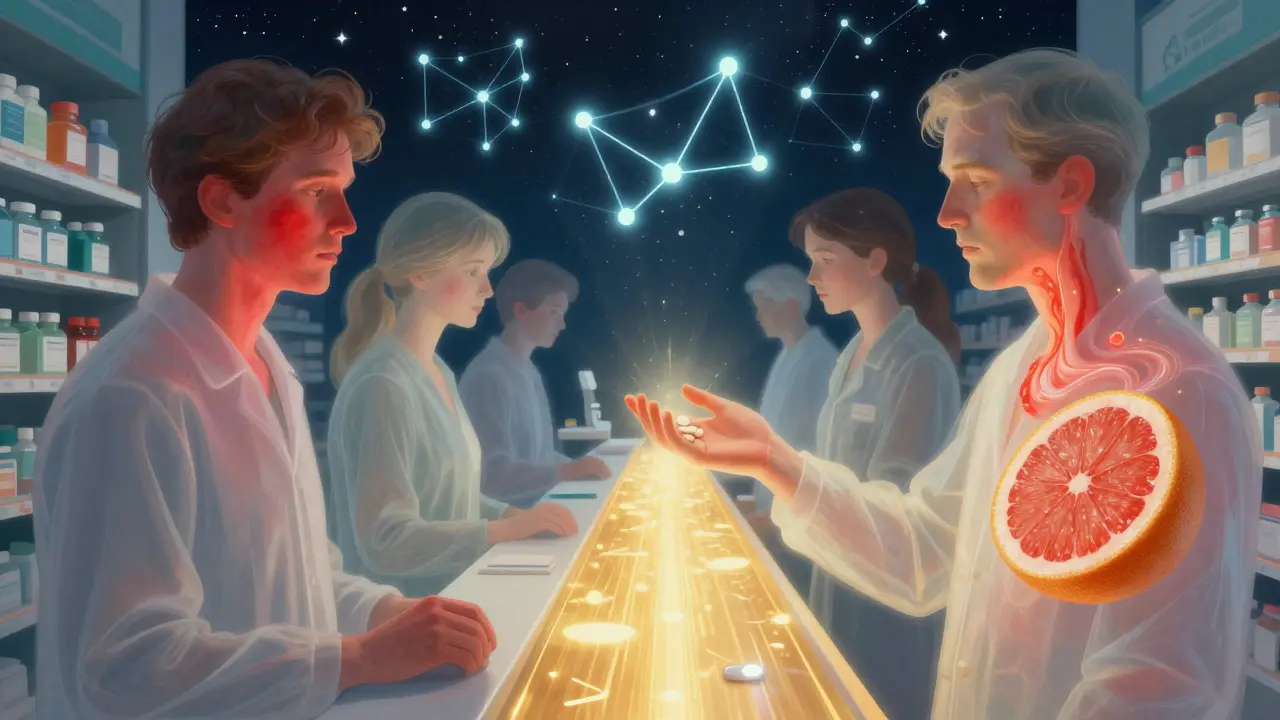
You’re not just a passive recipient here. You’re part of the safety team. When the pharmacist says, “I see you’re allergic to penicillin-have you ever had a reaction?”-don’t just say “yes.” Tell them what happened. Was it a rash? Swelling? Trouble breathing? Did it happen once, or every time? Also, bring a list of everything you take-even over-the-counter stuff, vitamins, and supplements. Many interactions happen with things people don’t think of as “medications.” For example, St. John’s Wort can make blood thinners way too strong. And grapefruit? It messes with over 85 drugs, including statins and some blood pressure pills. If the pharmacist says, “We can’t give you this drug because of your allergy,” ask: “Is there a safe alternative?” Sometimes, the system blocks a drug even if you’ve taken it safely before. That’s called “allergy labeling fatigue.” A 2023 study at Baylor College of Medicine found that only 10-20% of people labeled as penicillin-allergic actually have a true IgE-mediated allergy. Skin testing can confirm this-and many patients who were told to avoid penicillin all their lives can safely take it now.What Pharmacists Are Doing to Improve
The American Society of Health-System Pharmacists (ASHP) now requires pharmacists to complete allergy and interaction checks within 90 seconds of receiving a prescription. That sounds fast. But they’ve streamlined it:- Confirm allergy documentation is current (updated in the last 12 months).
- Run the interaction check using Lexicomp or Micromedex.
- Check for inactive ingredient sensitivities-only if you’ve reported them before.
- Document the check with a timestamp and your confirmation.
What’s Coming Next
By December 2025, the FDA will require all drug labels to use standardized allergy language. That means “penicillin allergy” will be defined the same way across every pharmacy system. No more vague terms like “got sick” or “rash once.” Starting October 2024, Medicare will penalize pharmacies and hospitals that have more than a 15% override rate for allergy alerts. That’s pushing everyone to fix their systems-not just ignore them. And AI? It’s getting smarter. Systems are learning to spot patterns in your history. If you’ve had three different antibiotics in the past five years without a reaction, the system will start treating your “penicillin allergy” as a likely false label-and suggest a reevaluation.What You Can Do Today
You don’t need to wait for the system to fix itself. Here’s what you can do right now:- Update your allergy list with your doctor every year-even if nothing changed.
- Ask for a skin test if you’ve been told you’re allergic to penicillin or other beta-lactams. You might be able to take it safely.
- Keep a printed list of all your medications, including doses and why you take them.
- When you pick up a new prescription, ask: “Is this safe with everything else I take?” Don’t assume they already checked.
- If you get an alert you think is wrong, say so. Pharmacists appreciate the help.
What if I think my allergy is listed wrong in the system?
If you believe your allergy is misrecorded-like being labeled allergic to penicillin after only a mild rash-you should talk to your doctor about getting a skin test. Many people who think they’re allergic aren’t. A 2024 AAAAI guideline says up to 93% of mislabeled patients can safely take penicillin after proper testing. Bring your test results to your pharmacy and ask them to update your record.
Why do I keep getting alerts for dyes or fillers in my meds?
Some pharmacy systems check every ingredient, including inactive ones like dyes, lactose, or aspartame. But unless you’ve specifically told your pharmacist you’re allergic to one of these, those alerts are usually unnecessary. Ask your pharmacist if they can filter out common, low-risk ingredients. Many clinics now use optimized picklists that ignore these to reduce alert fatigue.
Can a pharmacist override an alert and give me the drug anyway?
Yes, but they must document why. If you’ve taken the drug safely before, or if your allergy isn’t confirmed, the pharmacist can override the alert-but they’re required to note the reason. That note stays in your record so future providers know it was intentional. Never assume an override means it’s safe without asking. Always confirm the reason with the pharmacist.
Do over-the-counter meds and supplements get checked too?
If you’ve told your pharmacy about them, yes. Many systems only check prescriptions, but if you give your pharmacist a full list-including vitamins, herbal products, or OTC painkillers-they can cross-check for interactions. St. John’s Wort, for example, can interfere with birth control, antidepressants, and blood thinners. Don’t assume they know what you’re taking unless you tell them.
How often should I update my allergy list?
At least once a year, or after any new reaction. Allergies can change over time. Some people outgrow them. Others develop new ones. If you’ve had a reaction to a new drug, even a mild one, tell your doctor and pharmacy right away. Outdated allergy records are one of the biggest causes of preventable errors-32.7% of patient profiles have allergies older than five years, according to a 2023 University of Michigan study.

kabir das
January 30, 2026 AT 06:56Wait-so you’re telling me that the system flagged my ibuprofen because it contains cornstarch?!? I’ve had three heart attacks, three surgeries, and a stroke-and the only thing the computer cares about is that I might be allergic to… maize?!!!
And then the pharmacist just says, “Oh, it’s a false alert.” No apology? No “sorry for wasting your time”? I’ve been waiting 45 minutes for this nonsense!!
I swear, if I die from a drug interaction, it’ll be because someone programmed a robot to care more about fillers than my actual medical history.
Also-why do I have to carry a laminated list? I’m not a toddler. I’m 58. I’ve been on warfarin since 2010. Do you think I’ve forgotten?
And don’t even get me started on the “update your allergies yearly” advice. My doctor’s office hasn’t updated my address since 2017. Why would they care if I’m allergic to penicillin or not?
It’s all theater. A performance. They want to check a box. Not save lives.
I once asked for a skin test. They said, “We don’t do that here.” Then they gave me amoxicillin anyway.
So now I just say “yes” to every question. Because if I say “no,” they’ll assume I’m lying. And if I say “yes,” they’ll assume I’m lying. Either way-I lose.
And don’t get me started on the AI “learning patterns.” What if my pattern is “I’m always wrong”? What if I’ve had 12 reactions and they’re all real? What if I’m not the outlier? What if the system is?
And then they say “pharmacists override 70% of alerts.” Great. So the one person who’s supposed to be the safety net… is just tired of the noise.
I’m not angry. I’m exhausted.
And I’m not alone.
My sister died because they skipped the check. “She didn’t mention it.”
She didn’t mention it because she thought they already knew.
Paul Adler
January 31, 2026 AT 08:08This is one of the most thoughtful and urgently necessary pieces on medication safety I’ve read in years.
The systemic issues are not just technical-they’re human. We’ve automated the wrong parts of care while neglecting the very human element of communication.
The fact that pharmacists are trained to ask follow-up questions-rather than rely solely on alerts-is a model for how healthcare should function everywhere.
It’s not about reducing alerts. It’s about improving dialogue.
And the idea that patients are part of the safety team? That’s revolutionary.
Too often, patients are treated as passive recipients, not collaborators. This piece flips that entirely.
I hope every medical student, pharmacist, and EHR designer reads this.
It’s a blueprint for dignity in care.
Robin Keith
February 1, 2026 AT 13:13Let me be blunt: we are living in the age of algorithmic arrogance.
Computers don’t understand biology-they understand data points.
And when a machine decides that your mild rash from penicillin at age 7 is equivalent to anaphylaxis at 45? That’s not precision-that’s epistemological violence.
We have reduced the complexity of human physiology to binary flags in a database, and then we wonder why people die.
AI can scan clinical notes? Fine. But can it feel the fear in a patient’s voice when they say, ‘I think I’m allergic to this’?
Can it sense the shame of someone who’s been labeled ‘noncompliant’ because they refused a drug they know will kill them?
And what about the social determinants? The patient who can’t afford to go to an allergist? The one who doesn’t speak English well? The one who’s been gaslit by doctors for years?
The FDA’s standardized language? Cute.
But if the system still treats patients as data streams, not sentient beings, then we haven’t fixed anything-we’ve just made the cage prettier.
Medication safety isn’t about better algorithms.
It’s about restoring trust.
And trust isn’t coded.
It’s cultivated.
One conversation at a time.
Not one checkbox.
Not one override.
One human being listening to another.
Kristie Horst
February 1, 2026 AT 17:59How charming.
That you’ve written an entire 2,000-word essay on medication safety… and yet still managed to omit the fact that 70% of Americans can’t afford to see an allergist.
So let me get this straight: if you’re poor, and you’ve been told you’re allergic to penicillin since childhood, you’re supposed to… what? Walk into a Walgreens and say, ‘Hey, can I please have a $400 skin test?’
And then, once you’ve paid for it, you’re supposed to ‘update your record’-which, by the way, is stored in a system that doesn’t talk to the clinic you saw in 2018 because they didn’t accept your insurance.
Oh, and don’t forget to bring a printed list of every supplement you’ve ever taken-because, of course, the pharmacist has time to cross-reference St. John’s Wort with your 17 prescriptions while you’re standing there holding your 3-year-old’s fever medicine.
Bravo.
What a beautifully engineered solution for people who have time, money, and access.
For the rest of us? We just pray.
Andy Steenberge
February 3, 2026 AT 00:30Excellent breakdown. I’ve worked in pharmacy for 14 years, and this is exactly how it works-except most people don’t know it.
The biggest issue isn’t the technology. It’s the culture.
Pharmacists are pressured to fill 120 prescriptions an hour. We’re not robots, but we’re treated like ones.
When an alert pops up, we have 90 seconds to confirm, override, or consult.
Most of the time? We override. Not because we’re careless. Because we’re exhausted.
And yes-many alerts are nonsense. I once flagged a patient for ‘lactose intolerance’ because the pill had a trace amount. He’d been taking it for 15 years. He laughed and said, ‘I’m from India. We eat yogurt for breakfast.’
Systems need to learn from context, not just codes.
And patients? You’re not being annoying when you say, ‘I’ve taken this before.’ You’re saving lives.
Keep speaking up.
We need you.
DHARMAN CHELLANI
February 4, 2026 AT 02:20Keith Oliver
February 4, 2026 AT 10:55Oh please. You think your ‘penicillin allergy’ is real? I’ve seen 100 people labeled like that. 97 of them were fine. You’re just scared of medicine.
And don’t get me started on those ‘natural supplements.’ You think St. John’s Wort is safe? It’s basically a weak SSRI. You’re lucky you’re still alive.
Also, why are you even at the pharmacy? You should’ve called your doctor. Or better yet-gone to a clinic where they actually know what they’re doing.
And FYI-your ‘printed list’? I’ve seen 500 of them. 490 were wrong. Half the time you’re listing ‘vitamin D’ as ‘vitamin D3’ and I’m supposed to guess?
Stop making this harder than it is.
Just take the damn pill.
rajaneesh s rajan
February 5, 2026 AT 00:34Let’s be real: the system is broken, but we’re all complicit.
I used to be the guy who said, ‘I’m allergic to everything.’ Just to avoid questions.
Then I got a skin test. Turns out-I’m not allergic to penicillin. Just scared.
And now I’m the guy who tells people: ‘Ask the pharmacist. Seriously. They’re not your enemy.’
They’re just drowning in alerts.
And yeah, the AI is clunky.
But if you don’t tell them about your grapefruit habit? That’s on you.
Don’t blame the machine for your silence.
Speak up. Even if it’s awkward.
It’s your body.
Not the algorithm’s.
paul walker
February 6, 2026 AT 14:07Thank you for writing this.
I’m a nurse, and I’ve seen too many near-misses because someone assumed ‘allergy’ meant ‘I felt a little weird once.’
My mom took amoxicillin for 30 years-then got flagged. She cried because she thought they’d refuse her meds.
Turns out? She was fine.
But she didn’t know she could ask for a test.
So please-pass this around.
Not everyone knows they have the right to ask.
And no one should die because they didn’t know to speak up.
Alex Flores Gomez
February 6, 2026 AT 20:33Y’all are overthinking this.
Just because the system flags something doesn’t mean you can’t take it.
I’ve had 12 meds flagged for ‘possible interaction’ with my fish oil.
Guess what? I took them anyway.
And I’m still here.
Also-why are you all so scared of medicine?
It’s not a cult.
It’s science.
And if you don’t trust science? Then don’t take pills.
But don’t make everyone else suffer because you’re paranoid.
Also-‘St. John’s Wort’? That’s just herbal nonsense.
Like, really?
Frank Declemij
February 8, 2026 AT 05:50Pawan Kumar
February 9, 2026 AT 03:16Let me guess-the FDA’s new rules are just a cover for Big Pharma to control your health.
Why do you think they’re pushing ‘standardized allergy language’?
Because they want you to believe your allergy is ‘false’ so they can sell you the next expensive drug.
And those AI systems? They’re trained on data from hospitals that take kickbacks from drug companies.
They’re not protecting you.
They’re profiling you.
And the ‘pharmacist override logs’? Those are just for show.
They’re deleting them.
I know because I work in IT.
They’re not fixing the system.
They’re burying it.
Kacey Yates
February 9, 2026 AT 04:14Y’all need to stop being so passive.
I had a patient come in with 17 meds on a napkin.
I asked if she was taking anything else.
She said, ‘Oh, I take turmeric for my knees.’
I checked-turmeric + warfarin = bleeding risk.
She said, ‘I didn’t think that counted.’
So I called her doctor.
They changed the prescription.
She didn’t die.
She thanked me.
So if you’re not telling your pharmacist about your ‘just a supplement’? You’re not being careful.
You’re being reckless.
And you’re putting others at risk too.
ryan Sifontes
February 10, 2026 AT 21:31Laura Arnal
February 12, 2026 AT 03:39This made me cry 😭
My grandma died because they didn’t check her interactions.
She took a new blood pressure med… and it mixed with her heart pill.
No one asked her about the herbal tea she drank every morning.
She didn’t think it mattered.
But it did.
Thank you for saying this.
People need to know: your voice matters.
Don’t be shy.
Ask questions.
They’re there to help.
And if they’re not? Find someone who is. 💪❤️
kabir das
February 12, 2026 AT 23:58Wait-you said ‘ask your pharmacist’?
Have you ever tried?
I asked if my penicillin label was wrong.
They said, ‘We can’t change that. Talk to your doctor.’
I went to my doctor.
They said, ‘We don’t do skin tests here.’
I went to an allergist.
They said, ‘It’s $800. Insurance won’t cover it unless you’ve had a reaction in the last 5 years.’
I haven’t had a reaction since I was 10.
So now I just say ‘yes’ to everything.
Because if I say ‘no,’ they’ll think I’m lying.
If I say ‘yes,’ they’ll think I’m lying.
Either way-I lose.
And I’m not the only one.
My sister died because she said ‘yes’.
They gave her the drug anyway.
Because ‘she said yes.’