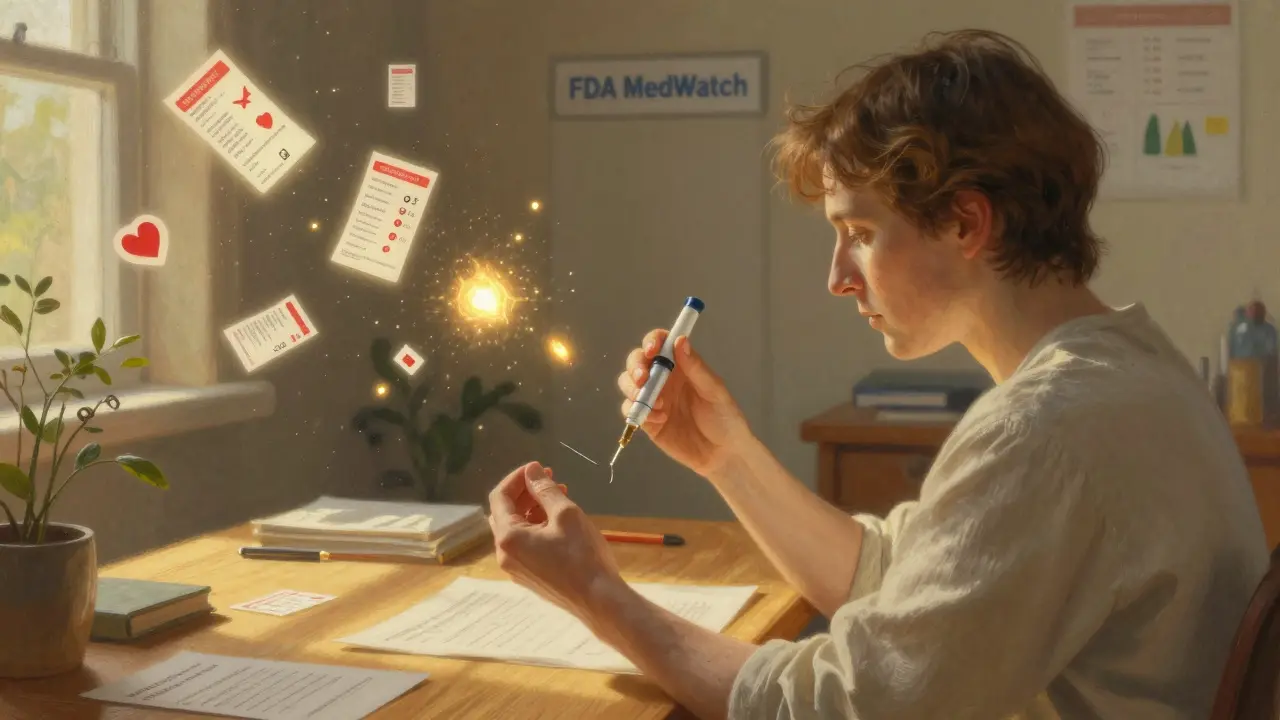
Every year, hundreds of thousands of people in the U.S. experience side effects, product failures, or safety issues with medications, medical devices, or even dietary supplements. But only a small fraction ever report them. If you’ve had a bad reaction to a drug, a device stopped working unexpectedly, or your insulin pen leaked because of a faulty seal-your report matters. The FDA doesn’t just rely on doctors and manufacturers to spot problems. Patient reporting is a critical part of how the agency finds hidden dangers before they hurt more people.
What Counts as a Reportable Issue?
You don’t need to be a doctor to know when something’s wrong. The FDA accepts reports for three main types of problems:- Adverse reactions - Serious side effects like liver damage from a new painkiller, severe allergic reactions to a biologic, or heart rhythm changes after starting a new antidepressant.
- Product quality issues - Pills that look different than usual, a glucose monitor giving wrong readings, a ventilator that shuts off unexpectedly, or a bottle of supplements with missing labels.
- Therapeutic failure or use errors - A blood pressure medication that suddenly stops working, a hearing aid that loses power after one week, or a patient using a nebulizer incorrectly because the instructions were unclear.
It doesn’t matter if you think it’s "not a big deal." If it disrupted your life, made you go to the ER, or scared you-you should report it. The FDA’s system is designed to catch rare events that clinical trials miss. For example, a drug tested on 2,000 people might only show side effects in 1 out of 10,000 users. That’s exactly the kind of problem patient reports uncover.
How to Submit a Report: Your Options
The FDA gives you several ways to report, so you can pick what works for you.- Online via the Safety Reporting Portal (SRP) - This is the fastest and most detailed option. Go to fda.gov/medwatch and click "Report a Problem." The form walks you through each section. You’ll need the product name, lot number, expiration date, your symptoms, when they started, and what other meds you’re taking. It takes 15-20 minutes to complete.
- Print and mail the FDA 3500 form - If the website crashes (which it still does, especially since August 2024), download the PDF version. Fill it out by hand and mail it to the address on the form. This is what many people do when the portal fails. You can also request a paper form by calling 1-800-FDA-1088.
- Call in - Dial 1-800-332-1088. A representative will take your report over the phone. This works best if you’re not comfortable typing or if you’re in a hurry. Make sure to get a reference number.
- Spanish-language form - If you’re more comfortable in Spanish, use the FDA 3500B form. It’s identical in structure but translated fully, and it’s accepted just like the English version.
Don’t let technical issues stop you. The FDA’s own data shows the online portal has had outages since August 2024. If you can’t get through, mail the form. It’s slower, but it still gets into their system.
What Information Do You Need?
You don’t need a medical degree, but having these details ready makes your report much more useful:- Product details - Name of the drug, device, or supplement. Brand and generic names both help. Lot number (found on packaging), expiration date, and manufacturer name.
- Your info - Age, sex, weight (if relevant). You don’t have to give your full name or address, but you must provide a way for the FDA to contact you if they need more info. Your identity is protected by law.
- Symptoms - Describe what happened in your own words. When did it start? Did it get worse? Did you go to the hospital? Did you stop using the product? Include how it affected your daily life.
- Other medications - List everything you’re taking, even over-the-counter stuff like ibuprofen or fish oil. Many reactions happen because of interactions.
- Outcome - Did you recover? Are you still having issues? Did you need surgery or hospitalization?
Many patients skip the lot number because it’s hard to find. But it’s critical. The FDA uses it to track which batch of a product caused the problem. If you threw away the box, check your pharmacy receipt or log into your pharmacy’s online portal. Some devices have serial numbers on the device itself.

Why Your Report Matters More Than You Think
Some people think, "The doctor already knows. Why bother?" But here’s the truth: doctors don’t report everything. They’re busy. They assume someone else will. Manufacturers often downplay complaints. The FDA’s own analysis shows that only about 5-10% of actual adverse events get reported-meaning 90-95% go unnoticed.But patient reports are different. A 2023 study in Drug Safety found that when patients report, they include 37% more details about when symptoms started and 28% more info about other products they were using. That kind of detail helps the FDA spot patterns.
Real examples:
- In early 2024, 287 patients reported insulin pens leaking or delivering inconsistent doses. The FDA issued a safety alert within months, leading to a redesign.
- Patient reports of a new migraine drug causing sudden vision loss led to a black box warning being added to the label.
- Multiple reports of a popular heart monitor giving false alarms prompted a software update.
These weren’t found in clinical trials. They were found because real people took the time to report.
What Happens After You Submit?
Once you hit submit, here’s what you can expect:- You’ll get a confirmation email within 5 business days (if you provided an email). Most people don’t know this happens.
- Your report goes into the FDA Adverse Event Reporting System (FAERS), a database with over 25 million reports.
- FDA analysts review your report alongside thousands of others. They look for clusters - the same problem reported by many people using the same product.
- If a pattern emerges, the FDA may issue a safety alert, require a label change, or even recall the product.
The process used to take weeks. Now, thanks to a new AI system rolled out in Q3 2024, the FDA can triage urgent reports in as few as 9 business days-down from 22. But there’s still a lag. The system isn’t designed for emergencies. If you’re having a life-threatening reaction, call 911 or go to the ER first. Reporting to the FDA is for long-term safety, not immediate care.
Common Problems Patients Face
Despite the system being designed for consumers, many run into roadblocks:- Website crashes - The Safety Reporting Portal has been unstable since August 2024. If it freezes, try again later or use the paper form.
- Missing lot numbers - Only 62% of packaged products have the lot number clearly printed. If you can’t find it, write "unknown" and describe the packaging.
- Medical jargon - You don’t need to say "bradycardia." Say "my heart felt like it was slowing down." The FDA’s new symptom wizard helps, but you still need to describe what you felt.
- Language barriers - Only English and Spanish forms are officially available. If you speak another language, you may need help from a family member or translator.
- Not knowing you’re protected - Under 21 CFR 10.75, your name and contact info are confidential. The FDA cannot share your identity without your permission. But a 2024 survey found 68% of patients didn’t know this.

How This Compares to Doctor or Manufacturer Reports
Doctors and manufacturers report too-but differently.- Doctors - They report using different forms and have access to medical records. Their reports are more clinically detailed but often miss daily-life context. Only 62% of patient reports include enough info for full review, compared to 89% from doctors.
- Manufacturers - They’re legally required to report. But they have an incentive to minimize problems. Patient reports often catch what companies overlook, especially misuse or off-label use.
For medical devices, patient reports are 2.3 times more likely to describe new use errors. That’s huge. For example, a patient might report that a knee implant made noise when climbing stairs-something no clinical trial tested for. That’s the kind of insight only real-world use can reveal.
What’s Changing in 2025 and Beyond
The FDA is working to fix the system. In January 2025, they launched the Next Generation Safety Reporting System (NGSRS). It includes:- Automated lot number verification
- AI that suggests standard terms for symptoms (like "dizziness" instead of "I felt woozy")
- Plans to add support for five more languages by 2027
- A goal to cut processing time to just 5 business days by late 2026
They’re also planning to merge all six current reporting portals into one unified system by 2028. Right now, reporting a drug problem is different from reporting a device or supplement issue. That’s confusing. A single portal would help.
But here’s the bottom line: none of these improvements matter if people don’t report.
What to Do Next
If you’ve had a problem with a medical product:- Don’t wait. File your report now, even if it’s been weeks or months.
- Collect what you can: product name, lot number, symptoms, dates.
- Use the online portal if it’s working. If not, print the form or call 1-800-332-1088.
- Keep a copy of your report. You can screenshot the confirmation page or save the mailed receipt.
- Tell others. Many patients don’t report because they don’t know it’s possible. Share this with friends, family, or patient groups.
Every report is a piece of the puzzle. The FDA can’t fix what it doesn’t know. Your voice is part of the safety net for everyone.
Can I report a problem anonymously?
You can choose not to give your name, but the FDA needs a way to contact you if they need more information. You must provide an email or phone number. Your identity is protected by law and won’t be shared without your permission.
Do I need to be a U.S. resident to report?
No. You can report even if you’re not a U.S. citizen or resident, as long as the product was used in the United States. The FDA collects reports from travelers, expats, and foreign patients who received care in the U.S.
What if I report and nothing happens?
Most reports don’t lead to immediate action. That’s normal. The FDA looks for patterns across hundreds or thousands of reports. One report might not change anything, but if 50 people report the same issue, it can trigger an investigation. Your report adds to the evidence.
Can I report a problem with a dietary supplement or cosmetic?
Yes. The FDA’s MedWatch program covers dietary supplements, cosmetics, infant formula, and medical devices-not just prescription drugs. If a supplement made you sick or a cream caused a severe rash, report it.
Is there a deadline to file a report?
No strict deadline for patients. Manufacturers and doctors must report serious events within 15 days, but patients can report anytime-even years later. The sooner, the better, but it’s never too late.

Cara C
December 22, 2025 AT 01:49I reported my insulin pen leak last year after it ruined three days of work. Didn’t think it mattered until I got that confirmation email. Turns out, they recalled the whole batch a month later. Just wanted to say - your voice counts, even if it feels like yelling into the void.
Don’t overthink it. Write like you’re telling a friend. They’ll figure out the rest.
Michael Ochieng
December 22, 2025 AT 12:31As a Nigerian living in Texas, I used a device here and had a reaction. Thought I couldn’t report because I’m not a citizen. Glad to see the FDA says you can! I just filed my report in Spanish using the 3500B form - my abuela taught me how to fill out paperwork, and she’d be proud.
Shoutout to the FDA for making this accessible. More countries should do this.
Cameron Hoover
December 23, 2025 AT 19:36My heart monitor started going off every time I sneezed. I thought it was broken. Called 1-800-FDA-1088 on a Tuesday at 3 PM. The lady was chill. Took my info, gave me a number. Two weeks later, got a letter saying they’d updated the firmware for 12,000 units. I didn’t even ask for that.
So yeah. Just report. It’s not just for you. It’s for the next person who’s gonna panic because their device thinks they’re having a seizure during yoga.
Grace Rehman
December 24, 2025 AT 09:38So the FDA’s got an AI now that turns "my chest felt like a cinderblock sat on it" into "chest pressure"
And we’re supposed to be grateful?
Meanwhile my cousin took a supplement that made her hair fall out in clumps and the system flagged it as "possible hair shedding due to stress" because she didn’t use the magic words
They want us to report but don’t want us to sound human
How about you fix the portal before you fix the language model
Also I’m pretty sure the "AI triage" just routes everything to a guy in Cincinnati who’s on his third cup of coffee
Jerry Peterson
December 25, 2025 AT 18:59Lot numbers are a nightmare. I threw out the box. Checked my pharmacy app. Nothing. Called my doctor’s office - they said they don’t track it. Finally found it on a receipt from Target’s pharmacy from 6 months ago. Took me 45 minutes.
Just write "unknown" and describe the bottle. The FDA’s not gonna reject you for that. They’ve seen worse. Trust me.
Meina Taiwo
December 26, 2025 AT 06:23Reported a supplement that caused dizziness. Took 10 minutes. Got confirmation. Done.
Simple. No drama.
Do it.
Adrian Thompson
December 27, 2025 AT 23:05They want you to report so they can track you.
That portal? It’s not for safety.
It’s for the biometric database.
They’re building a national health ID system under the guise of "patient safety".
And now they’re adding AI to make it "easier" - yeah right.
They already have your blood work, your prescriptions, your insurance claims.
Now they want your symptoms in a neat little box.
Next thing you know, your insurance denies your claim because "your report says you had a bad reaction to statins in 2023".
Wake up.
This isn’t help.
This is control.
Southern NH Pagan Pride
December 29, 2025 AT 16:51the fda is a puppet of the pharmas and the gov't
they dont care about you
they just want you to think you have power so you dont riot
the ai system? its just a filter to bury real complaints
the 287 insulin pen reports? they got buried for 8 months
they only acted because a journalist got a leak
theyll never fix the portal because they dont want you to report too easily
its all a smokescreen
and dont get me started on the "confidentiality"
your name is in their system
they can access it
they just wont admit it
trust no one
especially not the fda
Jackie Be
December 31, 2025 AT 07:46I just reported my daughter's reaction to her ADHD med - she started hallucinating at school
it took me 3 hours to find the lot number
but I did it
because if I didn't someone else's kid might get hurt
and honestly
if this saves one kid
it was worth every tear
thank you to the people who made this possible
you're heroes
even if no one ever knows your name
you changed the game