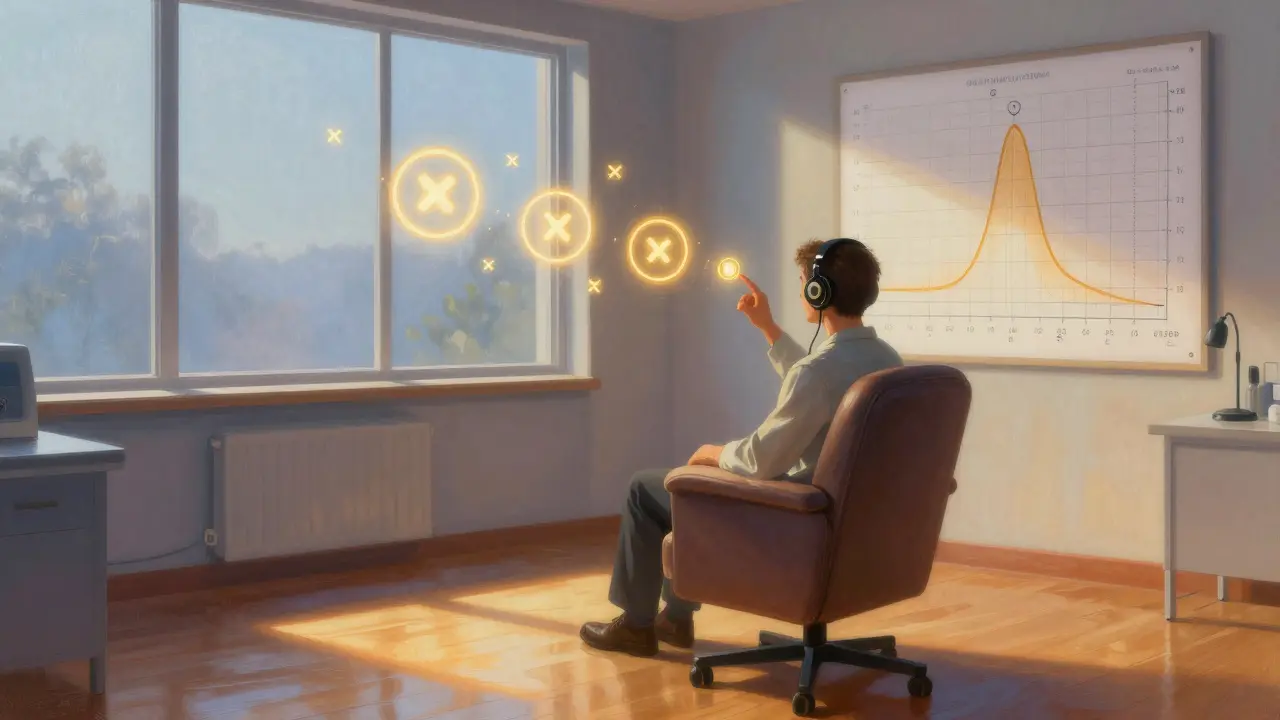
When you can’t hear the doorbell, struggle to follow conversations in noisy rooms, or always turn up the TV volume, it’s not just annoying-it might be a sign your hearing is changing. Audiometry testing is the most reliable way to find out exactly what’s going on. It’s not a guess. It’s a precise measurement of how well your ears respond to sound, using decibel levels to map your hearing ability across different pitches. This isn’t just for older adults. Kids, workers in loud environments, and even people with no obvious symptoms get tested because hearing loss often creeps in slowly-and catching it early makes all the difference.
What Happens During an Audiometry Test?
You sit in a quiet room, wear headphones, and press a button every time you hear a tone. That’s it. But behind that simple action is a highly controlled process. The test measures the softest sound you can hear at each frequency-from low rumbles at 250 Hz to high-pitched chirps at 8,000 Hz. These sounds are played at different volumes, measured in decibels hearing level (dB HL). The goal isn’t to hear every single tone, but to find the quietest one you catch about half the time. That’s called your threshold.
The test starts at 1,000 Hz, usually with a tone loud enough to hear clearly (around 40 dB). Then the audiologist turns it down by 10 dB until you no longer hear it. Then they go back up in 5 dB steps until you hear it again. This back-and-forth, called the modified Hughson-Westlake method, is the gold standard. It’s not random-it’s designed to find your true threshold with precision. The whole process takes about 10 to 15 minutes per ear.
Air Conduction vs. Bone Conduction: Why Both Matter
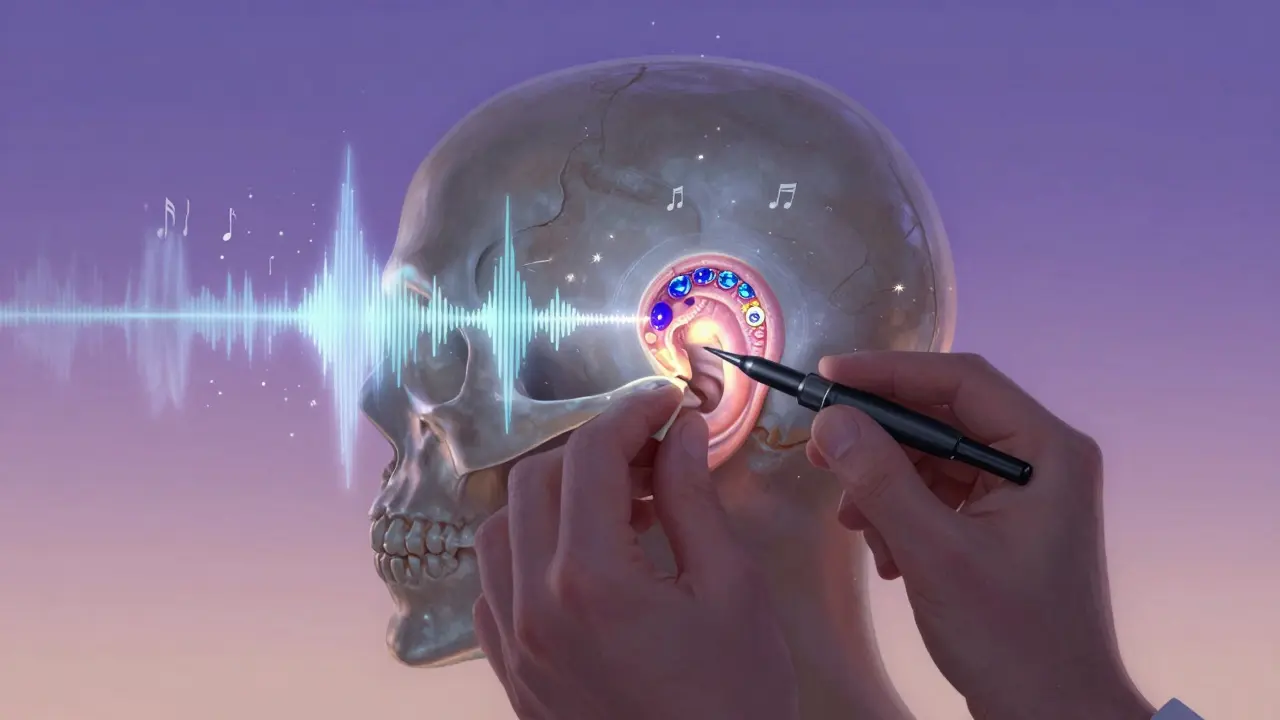
There are two ways sound can reach your inner ear: through the air (air conduction) or through your skull (bone conduction). Air conduction uses headphones and tests your entire hearing pathway-from outer ear to inner ear. Bone conduction skips the outer and middle ear entirely. A small device is placed behind your ear, on the mastoid bone, and sends vibrations directly to the cochlea.
This difference is critical. If your air conduction thresholds are worse than your bone conduction thresholds by 15 dB or more at multiple frequencies, you have a conductive hearing loss. That means something is blocking or disrupting sound before it reaches the inner ear-like earwax, fluid from an infection, or a damaged eardrum. If both air and bone conduction are equally poor, it’s sensorineural hearing loss, meaning the inner ear or auditory nerve is damaged. This could be from aging, noise exposure, or genetics. Knowing which type you have determines your treatment options.
What Do the Numbers on Your Audiogram Mean?
Your results are shown on a graph called an audiogram. The horizontal axis shows frequency (pitch), from low to high. The vertical axis shows volume in decibels, with 0 dB at the top-this is the quietest sound a person with normal hearing can detect. The lower the point on the graph, the louder the sound needs to be for you to hear it.
Normal hearing is defined as thresholds at or above 25 dB HL across all tested frequencies. Mild hearing loss is 26-40 dB. You might miss soft speech or consonants like “s” and “th.” Moderate loss (41-55 dB) means you struggle in group conversations. Severe loss (71-90 dB) makes speech nearly impossible without a hearing aid. Profound loss (91+ dB) means you hear only very loud sounds, if at all.
On the audiogram, circles represent your right ear’s air conduction, X’s for your left ear. Bone conduction is marked with brackets for the right ear and angled brackets for the left. These symbols aren’t just for show-they help audiologists quickly spot patterns. A gap between air and bone conduction? That’s conductive loss. A flat, low line across all frequencies? That’s likely sensorineural.
Speech Testing: Hearing Words vs. Hearing Tones
Hearing a tone isn’t the same as understanding speech. That’s why audiometry includes speech tests. First, the Speech Reception Threshold (SRT) finds the lowest volume at which you can repeat 50% of two-syllable words like “baseball” or “hotdog.” Your SRT should match your average pure-tone threshold at 500, 1,000, and 2,000 Hz-within 10 dB. If it doesn’t, something’s off.
Then comes the Word Recognition Score (WRS), also called speech discrimination. You listen to single-syllable words at a volume 25-40 dB above your threshold. A score of 90-100% is excellent. Below 70% suggests a problem deeper than just volume-maybe nerve damage or auditory processing issues. Someone might hear you fine in quiet, but if you’re talking fast or there’s background noise, their brain can’t keep up. That’s why two people with the same audiogram can have very different real-world hearing experiences.
Tympanometry and ABR: The Hidden Layers of Hearing
Audiometry doesn’t stop at tones and words. Tympanometry checks your middle ear. A small probe seals your ear canal and changes the air pressure while measuring how much your eardrum moves. A flat result (Type B) often means fluid behind the eardrum-common in kids with ear infections. A normal curve (Type A) means your middle ear is working right.
For babies, uncooperative patients, or people with neurological conditions, standard tests won’t work. That’s where Auditory Brainstem Response (ABR) comes in. Electrodes on the scalp record tiny electrical signals from the brain in response to clicks or tones. It doesn’t require you to respond. It’s objective. Newborns are screened with ABR in hospitals across the U.S. because early detection leads to better language development. If a baby fails the initial screen, they need a full diagnostic ABR by three months old.
Why Accuracy Matters: Calibration and Standards
Audiometers aren’t like regular speakers. They’re medical devices calibrated to strict standards. ANSI S3.6-2018 defines exactly how much sound pressure each frequency must produce at each decibel level. Equipment must be checked annually within ±3 dB. If it’s off, your results are wrong. That’s why you don’t get reliable results from phone apps or retail kiosks-they’re screening tools, not diagnostic.
Masking is another critical step. If one ear is much better than the other, the stronger ear might hear the tone meant for the weaker one. To prevent that, the audiologist plays noise in the good ear to block it out. Skipping masking leads to false results. About 12% of errors in audiometry come from improper masking, according to Mayo Clinic data. That’s why this test should only be done by a licensed audiologist, not a technician with minimal training.

Who Needs This Test-and When?
Anyone over 50 should get baseline testing. Hearing loss affects half of people over 75. But it’s not just age. If you work in construction, manufacturing, or music, you’re at risk. OSHA requires annual audiograms for employees exposed to 85 dB or more over an 8-hour shift. Even concertgoers or gym users who listen to loud music through headphones should consider testing.
Parents should watch for signs in kids: delayed speech, not responding to their name, turning up the TV, or seeming inattentive. The CDC recommends all newborns be screened before leaving the hospital. If they fail, diagnostic testing must happen by three months. Delaying beyond that increases the risk of permanent language delays.
People with diabetes, heart disease, or who take ototoxic drugs like certain antibiotics or chemotherapy (cisplatin) should get regular tests. These conditions can damage hearing silently. Some clinics now test up to 10,000 Hz for early signs of drug-induced hearing loss.
What to Expect After the Test
A good audiologist doesn’t just hand you a piece of paper with squiggly lines. They explain what the numbers mean in plain language. They show you on the audiogram where you’re losing hearing and how that affects your daily life. They discuss options: hearing aids, assistive devices, or medical referrals if something like an ear infection or tumor is suspected.
One patient said, “The audiologist showed me my audiogram and pointed to the 45 dB dip at 2,000 Hz. That’s where my wife’s voice gets fuzzy. I finally understood why I kept asking her to repeat herself.” That kind of clarity changes everything. It turns a vague frustration into a solvable problem.
Results are documented with standardized symbols and stored for future comparison. If you get a hearing aid, your next test will show whether it’s helping. If you’re monitoring noise exposure, trends over years tell you if your protection is working.
Challenges and Gaps in Access
Despite how effective audiometry is, access is uneven. Rural areas have far fewer audiologists-just 0.7 per 100,000 people compared to 2.3 in cities. That means long waits or traveling hours for a simple test. Tele-audiology is helping, especially for follow-ups, but diagnostic accuracy for very soft sounds still lags behind in-person testing.
And cost remains a barrier. Medicare doesn’t cover routine audiometry. Private insurance varies. Without coverage, a full diagnostic test can cost $200-$400. Many people delay testing because they don’t realize it’s often covered when tied to a medical diagnosis like tinnitus or vertigo.
Meanwhile, technology is advancing. AI tools now help interpret audiograms with 87% accuracy, flagging patterns of conductive loss. But they’re assistants, not replacements. The human audiologist still interprets context, patient history, and subtle cues no algorithm can see.
Hearing loss is the third most common chronic condition in the U.S., affecting 48 million people. Yet only 1 in 5 who could benefit from hearing aids actually use them. Often, it’s not about cost-it’s about not knowing there’s a fix. Audiometry testing is the first step to reclaiming your hearing-and your connection to the world around you.
How long does an audiometry test take?
A full diagnostic audiometry test usually takes 20 to 30 minutes per ear, including air and bone conduction, speech testing, and tympanometry. Screening tests are faster-around 5 to 10 minutes-but they don’t give a complete picture. If you’re getting a full evaluation, plan for about 45 minutes total.
Is audiometry testing painful?
No, it’s not painful. You might feel slight pressure from the earphones or the bone oscillator behind your ear, especially if you wear glasses. Some people find the bone conduction vibration uncomfortable, but it’s not harmful. The test is entirely non-invasive. You’re just listening and responding.
Can I do audiometry at home with a phone app?
Phone apps can give you a rough idea of your hearing, but they’re not reliable for diagnosis. Most aren’t calibrated to medical standards, background noise interferes, and earphones vary in output. The FDA and American Speech-Language-Hearing Association warn against using them for medical decisions. If you’re concerned about your hearing, see a licensed audiologist for accurate results.
What if my audiogram shows hearing loss?
Hearing loss doesn’t mean the end of clear communication-it means you need the right support. Depending on the type and severity, options include hearing aids, assistive listening devices, cochlear implants, or medical treatment for underlying issues like ear infections or wax buildup. Your audiologist will explain your options and help you choose based on your lifestyle, budget, and hearing goals.
How often should I get my hearing tested?
If you’re over 50, get tested every 2 to 3 years. If you’re exposed to loud noise regularly-like at work, concerts, or through headphones-get tested annually. If you already have hearing loss and use hearing aids, annual testing helps track changes and adjust your devices. Children with known hearing issues should be tested every 6 to 12 months.

Gerard Jordan
January 22, 2026 AT 08:57Just got my first audiogram back and honestly? I thought I was just bad at listening. Turns out I’m missing the high-end stuff-my dog’s whistle is basically a ghost sound now 😅. Glad I didn’t ignore it. Hearing aids aren’t for ‘old people’-they’re for people who still wanna hear their kid laugh.
Jerry Rodrigues
January 23, 2026 AT 21:21My dad’s audiogram looked like a mountain range. One ear was fine, the other was basically a silent movie. He got hearing aids and now he’s back to arguing about football without yelling. Weird how something so simple fixes so much.
Barbara Mahone
January 24, 2026 AT 13:58My job requires me to be in noisy warehouses all day. I ignored tinnitus for years until my audiogram showed a 30 dB dip at 4kHz. OSHA didn’t care until I brought the results. Now I get free earplugs and quarterly tests. Don’t wait until it’s too late.
lokesh prasanth
January 26, 2026 AT 02:07audiometry is just capitalism selling fear. you dont need a machine to know if you cant hear. just ask your wife. she always says you dont listen.
Coral Bosley
January 26, 2026 AT 16:04My husband thinks I’m being dramatic when I say I can’t hear him over the fan. Then he saw my audiogram. The dip at 3kHz? That’s where his voice goes to die. He cried. I didn’t. I just handed him a pair of Bluetooth earbuds and said, ‘Now you know why I’ve been pretending to be deaf since 2018.’
Dee Monroe
January 27, 2026 AT 22:14I used to think hearing loss was just part of aging, like gray hair or forgetting where I put my keys. But then I realized it wasn’t just about volume-it was about connection. The way my granddaughter’s voice used to ring through the house, the way my mom could still sing off-key in the kitchen, the way my best friend’s laugh used to feel like sunshine. When those sounds start fading, it’s not just your ears going quiet. It’s your world shrinking. Getting tested wasn’t about fixing a problem. It was about saving my relationships before they slipped away silently.
Sangeeta Isaac
January 29, 2026 AT 19:57so i tried that phone app thing bc i was too lazy to go to the audiologist. turns out my left ear heard like a bat and my right ear was basically a brick wall. the app said 'maybe see a pro.' yeah, no shit sherlock. i went. now i have hearing aids that look like tiny airpods. my mom says i look like a cyborg. i say i look like someone who can finally hear her cooking show yelling.
Alex Carletti Gouvea
January 31, 2026 AT 06:18Why are we even doing this? In my day, people just turned up the volume and got on with life. Now we’re running tests like we’re astronauts. I don’t need a graph to know I can’t hear my grandkids. I just need to ask them to repeat themselves five times. That’s enough.
Philip Williams
January 31, 2026 AT 14:06As a clinical educator, I’ve trained dozens of audiology students. The most common mistake? Underestimating the importance of masking. A single skipped step can lead to misdiagnosis. Audiometry isn’t just a test-it’s a precision science. Always seek a licensed professional, not a kiosk or an app.
Andrew Rinaldi
February 1, 2026 AT 21:37I used to think hearing loss was something that happened to other people. Then I realized I was the one who kept saying ‘what?’ during family dinners. My audiogram showed a classic noise-induced dip at 4kHz. I work in a warehouse. I thought earplugs were for wimps. Turns out they’re for people who still want to hear their kids say ‘I love you’ when they’re 30. I got fitted last week. It’s not a weakness. It’s a way to stay present.
Ben McKibbin
February 3, 2026 AT 13:33There’s a quiet revolution happening in audiology. AI can now flag patterns in audiograms with near-human accuracy-but it still can’t tell you why your patient stopped going to church because he couldn’t hear the hymns. Or why his wife cries when he asks her to repeat ‘I love you’ three times a night. The numbers matter. But the silence between them? That’s where the real story lives.