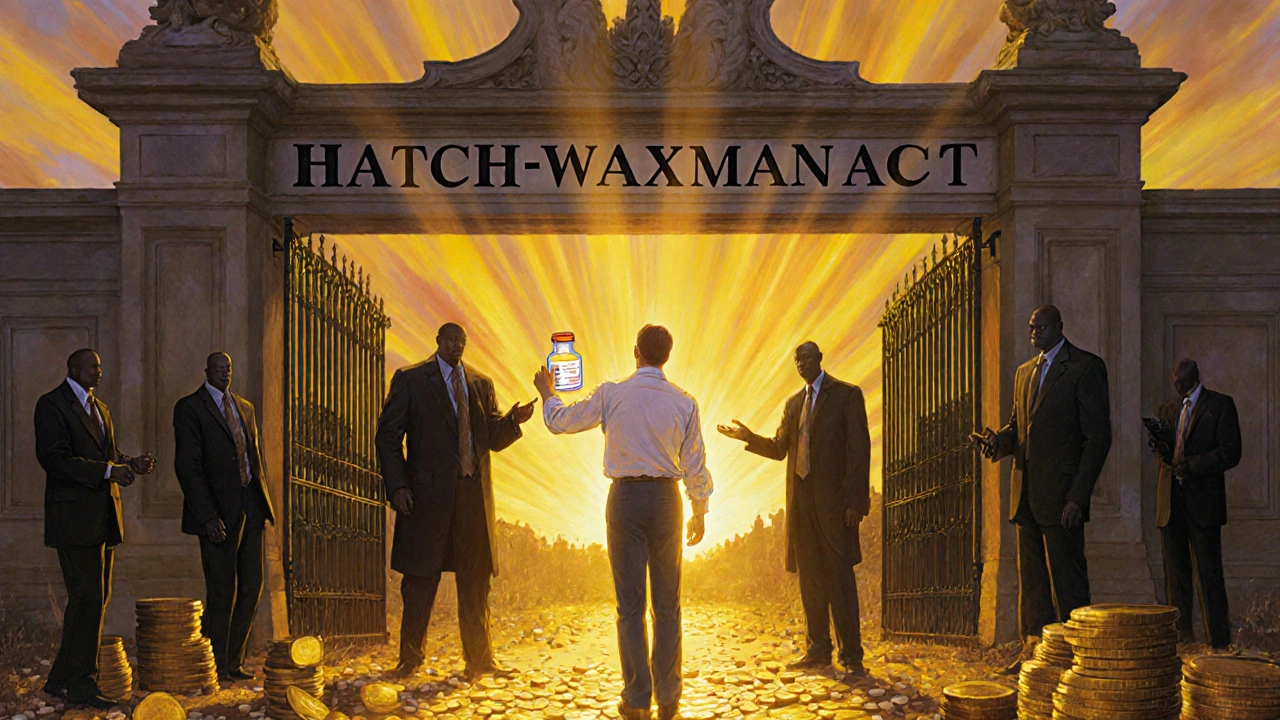
Generic drugs save Americans over $200 billion every year. That’s not a guess - it’s a fact backed by the Federal Trade Commission. But behind those savings is a quiet, complex battle between big pharma and the companies trying to bring cheaper versions of life-saving medicines to market. This isn’t just about price tags. It’s about rules - antitrust laws - designed to keep markets fair. And in the world of generic pharmaceuticals, those rules are constantly being tested, twisted, and sometimes broken.
How Generic Drugs Got Their Start
Before 1984, getting a generic drug approved in the U.S. was a nightmare. Companies had to run full clinical trials just to prove their version of a drug worked - the same tests the original maker had already done. That made it too expensive and too slow for most companies to bother. So, branded drugs held onto their monopoly for years, even after patents expired. That changed with the Hatch-Waxman Act a 1984 U.S. law that created a streamlined path for generic drug approval while protecting branded drug patents. Named after its sponsors, Senator Orrin Hatch and Representative Henry Waxman, the law let generic makers file an Abbreviated New Drug Application (ANDA). Instead of redoing clinical trials, they just had to prove their version was bioequivalent to the brand-name drug. It was a game-changer. The law also gave the first generic company to challenge a patent a 180-day exclusivity window. That meant they could be the only generic on the market for half a year - a big incentive to take on the legal risk of fighting a patent. By 2016, generic drugs made up 90% of all prescriptions filled in the U.S. Up from just 19% in 1984. The savings? Over $1.68 trillion between 2005 and 2014. One year alone - 2012 - saw $217 billion saved by patients and insurers.The Dark Side of the System
But the Hatch-Waxman Act didn’t just open the door for competition. It also created loopholes. And some branded drug companies learned how to exploit them. One of the biggest tricks? pay-for-delay agreements where branded drug companies pay generic manufacturers to delay launching their cheaper version. It sounds insane - why would a company pay someone not to compete? But the math works for them. If a branded drug brings in $1 billion a year and a generic cuts that by 80%, paying $200 million to delay the generic for a year is still a win. The FTC has been fighting these deals for decades. In 2013, the Supreme Court ruled in FTC v. Actavis that these payments could violate antitrust laws if they’re large and unexplained. Still, they kept happening. In 2023, Gilead Sciences paid $246.8 million to settle allegations of paying a generic maker to delay its HIV drug. Between 2000 and 2023, the FTC brought 18 pay-for-delay cases. Settlements totaled over $1.2 billion.Other Tactics to Block Generic Entry
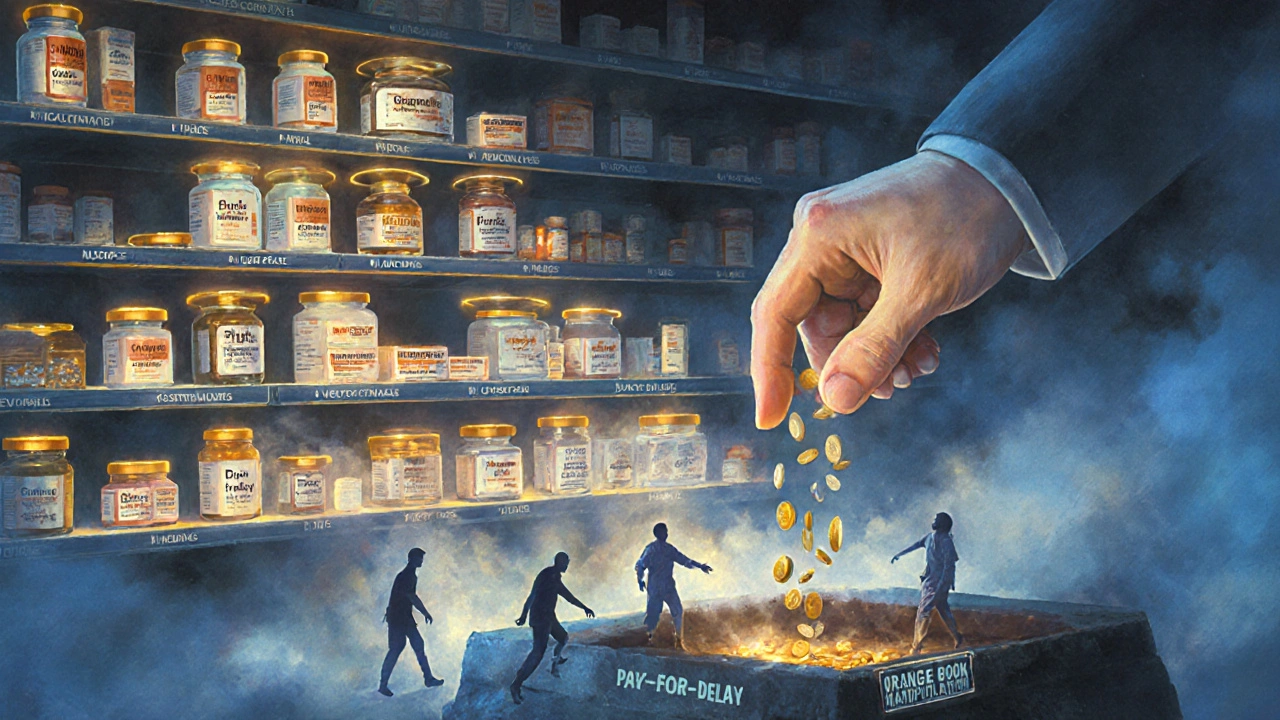
Pay-for-delay isn’t the only trick. There are several others, each more sneaky than the last.- Product hopping: When a company slightly changes a drug’s formulation - say, switching from a pill to a capsule - right before the patent expires. Then they convince doctors and pharmacies to switch patients over. The old version gets pulled from the market. The generic version? It can’t be substituted because it’s not the same formulation. AstraZeneca did this with Prilosec and Nexium. Courts didn’t always stop them.
- Sham citizen petitions: Companies file fake complaints with the FDA, claiming safety or efficacy issues with the generic version. These petitions often have no real scientific basis. But they tie up the approval process for months or years. In 2023, the FTC sued Teva Pharmaceuticals for filing dozens of these to delay a generic version of Copaxone, a multiple sclerosis drug.
- Orange Book manipulation: The FDA’s Orange Book lists all patents tied to a drug. Some companies list patents that don’t even cover the drug’s active ingredient - just the color of the pill or the packaging. That blocks generics from even starting their approval process. Bristol-Myers Squibb got hit with an FTC case in 2003 for doing exactly this.
- Restrictive distribution deals: Branded drug makers sign exclusive deals with distributors or pharmacies to block generics from getting shelf space. Some even require pharmacies to buy their branded drug in bulk to get access to other, more profitable drugs.
Global Differences in Enforcement
The U.S. isn’t the only place fighting this battle. But how they fight it varies. In the European Union a regulatory body that actively investigates pharmaceutical antitrust violations, especially around regulatory delays and disparagement, regulators focus more on how companies abuse the system. For example, some companies withdraw marketing authorizations in certain countries just to prevent generics from entering. Others make false claims about generics being less safe - a tactic called disparagement. The European Commission found that delays in generic entry cost European consumers €11.9 billion a year. In China a country that in 2025 introduced strict new antitrust guidelines targeting price fixing and algorithm-based collusion in pharmaceutical markets, the focus is on price fixing. In early 2025, China released new Antitrust Guidelines for the Pharmaceutical Sector. They identified five hardcore violations: price fixing, output limits, market division, joint boycotts, and blocking new technology. Six cases had already been penalized by Q1 2025 - five of them involved companies using messaging apps and algorithms to coordinate prices. Chinese regulators are now using AI to track suspicious pricing patterns online.Who Gets Hurt?
It’s easy to think of this as a fight between big corporations. But the real victims are patients. When a generic drug is delayed, prices stay high. A 2022 Kaiser Family Foundation survey found that 29% of U.S. adults skipped doses or didn’t fill prescriptions because they couldn’t afford them. That’s not just about money - it’s about health. For people with chronic conditions like diabetes, high blood pressure, or HIV, missing doses can lead to hospitalizations, complications, even death. The Congressional Budget Office estimates that generic competition cuts drug prices by 30% to 90%. That’s the difference between a $500 monthly pill and a $50 one. For many, that’s the difference between taking the medicine and not.
What’s Being Done Now?
The FTC is pushing for more transparency. In 2022, they held a workshop on generic drug entry after patent expiration. They’re calling for stricter rules on product hopping and citizen petitions. They’ve also asked Congress to limit the 180-day exclusivity window to one company - not multiple companies that team up to delay entry. Some states are stepping in. California and New York have passed laws requiring drug makers to disclose the reasons for price hikes. Others are creating public databases of patent listings to catch Orange Book abuses. The European Commission is pushing for faster generic approvals and stricter penalties for disparagement. China’s use of AI to monitor pricing could become a global model. But change is slow. Legal battles take years. And the stakes are huge - billions of dollars hang in the balance.Why This Matters Beyond Pharma
The fight over generic drugs isn’t just about pills. It’s a test case for how antitrust laws work in complex, regulated industries. If companies can delay competition in pharma - an industry where lives depend on affordable access - what’s stopping them from doing the same in medical devices, insulin pumps, or even cancer treatments? The tactics used here - pay-for-delay, product hopping, sham petitions - are being copied in other sectors. Once you see how they work in generics, you start seeing them everywhere. The Hatch-Waxman Act was meant to balance innovation and access. But when the system gets gamed, innovation becomes a shield for monopoly. And access becomes a privilege.What You Can Do
You don’t need to be a lawyer or a regulator to help. Here’s what you can do:- Ask your pharmacist if a generic version is available - and why it might not be.
- If your prescription is expensive, ask your doctor if there’s a generic alternative.
- Support policy changes that require transparency in drug pricing and patent listings.
- Speak up when you hear about drug price hikes. Patient voices matter.
Generic drugs aren’t just cheaper. They’re essential. And keeping them accessible isn’t just a legal issue - it’s a public health emergency.
What is the Hatch-Waxman Act and how does it affect generic drugs?
The Hatch-Waxman Act of 1984 created a legal pathway for generic drug manufacturers to bring cheaper versions of branded drugs to market without repeating expensive clinical trials. It lets them file an Abbreviated New Drug Application (ANDA) and offers 180 days of market exclusivity to the first company to challenge a patent. This law is why 90% of U.S. prescriptions are now filled with generics, saving consumers over $1.6 trillion since 2005.
What are pay-for-delay agreements and why are they illegal?
Pay-for-delay agreements happen when a branded drug company pays a generic manufacturer to delay launching its cheaper version. These deals prevent competition, keeping prices high. The U.S. Supreme Court ruled in 2013 that such payments can violate antitrust laws if they’re large and lack legitimate justification. The FTC has pursued over 18 of these cases since 2000, resulting in more than $1.2 billion in settlements.
How do companies use the Orange Book to block generics?
The FDA’s Orange Book lists patents tied to a drug. Some branded companies list patents that don’t actually cover the drug’s active ingredient - like patents for the pill’s color or packaging. These bogus listings block generic companies from starting their approval process. In 2003, the FTC successfully sued Bristol-Myers Squibb for doing this to delay generic versions of its heart drug.
What is product hopping and how does it hurt patients?
Product hopping is when a drug maker makes a minor change to a medication - like switching from a pill to a capsule - right before its patent expires. They then push doctors and pharmacies to switch patients to the new version, while pulling the old one from the market. Since generics can’t be substituted for the new version, patients lose access to cheaper options. AstraZeneca did this with Prilosec and Nexium, delaying generic competition for years.
How is China tackling antitrust issues in generic drug markets?
In January 2025, China released new Antitrust Guidelines for the Pharmaceutical Sector that identify five hardcore violations, including price fixing and algorithm-based collusion. By Q1 2025, six cases had been penalized - five involved companies using messaging apps and digital tools to coordinate prices. Chinese regulators are now using AI to monitor pricing trends online, making it harder for companies to hide collusion.
Why do generic drugs cost so much less than branded ones?
Generic drugs cost less because they don’t need to repeat the expensive clinical trials the original drug maker did. They only need to prove they’re bioequivalent - meaning they work the same way in the body. That cuts development costs by up to 90%. Plus, once multiple generics enter the market, competition drives prices down further. On average, generics cost 30% to 90% less than their branded counterparts.
What impact do delayed generic entries have on patient health?
When generic drugs are blocked from entering the market, patients pay more - and many can’t afford their prescriptions. A 2022 Kaiser Family Foundation survey found that 29% of U.S. adults skipped doses or didn’t fill prescriptions due to cost. For chronic conditions like diabetes or high blood pressure, skipping medication can lead to hospitalizations, complications, and even death. Every year of delay costs lives.

Erin Nemo
December 1, 2025 AT 04:48Just got my generic blood pressure med for $4 at Walmart. Branded version? $400. No brainer.
Alexander Williams
December 2, 2025 AT 01:30It's worth noting that the Hatch-Waxman Act's 180-day exclusivity window is a regulatory distortion masquerading as market incentive. The structural asymmetry it creates-granting monopolistic rents to the first filer while disincentivizing subsequent entrants-is not antitrust enforcement; it's rent-seeking codified. The FTC's enforcement actions are performative, given that the statute itself enables the very behavior it purports to condemn.
The notion that bioequivalence is sufficient for therapeutic interchangeability is a pharmacoeconomic fallacy. Pharmacokinetic parameters do not capture interpatient variability in metabolizing enzymes, nor do they account for excipient-mediated bioavailability shifts across populations. The FDA's ANDA framework is a statistical abstraction, not a clinical guarantee.
Furthermore, the economic narrative surrounding generic savings is misleading. Aggregate savings are inflated by volume effects, but per-unit price erosion is often offset by increased utilization and downstream healthcare expenditures-hospitalizations due to non-adherence, ER visits from polypharmacy interactions, etc. The true cost-benefit analysis is rarely performed with methodological rigor.
Pay-for-delay settlements, while distasteful, are economically rational under current IP law. If the patent is valid, and the generic challenger bears the litigation risk, then compensation for delayed entry is not a bribe-it's a risk premium. The Actavis decision was a judicial overreach that conflated economic efficiency with moral outrage.
Product hopping, while ethically dubious, is a legitimate lifecycle management strategy. If the new formulation offers clinical advantages-even marginal ones-physician preference and formulary placement are market outcomes, not market failures. The FDA's role should be to assess safety and efficacy, not to arbitrate commercial competition.
Orange Book listings are a procedural tool, not a weapon. If companies abuse the system by listing non-essential patents, the remedy lies in administrative review, not litigation. The FTC's crusade against patent thickets ignores the fact that patent law itself grants such rights. The problem isn't the actors-it's the framework.
China's AI-driven antitrust surveillance is a dystopian precedent. Algorithmic price monitoring implies state control over market signals, which undermines the very notion of competitive pricing. The U.S. should not emulate authoritarian regulatory models under the banner of consumer protection.
Ultimately, the real issue is not generic access-it's the lack of price transparency and the absence of universal healthcare. Blaming pharma for exploiting legal loopholes is a distraction from the systemic failure of our insurance-based model.
Rachel Stanton
December 3, 2025 AT 03:08Alexander makes some technically valid points about bioequivalence thresholds and regulatory capture-but he's missing the human cost. The FDA's ANDA pathway isn't perfect, but it's the only reason millions of diabetics can afford insulin. We don't need to dismantle the system-we need to fix the loopholes.
Those 180-day exclusivity windows were meant to incentivize patent challenges, not become a cartel tool. The FTC's push to limit it to one filer is long overdue. And yes, Orange Book abuse is rampant. I've seen pharmacies reject generics because the patent listing was outdated but still flagged in their system.
Product hopping? It's not just about switching formulations-it's about forcing prescribers to retrain, pharmacists to re-educate, and patients to re-learn how to take their meds. That's not innovation. That's obstruction.
And China's AI monitoring? It's not dystopian-it's pragmatic. When companies use Telegram groups to fix prices, you need tech to catch tech. The U.S. is still using spreadsheets.
We can preserve innovation and ensure access. But we have to stop pretending these tactics are ‘business strategy’ and call them what they are: predatory.
Suzanne Mollaneda Padin
December 3, 2025 AT 04:36As someone who worked in global regulatory affairs for a mid-sized generic manufacturer, I can tell you: the real bottleneck isn't pay-for-delay-it's the FDA's backlog on ANDAs. We submitted a simple generic version of a common antihypertensive in 2021. Took 3.5 years. Meanwhile, the brand kept raising prices. No one paid us to wait. The system just... slowed down.
And the Orange Book? We had a patent listed for ‘a blue capsule with a scored line.’ No active ingredient. Just a design patent. We couldn't even start our bioequivalence study until it was removed-after 14 months of appeals.
China's approach is scary, but effective. We had a client in India get hit with a price-fixing fine because their pricing algorithm matched a competitor's too closely. They didn't talk-they just both adjusted prices every Monday. AI caught it.
Here's what we need: mandatory public disclosure of all Orange Book patents within 30 days of filing, and a 12-month cap on FDA review for ANDAs. If they can't review it in a year, the patent is voided for generic entry.
And stop calling it ‘generic.’ It's a bioequivalent. That's the science. That's the truth.
Bonnie Youn
December 5, 2025 AT 04:31Stop overcomplicating this. People are dying because they can't afford their meds. Period. If a company pays another company to not sell a cheaper version of a lifesaving drug, that's not a business deal-that's a crime. And if you're defending it with jargon, you're part of the problem. We need real consequences, not workshops. Wake up.
ariel nicholas
December 5, 2025 AT 16:10Who gave the government the right to decide what’s ‘fair’ pricing? The free market doesn’t care about your ‘public health emergency’-it cares about supply, demand, and innovation! You want cheaper drugs? Stop subsidizing Big Pharma with patent monopolies! Let the market crush them! Instead, you’ve created a rigged system where the FTC picks winners and losers-and calls it justice! Pathetic! The Hatch-Waxman Act is a socialist scam disguised as pro-consumer policy! If you can’t afford your meds, get a better job-or die! That’s capitalism! You want free medicine? Move to Venezuela!
Lauryn Smith
December 5, 2025 AT 16:24I just want to say-thank you to everyone who’s fighting to make these drugs affordable. I’m a single mom with Type 1 diabetes. My insulin was $500 a month. Now it’s $35 thanks to a generic. I don’t know all the legal terms. I just know I’m alive because someone fought for this. Please keep pushing. We see you.
Charlotte Collins
December 6, 2025 AT 17:17It's fascinating how the same people who scream about ‘government overreach’ when it comes to mask mandates suddenly become ardent advocates for federal intervention in pharmaceutical pricing. The cognitive dissonance here is breathtaking. The FTC’s enforcement is not about fairness-it’s about controlling market outcomes under the guise of consumer protection. The real villain isn’t the pharma company paying a generic to delay-it’s the regulatory architecture that made such payments necessary in the first place. You can’t fix a broken system by throwing more regulators at it-you need to dismantle the incentives that created the problem.
And yet, the emotional rhetoric-‘people are dying’-is weaponized to bypass rational policy debate. That’s not activism. That’s manipulation.
Amber-Lynn Quinata
December 7, 2025 AT 00:34How can you sleep at night knowing you’re letting people die for profit?! 😭💔 I’m not even mad-I’m heartbroken. If you’re defending this, you’re part of the problem. I hope your kids need insulin one day. I hope they cry because they can’t afford it. Then you’ll understand. 🤕🩺
Edward Hyde
December 7, 2025 AT 16:52Big Pharma’s playbook is so predictable it’s boring. Pay-for-delay? Check. Product hopping? Check. Orange Book gaming? Please, I’ve seen the same shit since 2012. It’s like watching a bad Netflix crime drama where the villains never get caught. The only thing more pathetic than the tactics is how long it takes for anyone to do anything about it. Meanwhile, I’m paying $200 for a pill that costs $3 to make. And you want me to applaud the ‘free market’? Nah. I’ll just keep my mouth shut and take my meds… if I can afford them.