PAMORA Selection Tool
PAMORA Selection Tool
Select your specific situation to find the most appropriate PAMORA for managing opioid-induced constipation without affecting pain relief.
Recommended for:
Key Benefits
- Onset:
- Dose:
- Half-life:
Important Considerations
When someone takes opioids for chronic pain or after surgery, they often get stuck - not just in pain, but in constipation. Up to 80% of people on long-term opioids develop opioid-induced constipation (OIC). It’s not just uncomfortable. It can lead to hospital visits, reduced quality of life, and even stopping pain treatment altogether. Traditional laxatives? They often fail. That’s where Peripherally Acting Mu-Opioid Receptor Antagonists (PAMORAs) come in. These aren’t just another laxative. They’re precision tools designed to block opioid effects in the gut - without touching the pain relief in your brain.
Why Opioid Constipation Is Different
Opioids don’t just dull pain. They bind to mu-opioid receptors all over the body, including the gut. These receptors control how fast food moves through your intestines, how much fluid gets absorbed, and whether your bowels contract. When opioids activate them, everything slows down. Stools get hard, movement stops, and you’re stuck.
Unlike regular constipation, OIC doesn’t respond well to fiber, water, or stimulant laxatives. A 2019 analysis from the NCI Bookshelf found less than 30% of chronic opioid users get regular bowel movements with standard treatments. That’s why doctors needed something smarter.
How PAMORAs Work - And Why They Don’t Kill Pain Relief
PAMORAs are built to do one thing: block opioid receptors in the gut, and nowhere else. They’re designed to be too large or too charged to cross the blood-brain barrier. That means they sit in your intestines and fight the opioid effect locally, without interfering with pain control in your brain.
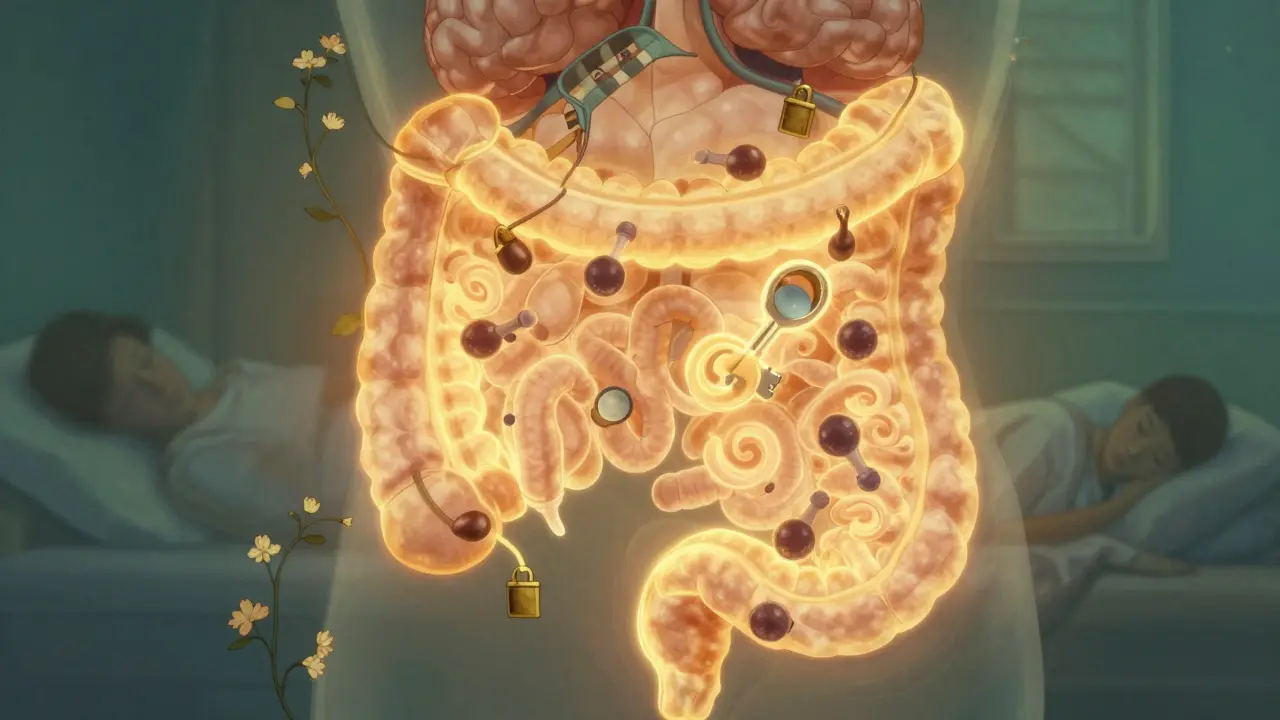
Think of it like this: your brain is a locked room. Opioids get in and block pain signals. PAMORAs? They’re like a key that only fits the locks on your gut doors. They unlock the bowel without touching the brain’s locks. This is why patients can stay on their pain meds and still have regular bowel movements.
The Three Main PAMORAs - Side by Side
There are three FDA-approved PAMORAs, each with unique features:
| Drug Name | Brand | Form | Dose | Onset | Half-Life | Key Use Case |
|---|---|---|---|---|---|---|
| Methylnaltrexone | RELISTOR | Injection or Oral Tablet | 0.15 mg/kg SC or 450 mg oral | 30 min - 1 hour | 1.8 - 2.5 hours | Cancer and noncancer chronic pain |
| Naloxegol | MOVANTIK | Oral Tablet | 25 mg daily | 2.5 hours | 8 - 13 hours | Noncancer chronic pain |
| Naldemedine | SYMPROIC | Oral Tablet | 0.2 mg daily | 1 - 2 hours | 11 hours | Noncancer chronic pain |
Methylnaltrexone is the only one available as both a shot and a pill. It’s often used in cancer patients because it works fast and doesn’t need daily dosing. Naloxegol and naldemedine are daily pills, better suited for long-term use in noncancer pain.

How Effective Are They?
Clinical trials show real results:
- Methylnaltrexone: 52.4% of patients had a bowel movement within 4 hours - compared to just 30.2% on placebo.
- Naloxegol: 44.4% of patients had spontaneous bowel movements at 12 weeks - vs. 31.4% on placebo.
- Naldemedine: 47.6% response rate at 12 weeks - vs. 34.6% on placebo.
These aren’t minor improvements. They’re life-changing for people who were stuck for months. On patient forums, many say: “I finally stopped dreading my bowel movements.”
Who Shouldn’t Take Them?
PAMORAs are powerful - but not for everyone. They’re contraindicated if you have a bowel obstruction. That’s a hard rule. If your gut is physically blocked, these drugs can make things worse.
Also, they’re not safe for people with severe kidney problems. Naloxegol is outright banned in severe renal impairment. Methylnaltrexone needs a dose cut in half. Naldemedine is safer here, but still needs caution.
And while they don’t affect brain pain relief in most cases, a small number of people report increased pain or cramping. Around 32% of negative reviews mention abdominal pain. That’s not common, but it’s real.
Cost and Access - The Hidden Barrier
Here’s the tough part: these drugs cost $5,000 to $6,000 per year without insurance. That’s more than most people can afford. Even with insurance, copays can hit $450 a month.
On Drugs.com, users report mixed results. Methylnaltrexone has a 5.8/10 rating. Naloxegol is slightly better at 6.2/10. One patient wrote: “It worked for two weeks, then stopped. I paid $450 a month for nothing.”
But for cancer patients on palliative care? The story’s different. On Reddit’s r/palliativecare, 65% of users said methylnaltrexone “improved quality of life.” For them, it’s not about cost - it’s about dignity.

How to Use Them Right
Timing matters. The best results happen when the PAMORA is taken about an hour before your opioid dose peaks. That’s when gut receptors are most active. If you take it too late, it won’t work as well.
Doctors often underdose at first. A 2022 survey found 78% of pain specialists started too low. It takes 2-3 weeks to find the right dose. Don’t give up after a few days. Talk to your provider about adjusting.
For methylnaltrexone injections: the first dose is usually given in a clinic. After that, many patients learn to self-inject. Oral tablets? You can start those at home.
What’s Next?
Research is moving fast. In January 2023, a new 300 mg tablet of methylnaltrexone was approved for patients who don’t respond to standard doses. The NIH is testing a combo drug that blocks opioid receptors and stimulates gut movement - early results show a 68% response rate.
Biosimilars are coming too. A Chinese company has started phase 3 trials for a methylnaltrexone copy. If it gets approved in the U.S., prices could drop by half.
But here’s the catch: without major price cuts, only 35-40% of people who need PAMORAs will ever get them. That’s a problem. These drugs fix the root cause of constipation - not just the symptoms. They should be accessible, not a luxury.
Final Thought
Opioid constipation isn’t just a side effect. It’s a treatment killer. PAMORAs change that. They’re not perfect. They’re expensive. They can cause cramps. But for many, they’re the only thing that lets them live normally while staying on pain relief. If you’re stuck - and laxatives aren’t working - ask your doctor about PAMORAs. It might be the key to getting your life back.
Do PAMORAs reduce pain relief?
No, not when used correctly. PAMORAs are designed to act only in the gut and cannot cross the blood-brain barrier in effective amounts. Clinical trials and real-world use confirm that pain control remains intact. A 2020 review in Dove Press found no significant reduction in opioid analgesia at standard doses. However, very high doses or misuse could theoretically reduce pain relief - which is why dosing should always be guided by a healthcare provider.
Can I take PAMORAs with other laxatives?
Yes, but it’s usually not necessary. PAMORAs are meant to replace traditional laxatives, not add to them. Most patients don’t need additional stool softeners or stimulants. If you’re still struggling after 7-10 days on a PAMORA, your doctor may add a mild osmotic laxative like polyethylene glycol. But combining multiple bowel stimulants increases the risk of cramping and dehydration.
Why is methylnaltrexone available as both a shot and a pill?
The injection works faster and is more reliable in patients with poor gut absorption - common in cancer patients or those on high-dose opioids. The oral form is easier for long-term use in noncancer pain. Both deliver the same drug, but the injection bypasses the gut entirely, ensuring consistent absorption. This dual form gives doctors flexibility based on patient needs.
Are PAMORAs safe for elderly patients?
Yes, but with caution. Older adults are more likely to have kidney issues or take multiple medications. Naloxegol is contraindicated in severe kidney disease, and methylnaltrexone needs dose adjustments. Naldemedine is often preferred in older patients because it’s once-daily and has fewer drug interactions. Always check kidney function before starting any PAMORA.
Is there a generic version of these drugs?
No generics are available yet in the U.S. as of 2026. Methylnaltrexone’s patent expires in 2027, and biosimilar development is underway in China and Europe. Until then, patient assistance programs from manufacturers (like RELISTOR’s copay card) can reduce costs by up to 80%. Always ask your pharmacist about savings options.

Levi Viloria
February 28, 2026 AT 18:30Cost is insane though. $500 a month? I'm lucky my insurance covers it.
Megan Nayak
March 1, 2026 AT 15:01Meanwhile, real solutions like physical therapy, acupuncture, or even just lowering the opioid dose? Nah. Too cheap.
Diane Croft
March 3, 2026 AT 03:28Chris Beckman
March 4, 2026 AT 14:38Siri Elena
March 6, 2026 AT 14:22Meanwhile, the patient who can't afford it is still sitting on a toilet for 45 minutes while their kidneys fail from dehydration. Classy.
Richard Elric5111
March 7, 2026 AT 00:15Yet one must ask: if we can so precisely isolate gut function from cerebral function, are we not, in essence, commodifying the human organism into modular components? And if so - at what cost to the integrity of the self?
Tildi Fletes
March 8, 2026 AT 14:35Ivan Viktor
March 8, 2026 AT 21:10Divya Mallick
March 8, 2026 AT 21:52Stephen Vassilev
March 9, 2026 AT 10:39Instead, we invent a $6000 band-aid. And call it innovation.
Meanwhile, 14% of Americans can't afford their meds. And we're debating which $6000 drug is 'better'?
Raman Kapri
March 9, 2026 AT 12:47Donna Zurick
March 11, 2026 AT 08:58