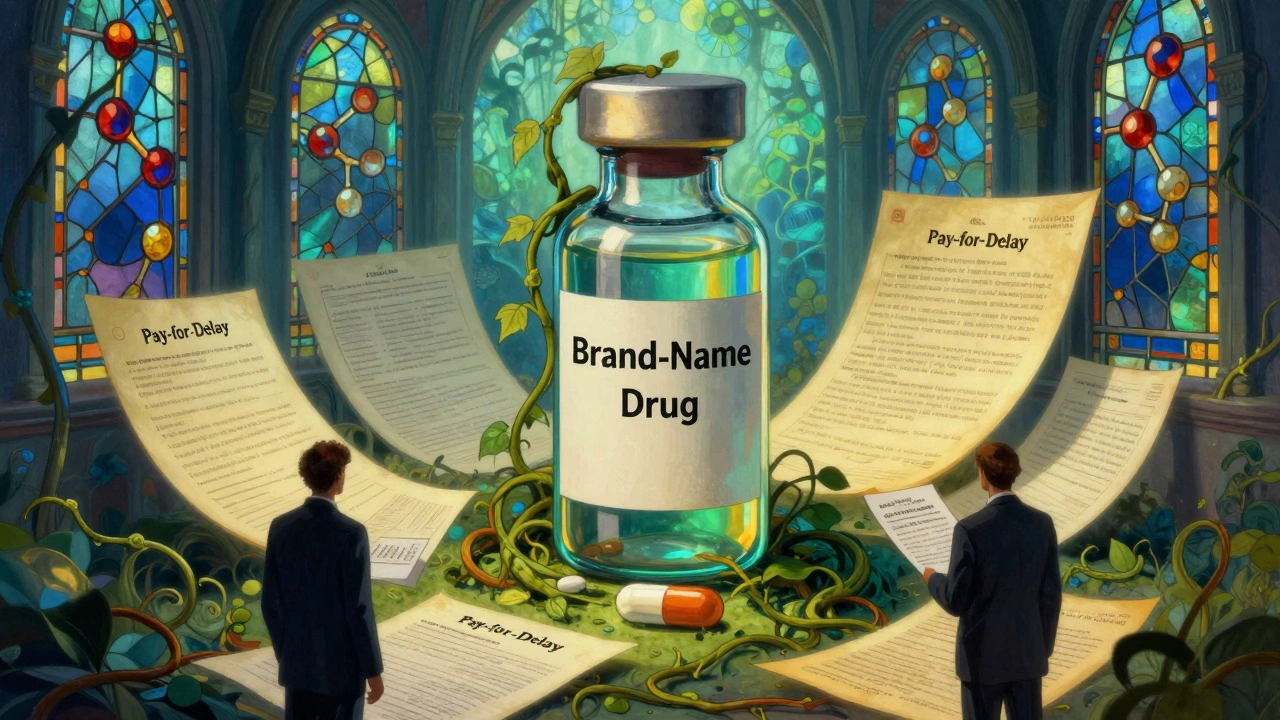
Not every brand-name drug has a generic version-even after the patent runs out. You might assume that once a drug’s patent expires, cheaper copies automatically appear on shelves. But that’s not always true. Some medications remain expensive for years, sometimes decades, after their patent protection ends. Why? It’s not just about patents. It’s about complex chemistry, legal loopholes, manufacturing nightmares, and business strategies designed to keep prices high.
Patents Aren’t the Whole Story
Most people think patents are the only thing blocking generics. And yes, a 20-year patent gives the original company exclusive rights to make and sell the drug. But patents aren’t the full picture. Many drugs still don’t have generics even after patents expire. That’s because companies use other tools to extend their monopoly. The Hatch-Waxman Act of 1984 was meant to speed up generic approvals. But it also gave drugmakers extra tricks. They can get an extra five years of exclusivity if they’re a new chemical entity. They can get six more months if they test the drug on kids. Some companies file dozens of secondary patents-on coating, dosage form, delivery method, even packaging. These aren’t new drugs. They’re tiny tweaks. But they still block generics. This is called patent thickets. One study found these tactics add an average of 3.2 years of extra monopoly time. Take Nexium (esomeprazole). The original drug, Prilosec (omeprazole), lost its patent in 2001. But AstraZeneca kept selling Nexium-a slightly different version of the same molecule-until 2014. They didn’t make a better drug. They just repackaged the old one. And because it was a new patent, generics couldn’t enter until then.Some Drugs Just Can’t Be Copied
Not all drugs are made the same way. Simple pills with one active ingredient? Easy to copy. But some drugs are made from living cells, complex mixtures, or natural sources that can’t be perfectly replicated. Premarin, a hormone therapy for menopause, is made from the urine of pregnant mares. It contains a mix of 10 or more estrogen compounds, many of which aren’t fully identified. No lab can recreate that exact blend. Even though the patent expired decades ago, there’s still no true generic. Generic manufacturers can’t prove they’re making the same thing. The FDA won’t approve it. Biologics are another category that’s nearly impossible to copy exactly. Drugs like Humira (adalimumab) and Enbrel (etanercept) are made from living cells, not chemicals. They’re huge, complex proteins. You can’t just mix ingredients in a vat like you would with aspirin. Instead, we have biosimilars-close copies that still need years of testing to prove they work the same. The first Humira biosimilar didn’t hit the U.S. market until 2023, even though the patent expired in 2016. That’s a seven-year delay.Manufacturing Is a Hidden Barrier
Even if the active ingredient is simple, how it’s delivered can be a roadblock. Think about inhalers like Advair Diskus or nasal sprays. The drug isn’t just the chemical. It’s the spray mechanism, the propellant, the way the particles are sized and delivered to your lungs. Change the nozzle by a fraction of a millimeter, and the dose you get changes. The FDA requires generics to prove they deliver the same amount of medicine to the same place in the body. That’s hard. It takes more testing. More time. More money. Same with extended-release pills. Prozac Weekly, for example, releases the drug slowly over seven days. A generic version has to match that exact timing. If it releases too fast, you get side effects. Too slow, and it doesn’t work. Minor differences in inactive ingredients-like fillers or coatings-can change how the drug behaves. That’s why some generics take years longer to appear.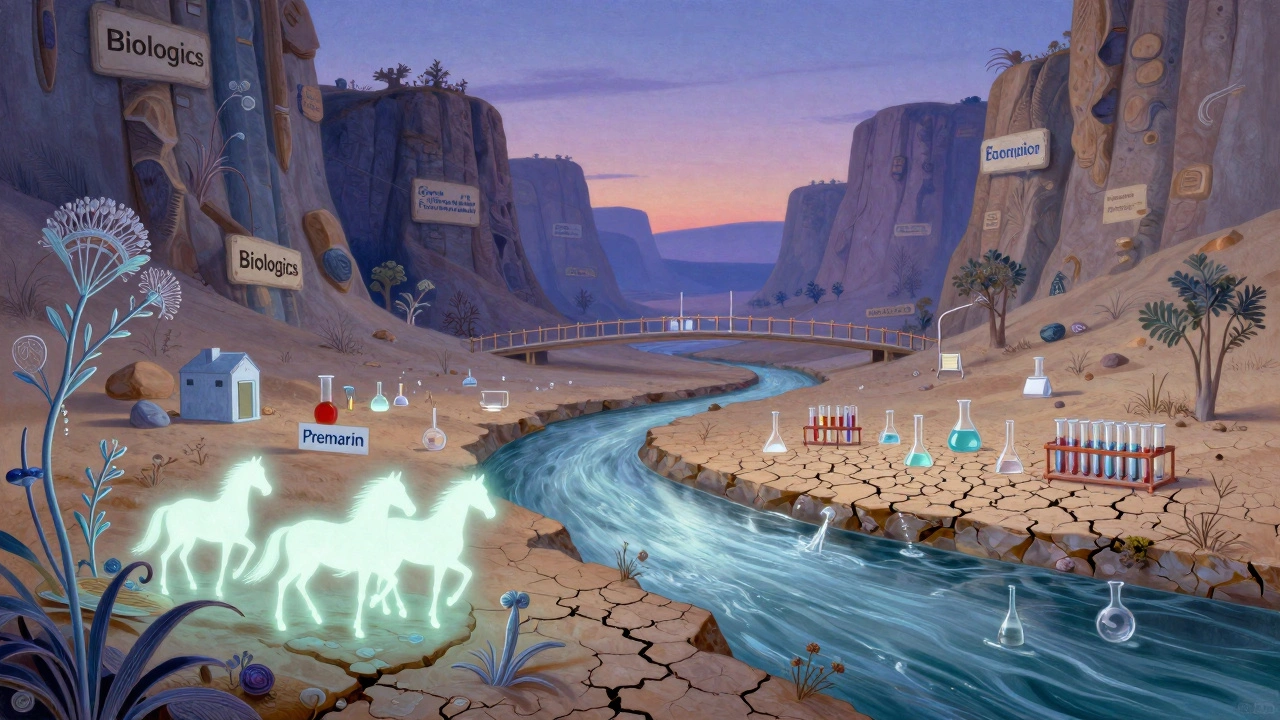
Companies Block Generic Entry on Purpose
Sometimes, the barrier isn’t science. It’s strategy. One tactic is called product hopping. A company makes a small change to its drug-switching from a pill to a tablet, changing the dosage, or adding a digital tracker-right before the patent expires. Then they convince doctors and patients to switch to the new version. They stop making the old one. Generics can’t enter because there’s no original product left to copy. The FDA still approves the new version as the same drug, but it resets the clock. EpiPen is a classic example. Mylan made minor design changes to the auto-injector over the years. Even after patents expired, they kept the original version off the market. No generic could be approved because there was no standard version to match. Then there’s pay-for-delay. Big drug companies pay generic manufacturers to stay out of the market. The FTC found 297 of these deals between 1999 and 2012. In one case, a brand-name company paid a generic maker $200 million to delay launching a cheaper version for a year. These deals cost consumers an estimated $3.5 billion a year.Why It Matters for Patients
The cost difference isn’t small. A brand-name drug with no generic can cost 3 to 6 times more than a generic version. GoodRx found that drugs without generics cost, on average, 437% more than those with generics. Take Gleevec, a leukemia drug. Before its patent expired in 2016, patients paid $14,500 a month. After generics arrived, the price dropped to $850. That’s a 94% drop. For people on Medicare or without insurance, that difference is life or death. But even when generics exist, not all are equal. Some patients report that generic versions of seizure meds like lamotrigine or thyroid meds like levothyroxine don’t feel the same. That’s because these drugs have a narrow therapeutic index-small changes in dosage can cause serious side effects or make the drug ineffective. The FDA allows generics to vary by up to 20% in how much of the drug enters your bloodstream. For some patients, that’s enough to cause problems. Medicare data shows that 22% of people taking drugs with no generic spend over $5,000 a year out of pocket. For those with generics, it’s only 8%.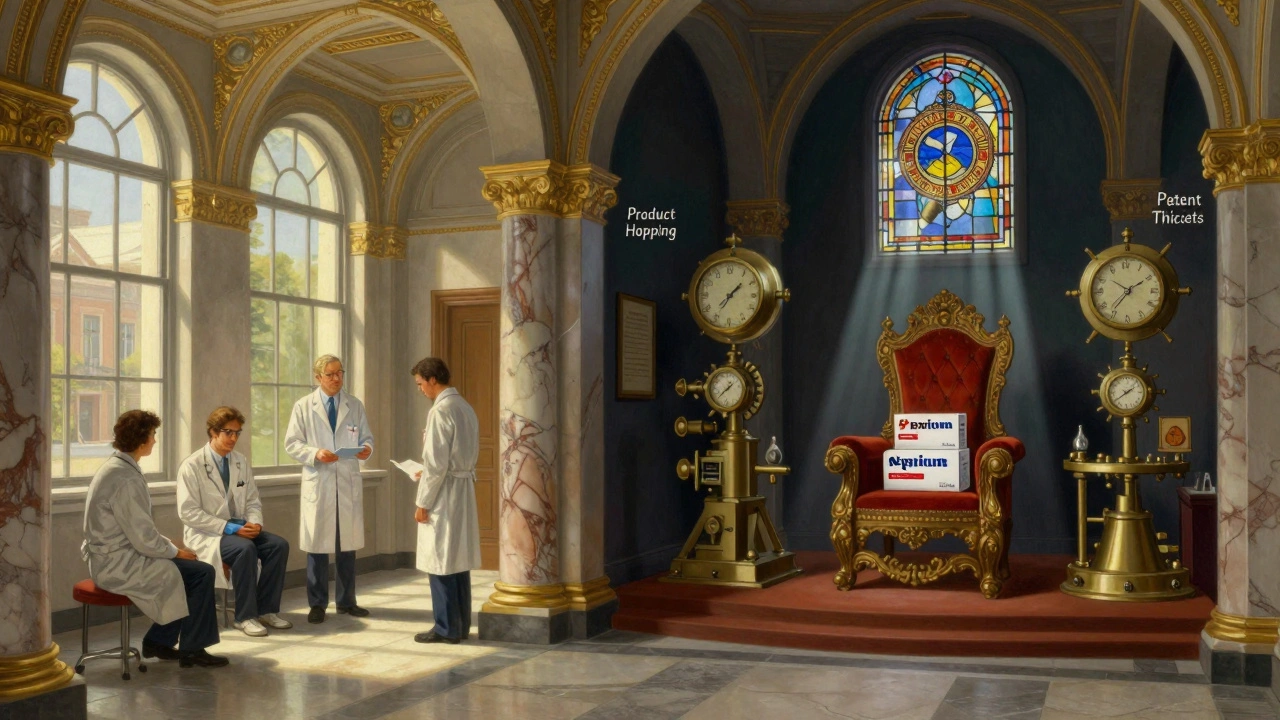
What’s Changing? What’s Not
There’s some progress. The CREATES Act of 2019 stops brand-name companies from refusing to sell samples to generic makers-something they used to do to delay testing. The FDA is also speeding up reviews of complex generics. In 2022, approvals for these drugs jumped 27% from the year before. Biosimilars are growing too. There were 32 approved in 2022. By 2025, that number is expected to hit 75. But even with these changes, some drugs will never have generics. Ultra-complex biologics-like those for rare cancers or autoimmune diseases-are so hard to replicate that true generics may never come. Same with orphan drugs for tiny patient groups. The market is too small for generic companies to invest in the expensive testing required.What Can You Do?
If you’re taking a brand-name drug with no generic, you’re not stuck. Talk to your doctor. Sometimes, there’s another drug in the same class that does the same job but has a generic version. For example, if you’re on Viibryd (vilazodone) for depression, your pharmacist might suggest switching to sertraline, which is generic and just as effective for most people. Check the FDA’s Orange Book. It lists every drug, its patents, and when exclusivity ends. You can see if a generic is coming. Pharmacists can help you find this info. And if you’re paying too much, ask about patient assistance programs. Many drugmakers offer discounts if you can’t afford their brand-name drug-even if there’s no generic yet.The Bottom Line
Generic drugs save billions every year. But they’re not automatic. Some drugs stay expensive because they’re too hard to copy. Others stay expensive because companies fight to keep them that way. The system was designed to reward innovation. But too often, it rewards delay. The good news? Most drugs will eventually get generics. The bad news? For some, it might take years-or never happen. Understanding why helps you ask the right questions, push for alternatives, and make smarter choices about your care.Why don’t all brand-name drugs have generic versions after the patent expires?
Even after a patent expires, generics may not appear because of complex drug formulations, manufacturing challenges, legal tactics like patent thickets, or pay-for-delay deals. Some drugs, like biologics or those made from natural sources, can’t be exactly replicated. Companies may also stop selling the original version and push a slightly modified one, blocking generic entry.
Can a generic drug be different from the brand-name version?
Yes, but only in inactive ingredients like fillers, dyes, or coatings. The active ingredient must be identical. The FDA requires generics to deliver the same amount of medicine into the bloodstream within 80%-125% of the brand-name drug. For most people, this works fine. But for drugs with narrow therapeutic windows-like seizure or thyroid meds-even small differences can affect how well they work or cause side effects.
What is a biosimilar, and how is it different from a generic?
A biosimilar is a close copy of a biologic drug, which is made from living cells. Unlike traditional generics that copy simple chemical molecules, biosimilars can’t be exact copies because biologics are too complex. They must go through extensive testing to prove they work similarly. Biosimilars are approved under a different FDA pathway and require 12 years of data exclusivity for the original drug before they can enter the market.
What is product hopping, and how does it delay generics?
Product hopping is when a drug company makes a minor change to its drug-like switching from a pill to a tablet or adding a new delivery system-right before the patent expires. Then they stop making the original version and push doctors and patients to switch. Since generics can only copy the original, the change blocks them from entering the market. This tactic delays competition for 12-18 months per switch.
Are there any laws to stop companies from blocking generics?
Yes. The CREATES Act of 2019 prevents brand-name companies from refusing to sell drug samples to generic makers, which they used to do to delay testing. The FTC also investigates and blocks pay-for-delay deals, where brand companies pay generics to stay off the market. The FDA has also sped up reviews of complex generics under GDUFA III, approving 27% more in 2022 than in 2021.
Will all drugs eventually have generics?
Most will, but not all. Experts estimate that by 2030, 95% of drug categories will have generics. But about 5%-mainly ultra-complex biologics, orphan drugs for rare diseases, or drugs made from natural sources like Premarin-will likely never have true generics because they can’t be reliably replicated or the market is too small to justify the cost of approval.

Grant Hurley
December 3, 2025 AT 09:56Man, I had no idea so many of these drugs were just rebranded junk. I’m on a med that costs $500/month and I just assumed it was because it was 'special'. Turns out it’s just corporate greed wrapped in a lab coat. 😒
Lucinda Bresnehan
December 3, 2025 AT 20:31As a pharmacist, I see this daily. Patients cry over copays for drugs that could be $20 generics… if the company didn’t stop making the original version. Product hopping is disgusting. I’ve had patients switch from a pill to a patch, then the pill vanished overnight. No warning. No alternatives. Just ‘sorry, it’s gone.’
Shannon Gabrielle
December 5, 2025 AT 11:53Oh wow, so the FDA lets companies play Tetris with patents and call it innovation? Brilliant. Next they’ll patent the color of the pill and charge extra for blue vs. white. 💀
Conor Forde
December 6, 2025 AT 12:50Let me get this straight-pharma execs are literally gaming the system by changing the damn *tablet shape* to block generics? That’s not capitalism, that’s a con artist convention with a CEO badge. And we call this a ‘free market’? I’d like to see one of these suits swallow a 14K/month drug and then tell me it’s ‘fair.’
Also, Premarin? Made from horse pee? Who approved this? Did someone wake up and say, ‘Hey, what if we monetized a barn?’
And don’t get me started on pay-for-delay. That’s not a business model-it’s a crime scene with a PowerPoint.
Dennis Jesuyon Balogun
December 7, 2025 AT 02:32This is systemic exploitation wrapped in scientific jargon. The FDA’s approval process for generics is a labyrinth designed to favor Big Pharma. The same corporations that lobby against price controls also fund the regulators who approve their ‘innovations.’ It’s a closed loop of profit. In Nigeria, we see this too-patients die because they can’t afford ‘brand-only’ insulin. This isn’t about science. It’s about power.
And biosimilars? They’re not ‘close enough.’ They’re the pharmaceutical equivalent of a photocopy of a photocopy. You lose fidelity every time. Yet we pretend it’s ‘good enough’ because the rich can’t stand the idea of paying less.
patrick sui
December 8, 2025 AT 07:56Patent thickets are a masterclass in legal engineering. One drug can have 20+ patents on coatings, pH levels, even the *font* on the label. It’s not innovation-it’s IP landscaping. The Hatch-Waxman Act was supposed to fix this, but it became a loophole factory. And don’t even get me started on the ‘new chemical entity’ loophole-some companies tweak one atom and call it a new drug. It’s like painting a car red and calling it a Tesla.
Biologics are a different beast. Yes, they’re complex. But 12 years of exclusivity? That’s longer than some people’s college degrees. And the market size for orphan drugs? Tiny. But guess what? The price per patient is astronomical. That’s not ‘rare disease innovation’-that’s predatory pricing with a lab coat.
The CREATES Act is a baby step. We need price caps, mandatory licensing, and public manufacturing for essential meds. Not ‘patient assistance programs’-those are PR stunts. Real reform means breaking the monopoly, not begging for charity.
Matt Dean
December 9, 2025 AT 06:25Anyone who thinks generics are ‘just as good’ hasn’t had a seizure. My cousin switched from brand Lamictal to generic and went from stable to ER in 72 hours. The FDA’s 80-125% window? That’s not science-it’s a gamble with people’s lives. Stop pretending this is about cost savings. It’s about cutting corners on human health.
ANN JACOBS
December 9, 2025 AT 19:12While it is undeniably true that the pharmaceutical industry has, in certain instances, employed strategies that may be perceived as ethically questionable in order to maintain market exclusivity, one must also acknowledge the immense capital investment, scientific rigor, and clinical trial complexity required to bring any novel therapeutic to market. The development of a single biologic, for instance, often exceeds $2 billion and requires over a decade of research. To suggest that these entities should be deprived of adequate return on investment is not only economically unsound, but potentially catastrophic for future innovation. The balance between accessibility and incentive remains delicate, yet vital.
That being said, the emergence of biosimilars and the FDA’s accelerated review pathways under GDUFA III represent meaningful progress. We are, slowly, moving toward a more equitable paradigm-not through vilification, but through structured, evidence-based reform.
Sean McCarthy
December 10, 2025 AT 01:13Patent thickets. Pay-for-delay. Product hopping. These aren’t bugs. They’re features. The system was built this way. The FDA approves it. Congress protects it. Patients pay for it. It’s not broken. It’s working exactly as designed.
Declan O Reilly
December 11, 2025 AT 05:29So we’re saying the whole system is rigged? I mean… yeah, obviously. But here’s the thing-most people don’t even know what a patent thicket is. They just see a $1000 pill and think ‘I’m being robbed.’ And they’re right. But the real tragedy? We’re all just… numb. We scroll past this stuff like it’s a TikTok ad. Meanwhile, someone’s choosing between insulin and rent. We need more outrage. Less memes. More action. And maybe… just maybe… we stop treating medicine like a luxury brand.