
If you’ve been told you have IBS but nothing seems to help - bloating after every meal, constant gas, diarrhea or constipation that comes and goes - you might be dealing with something more specific: Small Intestinal Bacterial Overgrowth, or SIBO. It’s not a buzzword. It’s a real condition that affects millions, often going undiagnosed because the symptoms look just like irritable bowel syndrome. And here’s the kicker: the most common way doctors test for it - the breath test - isn’t as simple as it sounds. It’s messy, inconsistent, and sometimes wrong. But it’s still the best tool we have right now. Let’s break down how it works, what the real limitations are, and what actually helps when you’re diagnosed.
What Exactly Is SIBO?
Your small intestine is supposed to be mostly clean. It’s where nutrients get absorbed, and it’s not meant to be a bacterial buffet. But when bacteria from your colon creep up and start multiplying where they don’t belong - more than 10^5 colony-forming units per milliliter - that’s SIBO. It’s not about bad bacteria. It’s about bacteria in the wrong place. They ferment your food before you can digest it, producing hydrogen and methane gas. That’s what causes the bloating, the cramps, the nausea, and the unpredictable bowel movements.
It’s not random. People with past abdominal surgery, slow gut motility, long-term use of acid-reducing drugs like omeprazole, or even diabetes are at higher risk. Studies show up to half of people who’ve had bowel surgery develop SIBO. And if you’ve been diagnosed with IBS? There’s a 30% to 85% chance you actually have SIBO. That’s not a coincidence. It’s a mislabeling.
How Breath Tests Work - And Why They’re Flawed
The breath test is the go-to because it’s cheap, non-invasive, and available almost everywhere. You fast for 12 hours. You drink a sugary solution - either glucose or lactulose. Then you blow into a bag every 15 to 20 minutes for up to two hours. The machine measures how much hydrogen or methane your gut produces.
Here’s the logic: if bacteria are overgrown in your small intestine, they’ll eat that sugar fast and release gas earlier than they should. A spike of 20 ppm hydrogen or 10 ppm methane within 120 minutes is considered positive.
But here’s where it falls apart.
- Glucose test: Absorbed quickly in the upper small intestine. If you’re fast, it won’t reach the lower parts where overgrowth might be. That means it misses a lot - sensitivity is only around 46%. But it’s specific: if it’s positive, you’re likely telling the truth.
- Lactulose test: Doesn’t get absorbed, so it travels further. Better at catching overgrowth in the lower small intestine. But it’s less specific. Some people with normal transit still show early gas spikes. False positives? Up to 18% in IBS patients.
And then there’s the methane problem. About 15-20% of people don’t produce hydrogen at all - they make methane. If your test doesn’t measure methane, you’re getting a false negative. Methane is linked to constipation, and it responds differently to treatment. Ignoring it means mismanaging the whole condition.
Even worse - no one agrees on the cutoff. One lab says 10 ppm is positive. Another says 20. One uses 90 minutes. Another goes to 120. This isn’t a science. It’s a guessing game.
The Gold Standard? It’s Not So Golden
For decades, the only real way to diagnose SIBO was to stick a tube down your throat, past your stomach, into your small intestine, and suck out 3-5 mL of fluid. Then culture it. If you hit over 10^5 CFU/mL - bingo, SIBO.
It sounds brutal. And it is. But here’s the thing: it’s accurate. And it tells you which bacteria you’re dealing with. That matters because not all antibiotics work the same on every bug. UC Davis Health started doing this routinely in August 2024. Their director, Dr. Hisham Hussan, says breath tests are only 60% accurate. That means 4 out of 10 people are being misdiagnosed - either getting treatment they don’t need, or missing it entirely.
But here’s the catch: this procedure isn’t available outside major hospitals. It costs $1,500 to $2,500. It needs a skilled endoscopist. It’s messy. And contamination? It happens in 25-35% of cases. So while it’s better, it’s not practical for most people.

Why Breath Tests Are Still the Default
So why do 85% of SIBO tests in the U.S. use breath tests? Three reasons: accessibility, cost, and speed.
- 95% of gastroenterology offices have a breath test machine. You can walk in, no referral needed.
- It costs $150-$300. The endoscopy? Ten times more.
- You get results in a day. Culture takes days to weeks.
Companies like Genova Diagnostics, Quest, and Commonwealth Diagnostics have turned this into a business. They sell kits. They train technicians. They interpret results. And they’re growing fast. The global SIBO testing market is projected to hit $310 million by 2028. That’s not just medicine - it’s a market.
But the FDA only clears the machines - not the interpretation rules. So while your machine might be approved, the lab’s criteria? Not regulated. That’s why two labs can look at the same breath sample and give you opposite answers.
What Happens After a Positive Test?
Let’s say you get a positive result. Now what?
The first-line treatment? Rifaximin. It’s an antibiotic that doesn’t get absorbed into your bloodstream. It stays in your gut. You take 1,200 mg a day for 10 to 14 days. Studies show 40-65% of people improve. Sounds good? Until you find out: over 40% relapse within 9 months.
Why? Because antibiotics don’t fix the root cause. They just knock down the bacteria. If your gut motility is slow, your stomach acid is low, or you’re still on proton pump inhibitors - the bacteria will come back.
For methane-dominant SIBO? Rifaximin alone doesn’t cut it. You need neomycin too. A combo of rifaximin and neomycin works better - but it’s harder on your body. It can cause dizziness, nausea, even kidney stress. That’s why some doctors now use herbal antimicrobials - oregano oil, berberine, garlic extract. A 2020 review found they work just as well as antibiotics for some people, with fewer side effects.
And then there’s diet. The low FODMAP diet helps. The SIBO-specific diet - which cuts out fermentable carbs - helps more. But it’s hard. And it’s not a cure. It’s a management tool. You can’t stay on it forever.
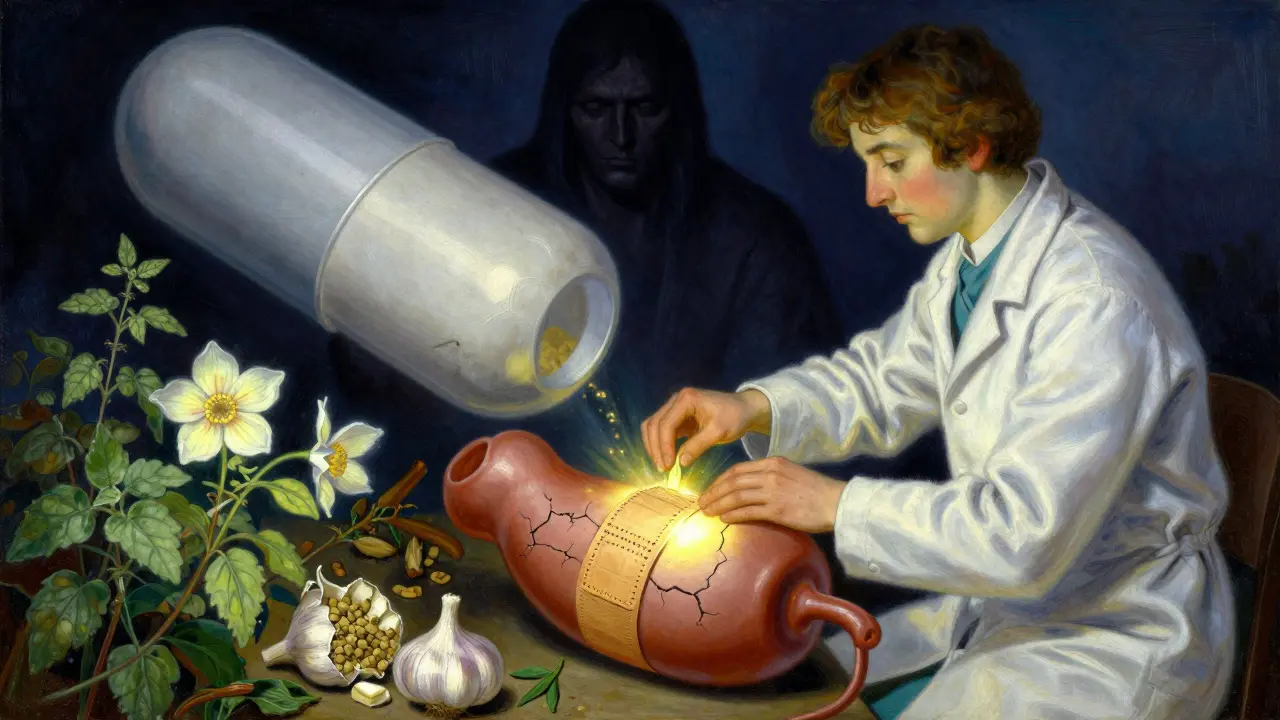
The Bigger Picture: SIBO Is a Symptom, Not a Disease
Here’s what most doctors miss: SIBO isn’t the problem. It’s the symptom. Something broke in your gut’s natural balance. Maybe your ileocecal valve leaks. Maybe your migrating motor complex (the gut’s cleaning wave) is sluggish. Maybe your stomach acid dropped after years of antacids. Maybe you had food poisoning that damaged your nerves.
Fixing SIBO without fixing the cause? You’re putting a bandage on a broken bone. That’s why recurrence is so high.
That’s why the best approach is layered:
- Use the breath test to confirm overgrowth - but know its limits.
- Address the root: stop unnecessary PPIs, treat motility issues, check for low stomach acid.
- Treat with antibiotics or herbs - but not forever.
- Rebuild with diet, probiotics (carefully chosen), and movement.
- Test again. Don’t assume it’s gone.
And if you’re still stuck? Ask for the aspirate. It’s not perfect, but it’s the closest thing we have to the truth. And if your doctor won’t order it? Find someone who will.
What’s Next?
Researchers are working on better tools. Cedars-Sinai is testing a new breath analyzer with 85% predicted accuracy. Mayo Clinic and Johns Hopkins are exploring gene sequencing of gut gases. These could one day tell us not just if you have SIBO, but which bacteria, and how resistant they are.
For now? We’re stuck with imperfect tools. But knowledge is power. If you’ve been told you have IBS and nothing’s working - don’t accept it. Ask about SIBO. Ask about the breath test. Ask about the methane. Ask about the root cause. You’re not crazy. Your gut isn’t broken. It’s just out of balance. And balance can be restored.

Lillian Knezek
February 21, 2026 AT 19:33Maranda Najar
February 22, 2026 AT 19:08Christopher Brown
February 23, 2026 AT 19:34Sanjaykumar Rabari
February 25, 2026 AT 03:43Kenzie Goode
February 25, 2026 AT 21:12Jacob Carthy
February 27, 2026 AT 16:42Bhaskar Anand
February 28, 2026 AT 13:54William James
March 2, 2026 AT 02:41David McKie
March 3, 2026 AT 20:23Nick Hamby
March 4, 2026 AT 01:34kirti juneja
March 6, 2026 AT 01:25Haley Gumm
March 6, 2026 AT 03:19Gabrielle Conroy
March 7, 2026 AT 15:00Spenser Bickett
March 9, 2026 AT 08:09