
For decades, leukemia and lymphoma were treated the same way: harsh chemotherapy, long hospital stays, and uncertain outcomes. But since 2001, everything has changed. The approval of imatinib for chronic myeloid leukemia didn’t just introduce a new drug-it started a revolution. Today, doctors don’t just attack cancer cells blindly. They pick them apart at the molecular level. And in some cases, they use the patient’s own immune cells as living weapons. This isn’t science fiction. It’s real, it’s happening now, and it’s saving lives that were once considered lost.
Targeted Therapies: Hitting Cancer Where It Hurts
Targeted therapies work like precision tools. Instead of poisoning every fast-dividing cell in the body-like chemo does-they zero in on specific proteins or signals that cancer cells rely on to survive. For blood cancers like leukemia and lymphoma, two key targets have become game-changers: Bruton tyrosine kinase (BTK) and BCL-2. BTK inhibitors like ibrutinib and acalabrutinib block a signal that tells B-cells to keep growing. In chronic lymphocytic leukemia (CLL) and small lymphocytic lymphoma (SLL), these drugs have turned what used to be a slow, inevitable decline into a manageable condition. Patients take a pill once a day. Many live for years without needing chemo. One study showed that in patients treated with targeted therapy, it took nearly five years before their cancer transformed into a more aggressive form-compared to just over two years with old-school chemo. Then there’s venetoclax, a BCL-2 inhibitor. BCL-2 is like an emergency brake that cancer cells use to avoid dying. Venetoclax flips that switch. When combined with other drugs like obinutuzumab or ibrutinib, it creates fixed-duration treatments. Patients take the drugs for a set time-usually 12 to 24 months-and then stop. No lifelong pills. No constant monitoring. Many go into deep remission, with no detectable cancer left in their bone marrow. The biggest win? Fewer side effects. No hair loss. No constant nausea. No weeks spent in the hospital recovering. Patients work, travel, spend time with family. The quality of life isn’t just better-it’s radically different.Cellular Therapy: Rewiring the Immune System
If targeted therapies are like sniper rifles, CAR T-cell therapy is like training your own army to hunt down the enemy. It starts with a simple blood draw. Doctors collect T-cells-the body’s natural cancer fighters-and send them to a lab. There, scientists give them a new set of instructions: a chimeric antigen receptor (CAR) that lets them recognize CD19, a protein found on the surface of most B-cell lymphomas and leukemias. These modified T-cells are multiplied in the lab until there are millions. Then they’re infused back into the patient. It’s a one-time treatment. And when it works, it works powerfully. In relapsed or refractory mantle cell lymphoma, a new CAR T-cell therapy called LV20.19 achieved a 100% response rate in a 2025 clinical trial. Nearly 9 out of 10 patients had no detectable cancer left after treatment. That’s unheard of in advanced disease. Approved therapies like Yescarta (axicabtagene ciloleucel) and Kymriah (tisagenlecleucel) have changed survival curves. In patients with large B-cell lymphoma who had failed two prior treatments, Yescarta showed a 42.6% four-year survival rate. Before CAR T, that number was below 10%. And it’s not just about CD19 anymore. Newer versions, like KITE-363 and KITE-753, are designed to hit two targets at once-CD19 and CD20. This makes it harder for cancer to escape. Early results show a 63.6% complete remission rate in patients who had run out of options.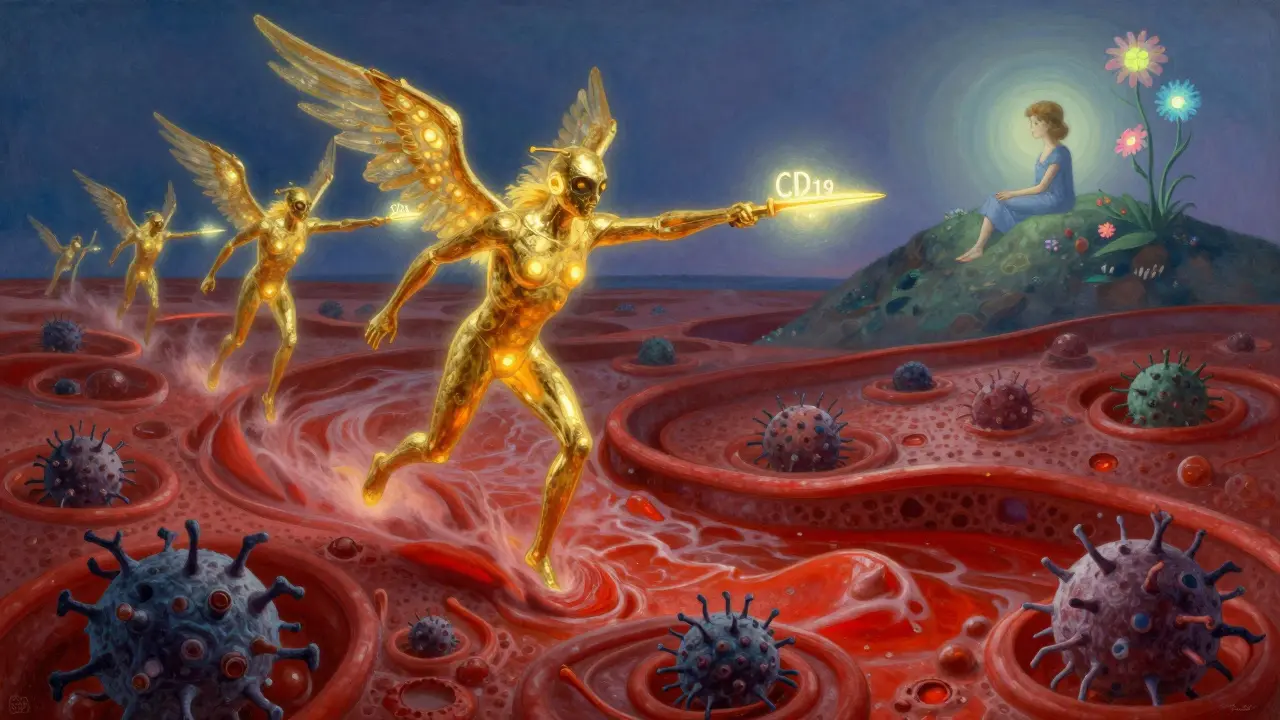
Why These Therapies Aren’t Perfect
No treatment is without trade-offs. Targeted therapies can stop working. Over time, cancer cells find new ways to survive. For patients on BTK inhibitors, the median time before the disease comes back is 3 to 5 years. And if you’ve tried both a BTK inhibitor and venetoclax, your options shrink fast. These are called double-refractory cases-and they’re still very hard to treat. CAR T-cell therapy has its own risks. About 1 in 3 patients develop cytokine release syndrome (CRS), a dangerous immune overreaction that can cause high fever, low blood pressure, and organ stress. Neurotoxicity-confusion, seizures, trouble speaking-happens in 20% to 40% of cases. That’s why these treatments are only given in specialized centers with ICU access. You can’t just walk into your local clinic and get it. Manufacturing takes 3 to 5 weeks. For someone with fast-growing cancer, that delay can be life-threatening. And then there’s the cost. A single CAR T-cell treatment averages $373,000 to $475,000. Even with insurance, out-of-pocket costs can hit $15,000 to $25,000 per month for targeted drugs over time. For older patients with other health problems, the financial burden can be as heavy as the disease itself.Who Benefits Most?
Not everyone is a candidate. Targeted therapies work best in patients with specific genetic markers-like mutations in the BTK or BCL-2 pathways. Testing is now standard before starting treatment. If you have a TP53 mutation or deletion (del17p), you’re less likely to respond long-term to BTK inhibitors. That’s why doctors now test for these upfront. CAR T-cell therapy is typically reserved for patients who’ve tried at least two other lines of treatment. But that’s changing. Early data shows that for high-risk lymphoma patients-those with bulky tumors or fast-growing disease-giving CAR T-cell therapy sooner leads to better outcomes. In fact, 68% of hematologists believe it will become a first-line option by 2030. For chronic lymphocytic leukemia, the choice isn’t always clear. Some patients start with a BTK inhibitor. Others go straight to venetoclax-based combinations. The decision depends on age, overall health, genetic profile, and personal preference. There’s no one-size-fits-all. That’s why treatment is now personalized, not protocol-driven.
What’s Next?
The next wave of treatments is already here. Researchers are developing CAR T-cells that can be made faster-some in under 48 hours. Others are exploring “off-the-shelf” versions, made from donor cells, so patients don’t have to wait. There are also therapies targeting new antigens like CD22 and CD30, and even combinations of CAR T-cells with bispecific antibodies that act like bridges between T-cells and cancer cells. The FDA is moving quickly. In August 2025, it gave priority review to liso-cel (lisocabtagene maraleucel) for marginal zone lymphoma, with a decision expected by December. That’s one more disease that could soon have a new standard of care. Meanwhile, doctors are learning how to manage side effects better. New guidelines help predict CRS before it becomes dangerous. Home monitoring tools let patients track symptoms remotely. And manufacturer support programs-like Kite’s 24/7 nurse hotline-have improved patient satisfaction to 95%.The Real Impact
The biggest shift isn’t just in survival numbers. It’s in hope. Ten years ago, a diagnosis of relapsed lymphoma meant a countdown. Today, it can mean a pause. A chance. A new chapter. Patients who were told they had months to live are now celebrating birthdays, going back to work, watching their grandchildren grow. Some have been in remission for over five years. For the first time, we’re seeing the possibility of cure-not just control-in diseases that were once considered terminal. The challenge now isn’t finding better drugs. It’s making sure everyone who needs them can get them. CAR T-cell therapy is available in 89% of major cancer centers, but only 32% of community clinics. That gap leaves rural patients, older adults, and those without strong insurance at a disadvantage. The future of leukemia and lymphoma treatment isn’t about choosing between targeted and cellular therapy. It’s about using them in the right order, for the right person, at the right time. And that’s where the real art of medicine begins.What’s the difference between targeted therapy and CAR T-cell therapy?
Targeted therapies are pills or infusions that block specific proteins cancer cells need to grow-like turning off a switch. CAR T-cell therapy is a one-time treatment where your own immune cells are removed, genetically changed in a lab to recognize cancer, multiplied, and put back into your body to hunt down the disease. One is a drug; the other is a living medicine.
Are these therapies only for advanced cases?
Not anymore. While CAR T-cell therapy was originally used only after multiple failed treatments, new data shows it works better when given earlier-especially for high-risk patients. Targeted therapies are now first-line options for many types of CLL and lymphoma, even in newly diagnosed patients. Doctors are shifting from "save it for later" to "use it now" when it makes sense.
How long do the effects of CAR T-cell therapy last?
For many patients, the response is long-lasting. In some cases, remission lasts five years or more. In the ZUMA-7 trial, 42.6% of patients with aggressive lymphoma were still alive after four years with Yescarta. But not everyone stays in remission. Some cancers return, especially if they lose the target protein (like CD19). That’s why researchers are now designing CAR T-cells that hit two targets at once to prevent escape.
Can I get CAR T-cell therapy at my local hospital?
Probably not. CAR T-cell therapy requires specialized centers with ICU capabilities, trained staff, and experience managing serious side effects like cytokine release syndrome. Only about 32% of community clinics offer it. Most patients are referred to major cancer centers or academic hospitals. If you’re being considered for this treatment, your doctor will help arrange transfer to an approved facility.
What are the biggest side effects of targeted therapies?
Compared to chemo, side effects are milder. But they’re still real. BTK inhibitors can cause bleeding, diarrhea, fatigue, and irregular heartbeat. Venetoclax can trigger tumor lysis syndrome-especially in the first few weeks-which requires hospital monitoring. Most patients tolerate these well, but regular blood tests and doctor visits are essential. The key difference? You’re not losing your hair or spending weeks in the hospital recovering.
Is there a cure for leukemia or lymphoma with these therapies?
For some patients, yes. In relapsed or refractory cases where nothing else worked, CAR T-cell therapy has led to long-term remissions that doctors now call functional cures. For others, especially with CLL, targeted therapies can control the disease for many years-so long-term, it feels like a cure. But we don’t yet know if the cancer is truly gone forever. That’s why ongoing monitoring is still needed, even after years of remission.

Trevor Davis
January 13, 2026 AT 21:14I remember when my uncle got diagnosed with CLL back in 2010. They told him he had maybe two years. He’s been on ibrutinib since 2015. Last month he took his grandkid to Disney. No chemo. No hospital. Just a damn pill and a whole life back. I don’t care what the stats say-this is real magic.
And yeah, it’s expensive. But so is watching someone fade away slowly. We’re paying for this. We should be proud we’re doing it.
Alan Lin
January 15, 2026 AT 16:23While the clinical outcomes are undeniably transformative, the structural inequities in access remain a moral crisis. The disparity between academic centers and community clinics isn’t merely logistical-it’s existential. A patient in rural Iowa has a statistically lower chance of survival not because of biology, but because of zip code. This isn’t innovation-it’s stratification dressed in white coats.
Until CAR-T is accessible at the same level as insulin, we are not healing-we are privileging.
James Castner
January 16, 2026 AT 23:23Let’s pause for a second and really sit with what’s happening here. We’re not just treating cancer anymore-we’re reprogramming human biology. The idea that we can take someone’s T-cells, give them a new identity, and send them back into the body like guided missiles… that’s not medicine. That’s alchemy.
And yet, we’re still stuck in the 20th century with insurance forms and prior authorizations. We’ve unlocked the door to the future, but we’re still arguing over who gets the key. Is this really the best we can do? Are we so afraid of abundance that we ration hope?
I don’t believe in miracles. But I do believe in science. And if science can turn a dying man into a grandfather again, then our failure isn’t technical-it’s ethical. We owe it to every patient who’s waited three weeks for their cells to grow to make this available to everyone, not just the ones who can afford a second mortgage.
John Pope
January 18, 2026 AT 18:41Okay but have you heard about the new CAR-Ts targeting CD22 and CD30? Like, the ones that are dual-antigen? It’s wild. The tumor escape mechanisms are getting outmaneuvered like chess pieces. We’re entering the era of multi-layered immunological warfare. And the cytokine storms? Yeah, they’re nasty-but we’re getting better at preemptive IL-6 blockade. It’s not perfect, but it’s evolution. And evolution doesn’t care about your insurance plan.
Also, venetoclax + obinutuzumab? That combo is basically a silent assassin. No hair loss. No chemo vibes. Just… poof. Cancer’s gone. It’s like the universe whispered, ‘you win this round.’
Adam Vella
January 18, 2026 AT 23:29It is imperative to clarify a common misconception: targeted therapies do not constitute a cure in the strict oncological sense. Remission, even deep molecular remission, does not equate to eradication. The persistence of minimal residual disease (MRD) is well-documented in CLL patients on BTK inhibitors. Long-term follow-up data from the RESONATE-2 trial demonstrates that 68% of patients still harbor detectable clones after five years. Therefore, labeling these outcomes as ‘cures’ is scientifically inaccurate and potentially misleading to patients.
Furthermore, the cost-benefit analysis of CAR T-cell therapy remains contentious. The incremental survival benefit must be weighed against the risk of severe neurotoxicity and the psychological burden of prolonged hospitalization. Ethical allocation requires rigorous cost-effectiveness modeling-not anecdotal triumphs.
Robin Williams
January 19, 2026 AT 18:04bro. i just watched my cousin’s mom go through this. she was done. no energy, no hope. then she got venetoclax. 6 months later she’s hiking in the Rockies with her dog. no hair loss, no puking, just… life. i cried watching her. we thought we lost her. turns out we just needed the right key.
why the hell is this still a luxury? it’s not sci-fi. it’s here. fix the system.
Angel Molano
January 20, 2026 AT 00:10Stop romanticizing this. People are dying waiting for CAR-T because hospitals can’t manufacture it fast enough. You think a 72-year-old with heart failure and Medicare is getting priority? Nah. They’re pushed to the back while Silicon Valley billionaires fund the next trial. This isn’t progress-it’s a rigged game.
Vinaypriy Wane
January 20, 2026 AT 20:04Thank you for sharing this detailed and compassionate overview. I am from India, and I have watched many patients here struggle to even access basic chemotherapy, let alone targeted therapies or CAR-T. The cost barrier is not just financial-it is cultural, systemic, and often fatal. While I celebrate these advances, I also grieve for those who will never see them. We must not let innovation become a privilege of geography. May we all work toward equity, not just efficacy.
Randall Little
January 21, 2026 AT 04:49So… we’re turning people into walking bioweapons now? Cool. Guess I’ll just hand my T-cells to some lab tech in a white coat and hope they don’t accidentally turn me into a human grenade. And hey, if I survive the cytokine storm, maybe I’ll get to pay $400k for the privilege. Sounds like a Netflix docu-series. Or a dystopian thriller. Either way-I’m not signing up.
Also, who decided ‘living medicine’ was a good marketing term? That’s just corporate speak for ‘we have no idea what’s going to happen next.’