
When you pick up a prescription for generic sertraline or metformin, you probably don’t think about how the price got so low. It’s $4 at the pharmacy. Maybe $10. Sometimes even less. But behind that simple price tag is a complex system of rules, competition, and government strategy-none of which involve setting a maximum price. Unlike brand-name drugs, where governments sometimes step in to cap costs, generic drugs are kept affordable not by law, but by design: competition.
Why Generic Drugs Don’t Need Price Caps
Generic drugs are copies of brand-name medicines that enter the market after the original patent expires. They have the same active ingredients, same effectiveness, same safety profile. But they cost far less. In the U.S., generics make up about 90% of all prescriptions filled, yet they account for only 23% of total drug spending. That’s because once a generic hits the market, prices plunge-often by 80% to 90% within two years. This isn’t magic. It’s economics. When multiple companies can make the same drug, they compete on price. One company lowers its price to win business. Others follow. Soon, the drug is selling for pennies. The government doesn’t need to set a price limit because the market does it better. The Congressional Budget Office found that applying international price controls to generics would save Medicare just $2.1 billion a year-less than 0.4% of total generic spending. Meanwhile, negotiating prices for just 15 high-cost brand-name drugs like Ozempic could save $158 billion. That’s why policymakers don’t waste time trying to control generic prices. They focus on making sure the competition stays fair.The System That Keeps Generics Cheap
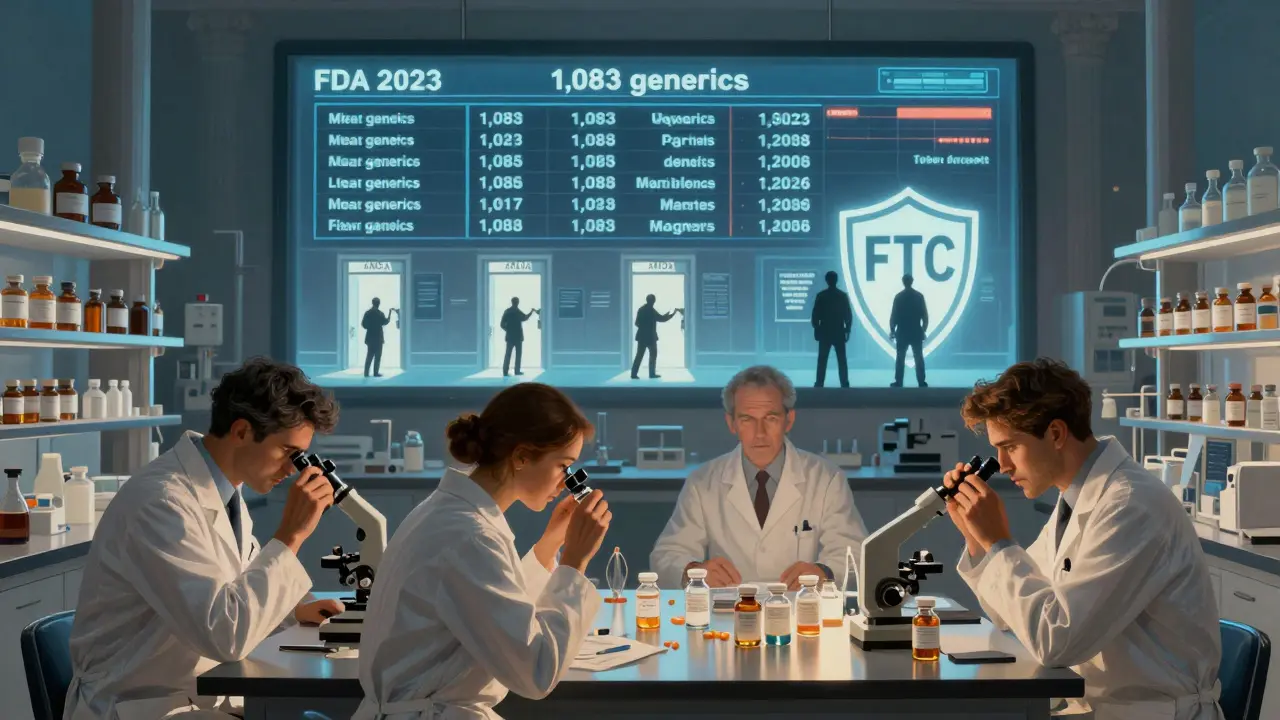
The backbone of this system is the Hatch-Waxman Act of 1984. Before this law, generic manufacturers had to run full clinical trials to prove their drug worked-costing hundreds of millions. Hatch-Waxman changed that. It let them prove their drug was bioequivalent to the brand-same absorption, same effect-without repeating expensive human trials. That cut development costs from $2.6 billion to just $2-3 million per generic. The FDA’s Abbreviated New Drug Application (ANDA) process became the gateway. Today, the FDA approves over 1,000 generics a year. In 2023 alone, they approved 1,083. And they’re speeding things up. Thanks to the Generic Drug User Fee Amendments (GDUFA), approval times dropped from 18 months to under 10 months for most drugs. That means more competitors enter faster, and prices fall quicker. The FDA also tracks every application in real time through its public dashboard. If a generic is stuck in review, manufacturers, pharmacies, and patients can see why. Transparency keeps the system honest.How Competition Actually Works in the Generic Market
You don’t need a price ceiling when you have three, five, or ten companies selling the same pill. Studies show that when three or more generic manufacturers enter the market, prices stabilize at just 10-15% of the original brand price. That’s the sweet spot-low enough to be affordable, high enough to keep companies making the drug. Here’s how it plays out in real life:- A brand-name drug costs $100 a month.
- One generic enters. Price drops to $40.
- Two more enter. Price falls to $15.
- Five enter. Price hits $5.
- By year two, it’s often under $2.
What Happens When Competition Breaks Down
Competition doesn’t always work perfectly. Sometimes, brand-name companies try to block generics. One common trick is “product hopping”-slightly changing the drug (like switching from a pill to a capsule) and pushing patients to the new version, then letting the old one’s patent expire. That delays generics. Another tactic is “pay-for-delay.” A brand-name company pays a generic maker to hold off on launching its cheaper version. The FTC called this “antitrust fraud.” In 2023 alone, they challenged 37 of these deals. They estimate that breaking these agreements saves consumers $3.5 billion a year. Then there are the “orphaned” generics-drugs with only one or two makers. If the price drops too low, the manufacturer may quit. That’s what happened with the antibiotic clindamycin and the heart drug digoxin. Prices spiked. Patients struggled. Hospitals ran out. The American Society of Health-System Pharmacists found that 18% of hospital pharmacists faced shortages of critical generics in 2024. Why? Because the price was below what it cost to make them. The system works when there’s enough competition to keep prices low-but not so low that no one can profit.Why Government Doesn’t Set Generic Drug Prices
You might wonder: if the government can negotiate prices for drugs like Ozempic, why not do the same for generics? The answer is simple: they already do. The Medicare Part D program doesn’t set prices. It negotiates rebates. In 2024, Part D plans paid an average of 15% below the manufacturer’s price for generics. Preferred generics got 28% off. That’s not price control. That’s market leverage. The Inflation Reduction Act of 2022 let Medicare negotiate prices for 15 high-cost brand-name drugs starting in 2026. But it explicitly excluded generics. Why? Because the Department of Health and Human Services said they already had “sufficient competition.” Even the 2025 Most-Favored-Nation Executive Order, which aimed to tie U.S. drug prices to those in other countries, focused only on branded drugs like Wegovy. Generics weren’t even mentioned. The White House knew: they’re already cheap. Legal experts agree. The Congressional Research Service wrote in 2025 that trying to set prices for generics would likely face “significant legal challenges” because current law gives Medicare no authority to do so. And why should it? The system works.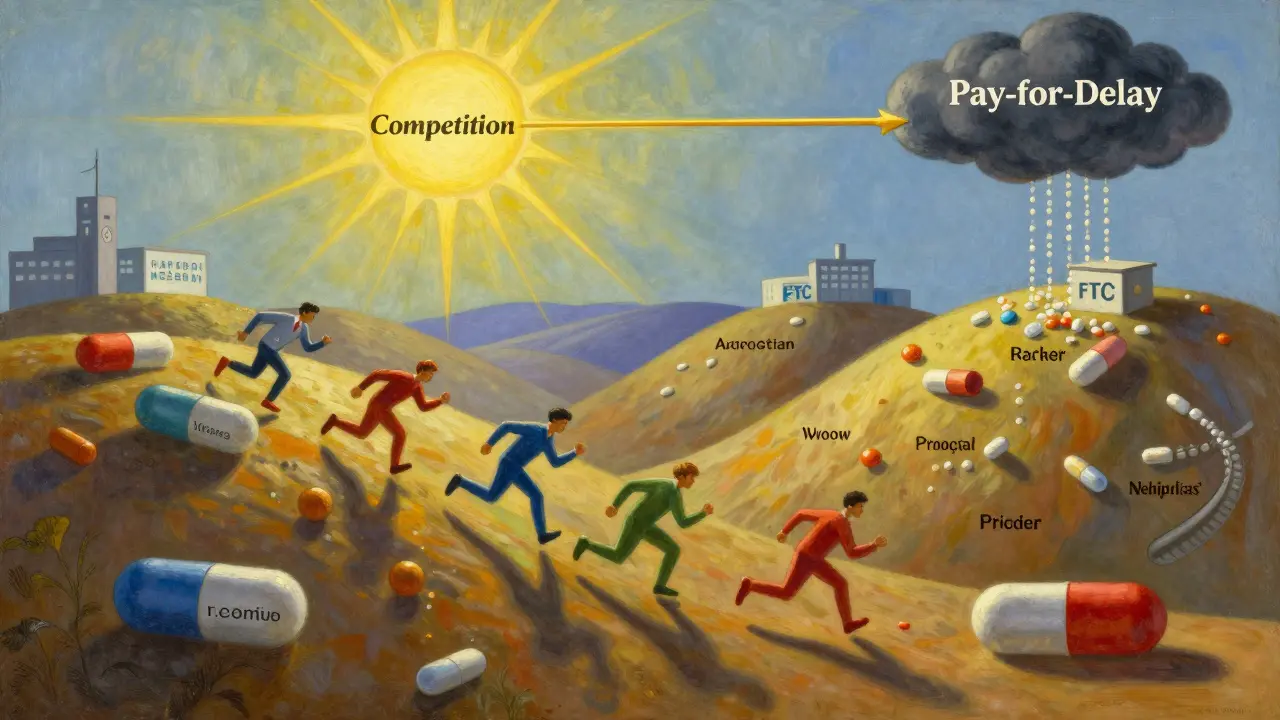
Real People, Real Prices
For most Americans, generic drugs are a win. A 2024 KFF survey found that 76% of people paid $10 or less for their generic prescriptions through Medicare Part D. Only 28% paid that little for brand-name drugs. Eighty-two percent of generic users said they were satisfied with affordability. Only 41% of brand-name users felt the same. On Drugs.com, 87% of reviews for generic medications mentioned words like “affordable” or “cost-effective.” Only 5% raised concerns about price. But there are outliers. In April 2024, a Reddit user complained that their generic sertraline jumped from $4 to $45 a month. That wasn’t a system failure. It was a market glitch. The FDA’s 2023 Drug Shortage Report showed that only 0.3% of generic drugs had price spikes like that. Most were due to supply chain issues or a single manufacturer exiting the market. That’s why the FDA and FTC don’t fix prices-they fix markets. They clear bottlenecks. They stop anti-competitive behavior. They encourage more makers to enter. That’s how you keep prices low without micromanaging them.What’s Next for Generic Drug Pricing?
The future isn’t about price caps. It’s about removing barriers. The FDA’s 2024-2026 plan focuses on two things: complex generics and authorized generics. Complex generics-like inhalers, injectables, or topical creams-are harder and slower to make. The FDA created a new submission template to speed them up. Pilot programs cut review times by 35%. Authorized generics are brand-name drugs sold under a generic label by the original maker. Sometimes, brands launch their own generic to block competitors. The FDA is cracking down on that tactic. Meanwhile, the CMS proposed a rule to stop insurance plans from forcing patients to jump through hoops to get generics. Prior authorization requirements for generics cost patients time and money. Removing them could save $420 million a year. The goal? More competition. Faster approvals. Fewer tricks. Lower prices.What You Can Do
If you’re on generics, you’re already benefiting from one of the most effective public health policies in modern history. But you can help keep it strong:- Ask your pharmacist if a generic is available-even if your doctor didn’t prescribe one.
- Use tools like GoodRx or the FDA’s Generic Drug Dashboard to compare prices across pharmacies.
- If you notice a sudden price spike, report it to the FDA’s MedWatch program.
- Support policies that encourage more manufacturers to enter the generic market, not ones that cap prices.
Why don’t governments set prices for generic drugs like they do for brand-name drugs?
Governments don’t set prices for generics because competition among multiple manufacturers naturally drives prices down-often to 10-15% of the original brand cost. The U.S. system relies on market forces, not price caps. The Medicare Drug Price Negotiation Program, for example, explicitly excludes generics because they already benefit from robust competition. Studies show that adding price controls to generics would save little money while risking supply shortages.
How do generic drug prices drop so quickly after a brand loses its patent?
When a brand’s patent expires, generic manufacturers can file for FDA approval using a simpler process called an ANDA, which doesn’t require new clinical trials. Once the first generic enters, prices typically drop 75% within six months. With three or more competitors, prices fall 90% within two years. The FDA approved 1,083 generics in 2023 alone, accelerating this process.
Are there cases where generic drug prices go up?
Yes, but they’re rare. Price spikes usually happen when only one or two companies make a drug, or when a manufacturer exits due to unprofitable pricing. Between 2019 and 2022, only 3% of generic drugs saw price increases above inflation. The FDA tracks these cases and works with manufacturers to restore supply. The FTC also investigates cases where companies collude to limit competition.
What role does the FTC play in generic drug pricing?
The FTC doesn’t set prices, but it protects competition. In 2023, they challenged 37 pay-for-delay deals where brand-name companies paid generics to delay entry. They also blocked the Teva-Sandoz merger over fears it would reduce competition for 13 drugs. Their goal is to ensure enough manufacturers enter the market so prices stay low naturally.
Can I trust that generic drugs are as safe and effective as brand-name ones?
Yes. The FDA requires generics to be bioequivalent to the brand-meaning they deliver the same amount of active ingredient into the bloodstream at the same rate. They’re held to the same manufacturing standards. Over 90% of prescriptions in the U.S. are generics, and studies consistently show they work just as well. The only difference is the price.

Alex LaVey
February 2, 2026 AT 12:55Just want to say how amazing it is that we’ve built a system where a life-saving drug like sertraline costs less than a coffee. No price caps, no bureaucracy-just smart rules that let competition do the heavy lifting. This is public health done right.
And honestly? It’s the kind of policy that makes me proud to be American. We don’t always get it right, but this? This is a win.
Coy Huffman
February 2, 2026 AT 21:42frankly i didnt even know generics worked this way. thought the gov just capped prices like with insulin. turns out its just pure capitalism doing its thing. who knew? 😅
also the part about pay-for-delay is wild. like, companies literally paying each other to NOT sell cheaper stuff? that’s not capitalism, that’s a cartoon villain plot.
Amit Jain
February 4, 2026 AT 01:19in india, generics are even cheaper. sometimes $1 for a month’s supply. but problem is, some factories cut corners. not all generics are equal. FDA is good, but not every country has that. so be careful.
Keith Harris
February 5, 2026 AT 06:52Oh please. You’re all acting like this is some magical free-market fairy tale. The FDA? More like a rubber stamp for Big Pharma’s subsidiaries. Did you know that 70% of generic manufacturers are owned by the same companies that make the brand-name drugs?
And don’t get me started on ‘authorized generics’-that’s just a shell game where the original company undercuts its own patent to scare off competitors. This isn’t competition. It’s corporate theater wrapped in a lab coat.
And don’t tell me about ‘market forces’-when a single plant in Puerto Rico makes 80% of your antibiotics, that’s not competition. That’s a hostage situation.
They don’t cap prices because they don’t want to. They want you to believe the market is working so you stop asking why your insulin costs $300 and your metformin costs $4. The answer? They’re not trying to fix the system. They’re trying to make you forget it’s broken.
Kunal Kaushik
February 5, 2026 AT 11:32so cool that the system actually works 😊
also the FDA dashboard is legit useful. i checked my meds last week and saw 3 new generics approved. felt like a superhero 🦸♂️💊
Mandy Vodak-Marotta
February 6, 2026 AT 19:44Okay but let’s be real-this whole thing is kind of terrifying when you think about it. I mean, imagine if the only thing keeping your blood pressure medication affordable is whether five different companies decide to enter the market in the same year? What if one of them gets bought out? What if a factory burns down? What if a CEO gets tired of making pennies and just quits?
It’s not that I don’t love the idea of competition-I do. But it’s like trusting your life to a game of Jenga where the blocks are made of your health. And if one block slips, you’re stuck paying $45 for sertraline again. And that’s not a market failure-it’s a human tragedy. We need more than just ‘trust the market.’ We need backup systems. We need safety nets. We need to stop pretending that capitalism alone can keep people alive.
Also, I just checked GoodRx and my pharmacy charges $12 for the same generic that another one down the street sells for $2. That’s not competition. That’s price gouging with a smile.
Nathan King
February 7, 2026 AT 09:02While the economic rationale underpinning the generic drug pricing paradigm is theoretically sound, one must not overlook the structural vulnerabilities inherent in oligopolistic market dynamics. The notion that 'competition naturally drives prices down' presumes perfect information, zero barriers to entry, and infinite elasticity-all of which are demonstrably absent in pharmaceutical supply chains. Furthermore, the regulatory framework, while ostensibly transparent, remains subject to administrative latency and discretionary enforcement, thereby introducing non-market distortions that undermine the very principles upon which the model is predicated.
One must therefore question whether the absence of price controls is a testament to market efficiency, or merely an artifact of regulatory inertia and ideological dogma.
Janice Williams
February 9, 2026 AT 06:06Let me be the first to say this: you’re all naive. The FDA doesn’t ‘speed up’ approvals-they’re pressured by industry lobbying. The FTC doesn’t ‘protect competition’-they only act when the media catches wind of a scandal. And the claim that generics are ‘cheap’? That’s only true for the 90% of people who have insurance and can afford copays.
Try being uninsured and paying cash for a generic that just went from $4 to $45 because the only manufacturer shut down. No one’s talking about that. No one’s crying about the 18% of pharmacists who can’t stock critical drugs. This isn’t a success story. It’s a time bomb wrapped in a press release.
And don’t even get me started on ‘GoodRx.’ That’s not a tool-it’s a middleman siphoning money from desperate people while pretending to be a hero.
Stop romanticizing capitalism. It’s not working. It’s just working well enough to keep you quiet.
Jhoantan Moreira
February 9, 2026 AT 23:17Wow, this is such a nuanced and thoughtful breakdown. I’m from the UK, and our system is totally different-we do have price negotiations, but we also have way fewer generic manufacturers. It’s interesting to see how the US model works with so much competition.
One thing I admire is how transparent the FDA dashboard is. That’s something other countries could learn from. And honestly? I’m glad someone’s fighting pay-for-delay deals. That’s just wrong.
Also, big thanks to the author for writing this. It’s rare to see such a clear, calm explanation of a complex issue. 🙌