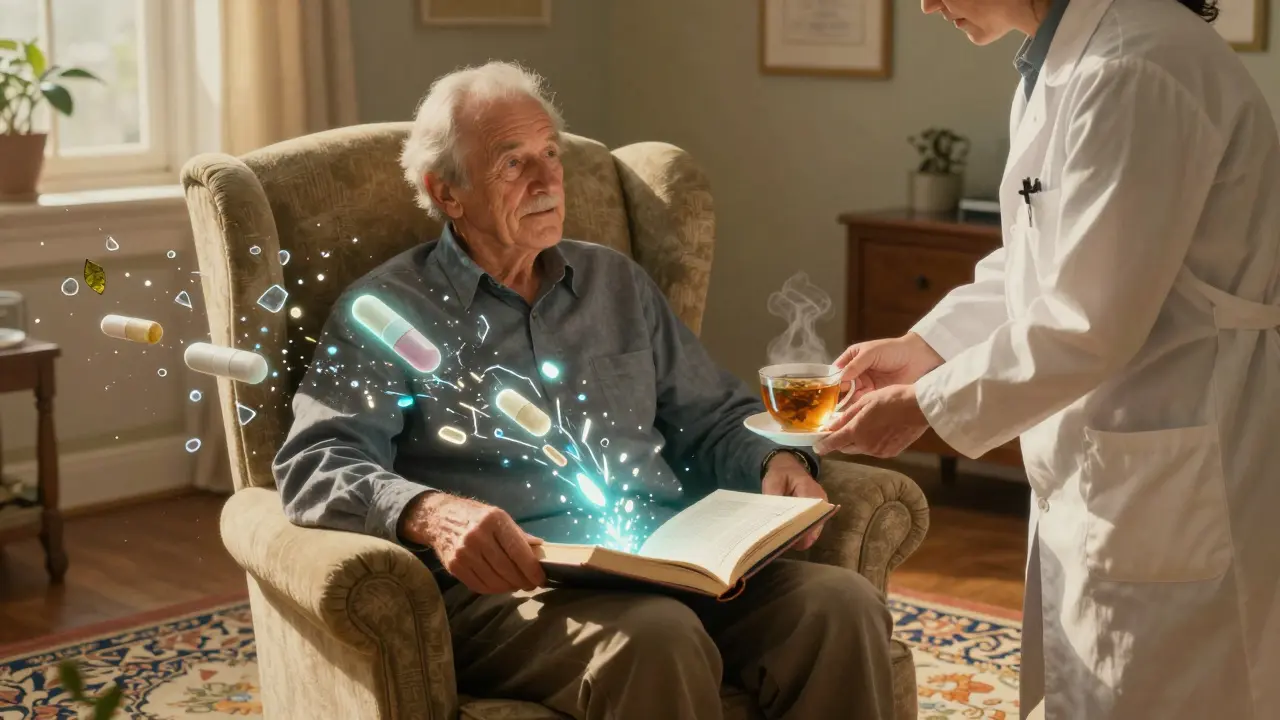
Why Older Adults Are at Higher Risk from Medications
When someone turns 65, their body changes in ways most people don’t think about until it’s too late. Kidneys slow down. Liver enzymes don’t process drugs the same way. Brain receptors become more sensitive. These aren’t just minor tweaks-they’re major shifts that turn normal doses into dangerous ones.
Take a simple painkiller like ibuprofen. For a 30-year-old, it’s harmless. For an 80-year-old with mild kidney issues, it can cause sudden kidney failure or dangerous bleeding. That’s why nearly 1 in 3 hospital admissions for people over 65 are linked to medications-not the illness they came in for, but the drugs meant to help them.
The problem gets worse when patients take five, six, or even ten different pills. This is called polypharmacy. It’s not always the doctor’s fault. Often, multiple specialists each prescribe something without knowing what the others ordered. A cardiologist adds a blood thinner. A neurologist prescribes an antipsychotic for sleep. A primary care doctor gives an NSAID for arthritis. No one sees the full picture. And that’s when things go wrong.
The Beers Criteria: The Gold Standard for Safe Prescribing
In 1991, the American Geriatrics Society created a simple list: the Beers Criteria. It wasn’t meant to be perfect. It was meant to be practical. Today, it’s the most cited tool in geriatric medicine, referenced over 1,200 times since 2020 alone.
The 2023 update lists 139 medications or classes that should be avoided or used with extreme caution in older adults. Some are outright banned-like diphenhydramine (Benadryl) for sleep, because it causes confusion and falls. Others need strict limits-like benzodiazepines, which are fine for short-term anxiety but dangerous if taken longer than two weeks.
One big change in 2023? Aspirin for heart disease prevention. It used to be okay up to age 80. Now, it’s discouraged after 70. Why? Because the risk of internal bleeding outweighs the benefit for most people in that age group. Men, especially, face higher bleeding risks. But here’s the catch: if someone has a history of heart attack or stents, aspirin might still be necessary. That’s why the Beers Criteria aren’t a rigid rulebook-they’re a guide, with exceptions built in.
The New Alternatives List: What to Prescribe Instead
Knowing what not to give is only half the battle. The real challenge? What to give instead.
That’s why, in July 2025, the American Geriatrics Society released the AGS Beers Criteria® Alternatives List. It’s not just a list of other drugs. It’s a toolkit of 47 evidence-backed options-38% of them aren’t drugs at all.
For example:
- Instead of melatonin or benzodiazepines for insomnia, try sleep hygiene training, light therapy, or cognitive behavioral therapy for insomnia (CBT-I).
- Instead of an anticholinergic like oxybutynin for overactive bladder, use timed voiding, pelvic floor exercises, or bladder training.
- Instead of an opioid like oxycodone for chronic pain, consider physical therapy, acupuncture, or topical capsaicin.
This matters because 68% of primary care doctors said they didn’t know what to prescribe when they wanted to stop a risky medication. The Alternatives List gives them a clear path forward.

How Emergency Rooms Are Changing the Game
Emergency departments (EDs) are ground zero for geriatric medication errors. Older adults show up with falls, confusion, or dizziness-and often, the root cause is a drug interaction or overdose.
The Geriatric Emergency Medication Safety Recommendations (GEMS-Rx), released in March 2024, gives ED teams a checklist for safe discharge. It focuses on just eight high-risk classes: antipsychotics, benzodiazepines, anticholinergics, NSAIDs, opioids, certain diabetes drugs, gabapentinoids, and proton pump inhibitors.
At the Mayo Clinic Rochester ED, a team of pharmacists, geriatricians, and ER doctors redesigned their workflow. They added a pharmacist to every geriatric patient’s discharge plan. Within six months, they cut risky prescriptions by 38%. But it wasn’t easy. It took 12 weeks of training, new documentation forms, and reprogramming their electronic health record to stop the alerts from firing for every patient over 65.
That’s the problem with tech: too many alerts. One ER doctor in Texas told Medscape, “Our system flags warfarin for atrial fibrillation-even though it’s the right drug. We override it 65% of the time because it’s nonsense.”
What Works: Multidisciplinary Teams and Real-World Results
Studies show that computer alerts alone reduce risky prescriptions by about 22%. But when you add a clinical pharmacist and a geriatrician to the team, that jumps to 37%.
The University of Alabama at Birmingham cut 30-day readmissions for medication-related problems by 22% using a pharmacist-led reconciliation program. Their team met with every patient over 65 before discharge, reviewed every pill, and called the primary care doctor to confirm changes.
CMS now tracks this. Measure 238, introduced in 2025, requires hospitals to report how often older patients are prescribed two or more drugs from the same high-risk class-like two different benzodiazepines or two NSAIDs. Hospitals that fail this metric face reimbursement cuts of 0.5%.
And it’s working. In 2022, only 52% of Level 1 Trauma Centers had formal geriatric medication safety programs. By 2025, that number jumped to 78%. Rural areas are still lagging-only 31% have full programs-but the momentum is clear.

The Human Side: When Rules Don’t Fit the Patient
Not every older adult is the same. One 82-year-old is active, lives alone, and takes no more than three meds. Another is 75, has dementia, lives in a nursing home, and takes 12 pills a day. The Beers Criteria can’t treat them the same way.
Dr. Joanne Schnur wrote in JAMA Internal Medicine that rigid use of the Beers Criteria can lead to “inappropriate deprescribing.” She told the story of a frail 80-year-old with cancer and severe pain. His doctor stopped his opioid because it was on the list. The patient’s pain got worse. His quality of life crashed.
That’s why experts say: use the Beers Criteria as a starting point, not a rulebook. Ask: What’s the patient’s goal? Do they want to live longer? Or to live better? If they’re in hospice, some “risky” drugs may be exactly what they need.
It’s not about avoiding all drugs. It’s about matching the right drug to the right person at the right time.
What’s Next: AI, Training, and the Future of Geriatric Care
The biggest challenge isn’t knowledge-it’s workflow. Most hospitals still use outdated systems that flood clinicians with alerts. The AGS is working on Beers Criteria Digital Integration Standards, set to launch in early 2026. These will use AI to understand context: Is the patient on dialysis? Do they have a history of falls? Is this a one-time prescription or long-term?
CMS is also expanding its tracking. In 2026, it will start measuring not just risky prescriptions, but also deprescribing events. That means hospitals will be rewarded for taking people off dangerous drugs, not just for avoiding them in the first place.
Training is improving too. The Geriatric ED Guidelines 2.0, coming in late 2025, will include new modules on shared decision-making and deprescribing conversations. They’ve even created scripts: “I’m concerned this medication might be making you more tired than it helps. Let’s try cutting it slowly and see how you feel.”
But the biggest barrier remains workforce. Only 1,247 pharmacists in the U.S. are board-certified in geriatric pharmacy. With 58 million Americans over 65-and that number growing fast-we’re running out of specialists who know how to do this right.
What You Can Do Right Now
If you’re caring for an older adult:
- Keep a full list of every medication-including vitamins, supplements, and over-the-counter drugs-and bring it to every appointment.
- Ask: “Is this still necessary? Could it be causing my symptoms?”
- Request a medication review with a pharmacist. Many insurance plans cover this now.
- If a new drug is prescribed, ask: “Is this on the Beers Criteria list? Is there a safer alternative?”
If you’re a clinician:
- Use the 2023 Beers Criteria and the 2025 Alternatives List together.
- Don’t rely on EHR alerts alone. Talk to your patients.
- Work with a clinical pharmacist. Even one hour a week makes a difference.
Geriatric medication safety isn’t about being more cautious. It’s about being smarter. The goal isn’t to avoid drugs entirely-it’s to use them in a way that actually improves life, not just prolongs it.
What are the most dangerous drugs for elderly patients?
The most dangerous drugs for older adults include benzodiazepines (like diazepam), anticholinergics (like oxybutynin), NSAIDs (like ketorolac), opioids (like meperidine), and certain antipsychotics (like haloperidol). These increase the risk of falls, confusion, kidney damage, and internal bleeding. The 2023 Beers Criteria lists 139 medications or classes to avoid or use with extreme caution.
Can aspirin be used for heart protection in seniors?
As of 2023, the Beers Criteria recommend against using aspirin for primary heart disease prevention in adults over 70. The risk of bleeding-especially in the stomach or brain-outweighs the benefit for most people in this age group. However, if someone has already had a heart attack, stroke, or stent placement, aspirin may still be necessary. Always consult a doctor before stopping or starting aspirin.
What is polypharmacy and why is it risky?
Polypharmacy means taking five or more medications at once. For older adults, it’s risky because aging affects how the body absorbs, processes, and clears drugs. The more pills someone takes, the higher the chance of dangerous interactions, side effects, and hospitalization. Studies show that each additional potentially inappropriate medication increases the risk of adverse drug events by 26%.
How can deprescribing help elderly patients?
Deprescribing means safely stopping medications that are no longer needed or are doing more harm than good. It can improve alertness, reduce falls, lower the risk of kidney damage, and improve quality of life. Programs that combine pharmacist support with patient education have achieved deprescribing rates of up to 42%. The AGS Alternatives List provides safe, evidence-based options to replace risky drugs.
Are there non-drug alternatives for common elderly conditions?
Yes. For insomnia, try sleep hygiene or CBT-I instead of benzodiazepines. For overactive bladder, timed voiding or pelvic floor exercises work better than anticholinergics. For chronic pain, physical therapy, acupuncture, or topical creams can replace opioids. The AGS Alternatives List includes 47 evidence-backed options, with 38% being non-drug approaches. These are often safer and more effective long-term.

Donna Peplinskie
January 2, 2026 AT 15:12My mom was on eight meds last year-some for things she didn’t even have anymore. I had to print out the Beers Criteria and take it to her doctor. She cried when they took away the Benadryl. Said she ‘couldn’t sleep without it.’ But after two weeks of sleep hygiene? She’s sleeping better than she has in a decade. It’s not about taking pills away-it’s about giving people back their lives.
Alex Warden
January 2, 2026 AT 22:31This is why America’s going to hell. Doctors got too soft. Back in my day, you took your medicine or you didn’t get better. Now we’re coddling old folks like they’re babies. If your kidneys can’t handle ibuprofen, tough. Don’t take it. Stop blaming the system.
Todd Nickel
January 3, 2026 AT 02:15The Beers Criteria are a necessary starting point, but their real value lies in contextual application. The 2023 update’s removal of aspirin for primary prevention in those over 70 reflects a nuanced shift toward risk-benefit analysis rather than blanket contraindications. What’s more, the integration of non-pharmacological alternatives-particularly CBT-I for insomnia and pelvic floor therapy for overactive bladder-demonstrates a maturation of geriatric care from pharmacocentric to patient-centered paradigms. The challenge, however, remains systemic: EHRs are still optimized for billing, not clinical judgment, and the alert fatigue described by the Texas ER physician isn’t an anomaly-it’s the norm. Until clinical decision support evolves to incorporate longitudinal data, functional status, and patient goals-not just age and drug codes-we’re just rearranging deck chairs on the Titanic.
Austin Mac-Anabraba
January 3, 2026 AT 03:34Let’s be real-this whole ‘safe prescribing’ movement is just another way for bureaucrats to control medicine. The Beers Criteria? A checklist written by academics who’ve never held a dying patient’s hand. You think a 78-year-old with stage 4 cancer and chronic pain shouldn’t get opioids because they’re on a list? That’s not medicine. That’s cruelty dressed up as protocol. And now they’re rewarding hospitals for *taking* drugs away? What’s next-mandating that we stop giving insulin to diabetics because ‘it’s risky’? This isn’t patient care. It’s ideological triage.
Phoebe McKenzie
January 5, 2026 AT 00:15THEY’RE LYING TO YOU. EVERY SINGLE ONE OF THEM. The Beers Criteria? Made by Big Pharma to sell MORE drugs-because if you take away the old ones, you need new ones to replace them! The ‘alternatives list’? That’s just a fancy way to push expensive therapy sessions that insurance won’t cover! And don’t get me started on CBT-I-where’s the profit in that? They want you to suffer quietly so they can sell you the next pill. The government’s tracking deprescribing? That’s not safety-it’s population control. Wake up. They’re not trying to help your grandma. They’re trying to make her disappear quietly.
gerard najera
January 5, 2026 AT 19:21Drugs aren’t the problem. The system is.
Stephen Gikuma
January 6, 2026 AT 16:26They’re pushing this ‘alternatives’ junk because they’re scared of the truth: the elderly are a drain on the system. No one wants to pay for real care. So they take away the pills, pretend the pain isn’t real, and call it ‘safety.’ Next thing you know, they’ll say ‘why are you still breathing at 80?’ This isn’t medicine. It’s eugenics with a stethoscope.
Bobby Collins
January 8, 2026 AT 09:43my aunt took 12 pills a day and now she’s on 3 and she’s dancing again 🤗 i’m so glad we listened to the pharmacist
Layla Anna
January 9, 2026 AT 10:14Just had my first meds review with a geriatric pharmacist. She sat with me for 90 minutes. Looked at every pill, supplement, even the turmeric capsules. She said ‘this one’s probably doing nothing’ and ‘this one’s making you dizzy.’ We cut three. I feel like a new person. This is what care looks like. Not alerts. Not lists. Just someone who cares enough to listen.