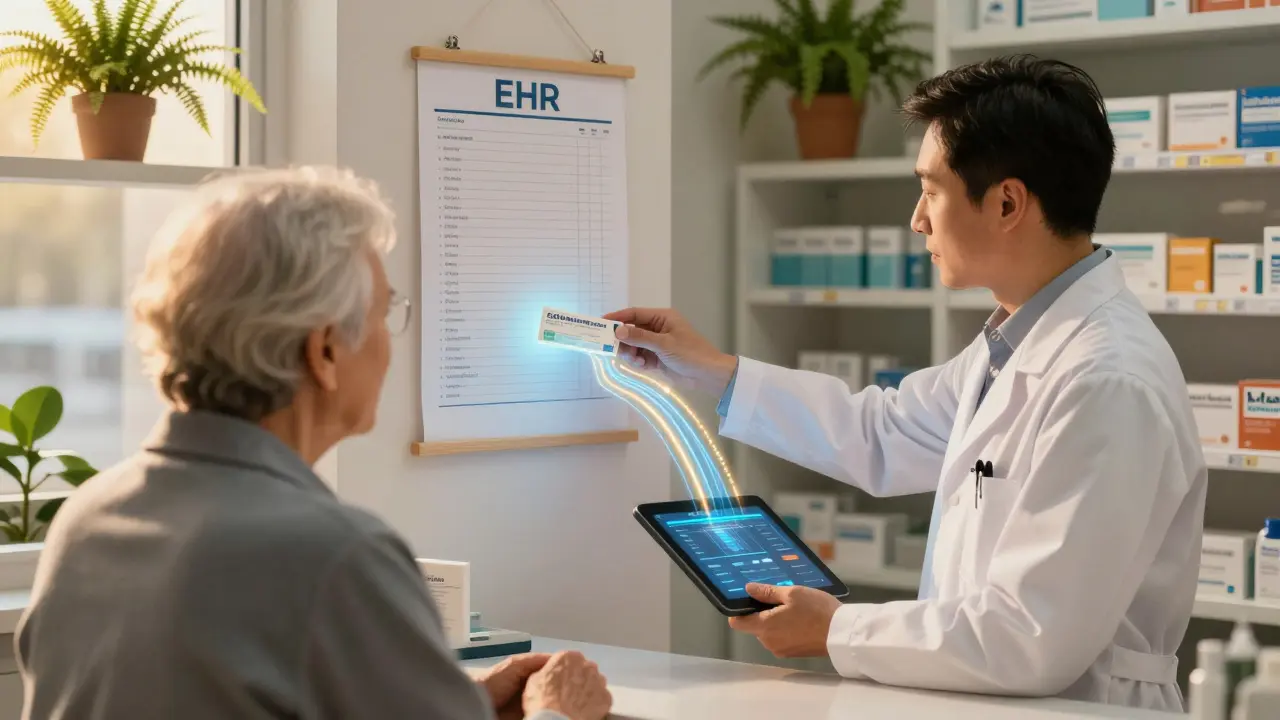
Imagine this: a patient walks into a community pharmacy with a new prescription for blood pressure medication. The pharmacist notices the patient is also taking a diabetes drug that could dangerously interact with the new one. But the pharmacist doesn’t have access to the patient’s full medical history - no lab results, no recent doctor visits, no notes from their primary care provider. So they call the clinic. The call goes to voicemail. Two hours later, the provider calls back and says, "I already changed that dose last week." The patient leaves confused, and the risk of harm lingers. This isn’t rare. It’s the norm - until EHR integration changes everything.
Why EHR Integration Matters for Prescriptions
Electronic Health Record (EHR) integration between providers and pharmacies isn’t just about sending prescriptions digitally. It’s about closing the communication gap that’s been costing lives and money for decades. Before integration, prescriptions were often faxed, called in, or printed and handed to patients. Each step introduced delays, errors, and lost information. Today, when EHR systems talk directly to pharmacy systems, the entire medication journey becomes safer, faster, and smarter.The real power lies in bidirectional communication. It’s not just the doctor sending a script to the pharmacy. It’s the pharmacist sending back critical insights - like drug interactions, adherence issues, or lab results that suggest a dose needs adjusting - directly into the provider’s EHR. This turns pharmacists from order-fillers into active care team members.
According to a 2022 study in the Journal of the American Pharmacists Association, pharmacists with access to integrated EHR data identify and resolve 4.2 medication-related problems per patient visit. Without access, that number drops to just 1.7. That’s more than double the chance of catching a dangerous error before it hurts someone.
How EHR and Pharmacy Systems Talk to Each Other
It’s not magic - it’s standards. Two main technical frameworks make this possible: NCPDP SCRIPT and HL7 FHIR.NCPDP SCRIPT (version 2017071) is the backbone for sending prescriptions electronically. It’s been around for years and handles the basics: drug name, dosage, quantity, instructions, prescriber details. Most pharmacies use it. But it’s one-way. It doesn’t tell the doctor about side effects the patient is having or whether they filled the script at all.
HL7 FHIR (Fast Healthcare Interoperability Resources) is the new game-changer. Released in 2019, it lets systems exchange rich clinical data - lab results, allergies, past prescriptions, care plans, even patient-reported symptoms. The Pharmacist eCare Plan (PeCP), built on FHIR, lets pharmacists document their interventions and send them directly into the provider’s chart. Think of it as a digital note from the pharmacist that shows up right next to the doctor’s notes.
These systems connect via secure APIs using OAuth 2.0 for login and TLS 1.2+ for encrypted data transfer. Everything must follow HIPAA rules. Audit logs track who accessed what and when - required by the 21st Century Cures Act to stop information blocking.
Big players like Surescripts handle over 22 billion transactions a year. They connect 97% of U.S. pharmacies to EHRs through Medication History, Eligibility checks, and Electronic Prior Authorization. But even with this scale, only 15-20% of pharmacies have full bidirectional integration. Most still operate in silos.
Real Benefits: Numbers That Matter
The data doesn’t lie. When EHR and pharmacy systems connect, outcomes improve - fast.- 31% fewer hospital readmissions due to medication issues, according to a University of Tennessee proof-of-concept study.
- 23% higher medication adherence - patients are more likely to take their drugs when pharmacists can flag missed refills and follow up directly through the EHR.
- 63% faster prescription processing. What used to take 15 minutes per script now takes under 6 minutes. That’s time saved for pharmacists to talk to patients, not chase down paperwork.
- 48% fewer medication errors thanks to automated alerts for interactions, duplications, or incorrect doses.
- $1,250 saved per patient annually by avoiding avoidable ER visits, hospitalizations, and wasted meds.
In Australia, the My Health Record system reduced preventable hospitalizations by 27% after integrating pharmacy data. In the U.S., a 2023 study found integrated systems cut medication therapy management time from 45 minutes to 22 minutes per patient. That’s more time for care, less time for admin.

The Big Hurdles: Cost, Time, and Payment
Despite the clear benefits, adoption is painfully slow - especially for independent pharmacies.Cost is the biggest blocker. Independent pharmacies face $15,000 to $50,000 just to get started. Then $5,000 to $15,000 a year to maintain it. For a small business, that’s not an investment - it’s a gamble.
Time is another problem. Community pharmacists average just 2.1 minutes per patient interaction. Even with EHR access, 68% say they don’t have time to review the data. One pharmacist on Reddit said it took 7 months and $18,500 to get integrated - and they still don’t have enough staff to use it fully.
And no one pays for it. Only 19 states have reimbursement models for pharmacists using EHR data to manage medications. Even though 48 states let pharmacists prescribe, they can’t get paid for the work they do when they see a patient’s full history. As Dr. Lucinda Maine of the American Association of Colleges of Pharmacy put it: "Without sustainable payment, EHR integration will remain a luxury."
Technical fragmentation makes it worse. There are over 120 EHR systems and 50 pharmacy software platforms. Getting them to talk smoothly often requires custom coding. One health information exchange reported 73% of pharmacy data doesn’t map cleanly into medical EHRs. That means hours of manual fixes, broken alerts, and frustrated staff.
Who’s Doing It Right?
Some organizations are leading the way.Surescripts connects the dots between prescribers, pharmacies, and payers. Their Medication History tool gives pharmacists instant access to a patient’s full prescription record - even from other pharmacies. Their Electronic Prior Authorization system cuts approval time from days to hours.
SmartClinix and DocStation offer pharmacy-specific EHR platforms with built-in integration to major systems like Epic and Cerner. Pharmacies using them report seamless workflows, but many complain about steep learning curves and limited features for specialty meds.
Integrated health systems - like Kaiser Permanente or Mayo Clinic - have it easiest. Their pharmacies are inside their own EHR ecosystem. Nearly 90% of these pharmacies have full integration. Independent pharmacies? Only 12% do.
One success story came from East Tennessee, where 12 independent pharmacies and 3 clinics partnered with EnlivenHealth® to integrate PioneerRx with Epic. Over 1,800 care interventions were documented - and 92% were accepted by providers. That’s proof it works, even outside big systems.
What’s Next? AI, Regulation, and the Road to 2027
The future is here - just unevenly distributed.The Office of the National Coordinator for Health IT (ONC) has set a goal: 50% of community pharmacies must have bidirectional EHR integration by 2027. That’s ambitious. But it’s backed by real pressure: CMS now requires Medicare Part D plans to integrate medication therapy management by 2025 to earn top Star Ratings. California’s SB 1115 mandates EHR integration for MTM services by 2026.
AI is stepping in. CVS and Walgreens are piloting machine learning tools that scan integrated EHR and pharmacy data to flag high-risk patients automatically. Early results show a 37% improvement in identifying medication problems before they escalate.
Meanwhile, the CARIN Blue Button 2.0 initiative lets patients share their own prescription and lab data directly with pharmacists - bypassing provider delays. And NCPDP is rolling out PeCP Version 2.0 in late 2024, adding smarter clinical decision support.
But none of this matters without payment reform. The Pharmacy and Medically Underserved Areas Enhancement Act (H.R. 5827), introduced in 2023, proposes Medicare reimbursement for pharmacist services delivered through integrated systems. If it passes, it could be the tipping point.
What Pharmacists and Providers Can Do Today
You don’t need to wait for federal mandates to start improving communication.- Pharmacists: Ask your pharmacy software vendor if they support FHIR and PeCP. Push for integration with your local clinics. Use Surescripts’ Medication History tool - it’s free for most pharmacies.
- Providers: Don’t just send scripts. Ask your pharmacy partner if they can send back alerts or care plans. Request access to pharmacy data in your EHR.
- Both: Start small. Pick one high-risk patient group - say, diabetics on multiple meds - and try integrating just for them. Track outcomes. Show the data. Build a case for scaling up.
The goal isn’t to replace doctors or pharmacists. It’s to connect them. When a pharmacist sees a patient’s blood sugar trend in the EHR and calls to adjust insulin, that’s not overstepping - it’s care. When a doctor sees a pharmacist’s note about non-adherence and changes the dosing schedule, that’s teamwork.
Technology didn’t create this gap. Policy, cost, and inertia did. Fixing it isn’t about fancy software. It’s about recognizing that pharmacists are essential care providers - and giving them the tools to act like it.
What is EHR integration in pharmacy?
EHR integration in pharmacy means electronically connecting a patient’s medical records (used by doctors and hospitals) with the pharmacy’s system. This allows two-way communication: providers can send prescriptions directly to the pharmacy, and pharmacists can send back alerts about drug interactions, refill issues, or lab results - all within the provider’s electronic chart.
How does EHR integration reduce medication errors?
Integrated systems automatically check for drug interactions, duplicate prescriptions, incorrect dosages, and allergies using real-time patient data. Studies show this cuts medication errors by up to 48%. Pharmacists also see lab results and past prescriptions, so they catch problems a paper script alone can’t reveal.
Why don’t more pharmacies have EHR integration?
The main reasons are cost, time, and lack of reimbursement. Independent pharmacies face $15,000-$50,000 in upfront costs and $5,000-$15,000 annually to maintain integration. Most don’t get paid for the extra work pharmacists do using the data. Plus, with over 120 different EHR systems, getting them to talk smoothly is technically complex.
What’s the difference between NCPDP SCRIPT and HL7 FHIR?
NCPDP SCRIPT is used to send prescriptions electronically - it’s the standard for filling orders. HL7 FHIR is newer and more powerful: it exchanges full clinical data like lab results, allergies, and care plans. FHIR lets pharmacists send detailed notes back to the provider’s EHR, turning communication from one-way to two-way.
Can patients help with EHR integration?
Yes. Through tools like Blue Button 2.0, patients can download their own prescription and lab history and share it directly with their pharmacist. This bypasses delays from providers and helps pharmacists fill gaps in data, especially when systems aren’t fully connected yet.
Is EHR integration required by law?
Not yet for all pharmacies, but regulations are pushing hard. The 21st Century Cures Act bans information blocking, and Medicare Part D requires integrated medication therapy management by 2025. States like California are mandating it for MTM services by 2026. The ONC aims for 50% of community pharmacies to be integrated by 2027.

Kitty Price
December 15, 2025 AT 17:46Colleen Bigelow
December 17, 2025 AT 03:52Randolph Rickman
December 19, 2025 AT 03:19sue spark
December 21, 2025 AT 01:35Arun ana
December 21, 2025 AT 15:01Dave Alponvyr
December 23, 2025 AT 00:10Kim Hines
December 23, 2025 AT 19:17Cassandra Collins
December 24, 2025 AT 04:08Joanna Ebizie
December 26, 2025 AT 00:24