Have you ever looked at a prescription bottle and wondered why the drug has three different names? One long, scientific word. Another short, simple one. And a third that sounds like a superhero alias? It’s not random. There’s a whole system behind it - one designed to keep you safe.
Why Drug Names Even Exist
Imagine if every hospital used a different name for the same pill. One calls it "A-234," another calls it "BlueBloatStopper," and a third uses "Propranolol." That’s chaos. Medication errors kill thousands every year. The drug nomenclature system was built to stop that.
In 1953, the World Health Organization launched the International Nonproprietary Names (INN) Programme. Their goal? One name per drug - the same everywhere. That way, a doctor in Tokyo, a pharmacist in Nairobi, and a nurse in Chicago all know exactly what medication they’re handling. Today, over 10,000 drugs have INNs. Around 200 new ones are added each year.
This system didn’t just pop up overnight. It evolved because real people got hurt. The Institute of Medicine found that in the U.S. alone, at least 1.5 million preventable drug errors happen annually. Many of them? Caused by confusing names.
The Three Layers of a Drug’s Identity
Every drug has three names. Each serves a different job.
- Chemical name: The science version. Precise. Long. Almost impossible to say.
- Generic name: The official, standardized name used by doctors and pharmacists worldwide.
- Brand name: The name the company sells it under - think "Lipitor," "Zoloft," "Advil."
Let’s take a real example: the heart medication you might know as "Coreg." Its generic name is carvedilol. Its chemical name? "(±)-1-(Carbazol-4-yloxy)-3-[(2,6-dimethylphenoxy)isopropylamino]-2-propanol."
You’ll never hear a pharmacist say the chemical name. But you’ll hear the generic name every time you refill a prescription. And the brand name? That’s what you see on TV ads.
Chemical Names: The Blueprint
Chemical names follow strict rules from the International Union of Pure and Applied Chemistry (IUPAC). They describe the exact molecular structure. For example, the chemical name for aspirin is "2-acetoxybenzoic acid." That tells you it’s a benzoic acid with an acetyl group attached at position 2.
But here’s the catch: these names are 20 to 50 characters long. They’re for chemists in labs, not for nurses in ERs. A pharmacist won’t write "1-(isopropylamino)-3-(1-naphthyloxy)propan-2-ol" on a label. They’ll write "propranolol."
That’s why chemical names stay in textbooks. They’re accurate. But useless for daily care.
Generic Names: The Safety Standard
This is the most important name for patient safety.
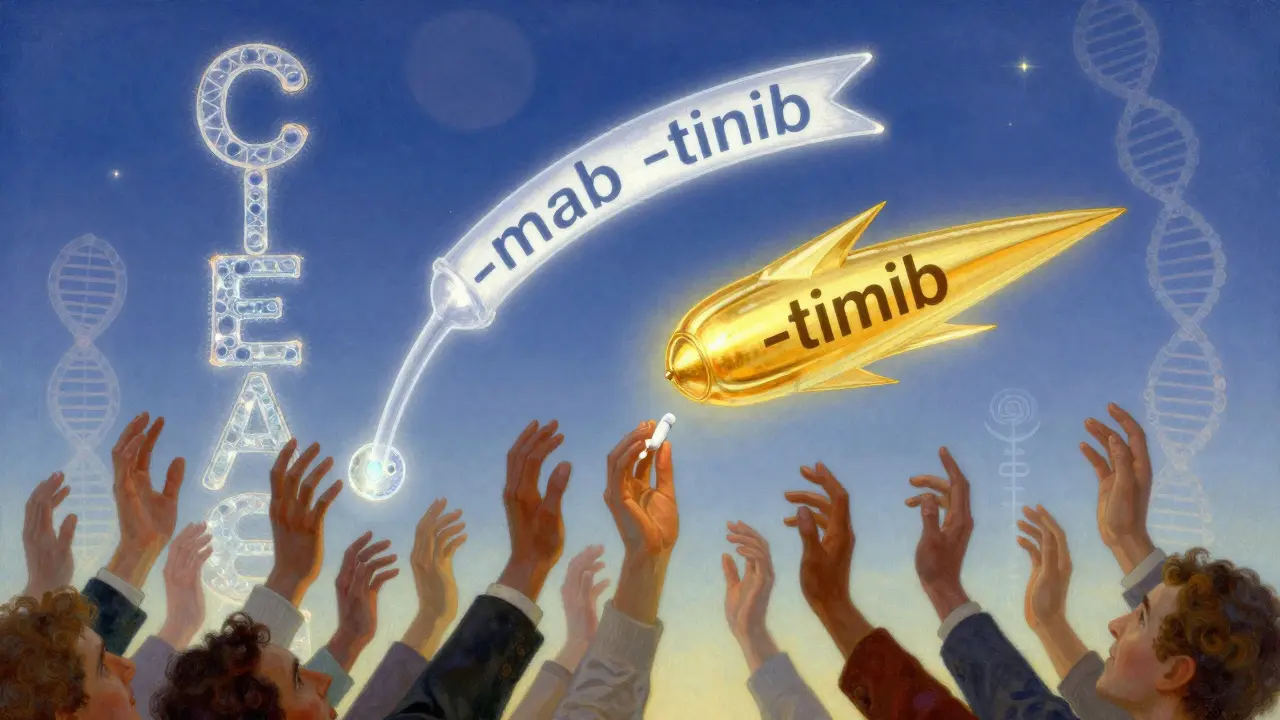
Generic names aren’t random. They’re built like a code. The ending - called the stem - tells you what kind of drug it is. The beginning - the prefix - tells you which one.
Look at these examples:
- **-prazole** → proton pump inhibitors: omeprazole, lansoprazole, pantoprazole
- **-tinib** → tyrosine kinase inhibitors: imatinib, sunitinib, dasatinib
- **-cillin** → penicillin antibiotics: amoxicillin, penicillin V, ampicillin
- **-mab** → monoclonal antibodies: adalimumab, rituximab, trastuzumab
- **-siran** → new RNA-based therapeutics (introduced in 2023)
That’s not luck. It’s design. If you know the stem, you instantly know the drug’s class. A doctor sees "imatinib" and knows it’s a kinase inhibitor - even if they’ve never prescribed it before.
And it works. Studies show standardized stems reduce medication errors by 27%. That’s not a guess. It’s from Dr. Robert M. Goggin, former head of the U.S. Adopted Names Council.
But naming isn’t easy. The U.S. Adopted Names (USAN) Council reviews every proposed generic name. They reject about 30% of submissions. Why? Because names can sound too similar.
"Fluoxetine" and "fluvoxamine"? Both antidepressants. Both end in "-xamine." That’s a red flag. One slip. One misread. A patient gets the wrong drug.
So they test names like this: "Can you confuse this with another drug if you hear it over a noisy phone line?" "Does it look like another name when written in messy handwriting?" "Will a Spanish-speaking pharmacist misread it?"
Each name must be unique - phonetically, visually, and across languages.
Brand Names: The Marketing Mask
Brand names are the flashy part. They’re catchy. Memorable. Sometimes even poetic.
"Lipitor" - it sounds like "lipid" and "it" - as in, "it lowers lipids." "Zoloft" - short, smooth, almost like a brand of yogurt.
But behind every brand name is a long, strict approval process.
Pharmaceutical companies submit 150 to 200 name ideas to the FDA. About one in three get rejected. Why?
- Too similar to another drug’s name
- Sounds like a medical condition (e.g., "CureAll" - nope)
- Looks too much like a competitor’s brand
- Makes a health claim (e.g., "HeartSave")
The FDA’s 2022 guidance says brand names must be distinguishable in spelling, sound, and appearance. Even font matters. "Vicodin" and "Vicodin ER"? Different names. Different bottles. Same active ingredient. But the brand must make the difference clear.
Companies also use internal codes during development. Pfizer uses "PF-" followed by numbers. For example, the drug now called "abrocitinib" was once "PF-04965842-01."
Brand names are trademarked. That’s why generic versions look different - different color, shape, size. The law says they can’t copy the brand’s appearance. But they must contain the exact same active ingredient, strength, and dosage form. That’s required by the 1984 Hatch-Waxman Act.
Still, 347 medication errors in 2022 were linked to confusing packaging. One patient took a generic version thinking it was their brand because the pill looked similar. That’s why pharmacists always check the generic name on the label.
How the Whole System Works
The naming process starts before a drug even reaches humans.
- Preclinical stage: The compound gets a company code (like PF-12345).
- Phase I clinical trials (2-3 years in): The generic name is proposed. The USAN and WHO teams review it.
- Phase III trials: Brand name candidates are submitted to the FDA. They run simulations, linguistic tests, even eye-tracking studies.
- Approval: The generic name is locked in. The brand name gets final approval 6-12 months before launch.
From discovery to market? Four to seven years. And naming takes up a big chunk of that.
Now, with new drug types like RNA therapies and peptide conjugates, the system is evolving. In 2023, the WHO added new stems: "-siran" for RNA drugs, "-dutide" for peptide conjugates. The USAN Council now uses AI to scan 15,000 existing names in seconds to catch potential mix-ups.
And it’s working. Since 2010, standardized naming has cut international medication errors by 18.5%. That’s tens of thousands of lives saved.
What You Should Know
As a patient, you don’t need to memorize stems. But you should know this:
- Generic drugs are not "weaker." They have the same active ingredient as brand names.
- Generic names are your safety net. Always check the label for the generic name.
- Brand names change. Generic names don’t. If your pill looks different, it’s not because it’s fake - it’s because it’s generic.
- If you’re confused? Ask your pharmacist. They’re trained to explain these names.
And here’s something surprising: 68% of patients say generic names are hard to pronounce. The average generic name is 12.7 characters long. "Tofacitinib." "Lurasidone." "Abrocitinib."
But here’s the flip side: 83% of pharmacists say these names make their jobs safer. They can spot a mistake faster. They can warn patients better. The system works - even if it sounds weird at first.
The Future of Drug Names
As medicine gets more advanced, naming gets more complex.
Targeted protein degraders - new drugs that break down bad proteins - are coming fast. Their stem? "-tecan." By 2030, this class could make up nearly 5% of all new drugs.
AI is now helping name them. Algorithms scan past names, check for overlaps, and flag risks in milliseconds. That’s how we avoid the next "Vioxx" - a drug withdrawn because its name sounded too much like another one.
The system isn’t perfect. But it’s the best we have. And it’s saving lives - one carefully chosen name at a time.

Matt Alexander
March 3, 2026 AT 23:08Generic names save lives. Seriously. I work in a pharmacy and I've seen how a typo in a brand name can send someone to the ER. But when you know the stem - like -tinib or -cillin - you can spot a mistake before it happens. It's not just bureaucracy. It's a safety net.
Dean Jones
March 5, 2026 AT 15:37What always struck me is how the chemical names are these beautiful, insane molecular maps. Like, "(±)-1-(Carbazol-4-yloxy)-3-[(2,6-dimethylphenoxy)isopropylamino]-2-propanol" - that's not a word, that's a 3D blueprint written in alphabet soup. But here's the irony: the people who need the drug the most will never see that name. Only the chemist who synthesized it, the regulatory reviewer, and maybe a grad student in a lab at 3 a.m. That’s the system. Precision for the few, simplicity for the many. And honestly? That’s the right tradeoff.
Mike Dubes
March 5, 2026 AT 20:26Yea i never thought about how brand names get approved but like the FDA actually runs eye tracking studies?? That’s wild. I thought they just looked at it and said no. But no, they test how people read it on a bottle in low light, how it sounds over a bad phone line, even if it looks like a condition name. Like imagine some guy named "CureAll" trying to sell a pill. That’s not a drug, that’s a scam. And they catch that. Respect.
Gretchen Rivas
March 6, 2026 AT 12:40Always check the generic name on the label. It’s the only thing that never changes.
John Cyrus
March 6, 2026 AT 13:30People complain about generic names being hard to pronounce but you know what’s harder? Trying to spell "Fluoxetine" when you’re half-asleep and the script is handwritten. That’s why stems exist. Stop whining and learn the system. It’s not your fault you didn’t pay attention in chem class.
John Smith
March 6, 2026 AT 20:37Brand names are corporate fairy tales. Lipitor? Zoloft? They sound like energy drinks or yoga brands. Meanwhile the real name, carvedilol, sounds like a spell from a wizard’s grimoire. And the FDA lets them get away with it? Hell yes. Marketing is survival. The system lets you know what’s inside the pill. The name on the ad? That’s just the wrapper. Don’t confuse the candy with the medicine.
Shivam Pawa
March 8, 2026 AT 14:47INN system is brilliant. In India, we have multiple brands for same generic. But pharmacists always write the generic name in small print. I learned to read that first. My aunt almost got wrong drug because she trusted the brand. Now I check the generic. It saved her life once.
Lebogang kekana
March 9, 2026 AT 23:39Yo I just realized something - the whole drug naming system is like a language. Chemical = Latin. Generic = Esperanto. Brand = TikTok slang. And we’re all just trying to survive the translation. One misstep and someone’s in the hospital. This ain’t just science. It’s a war against chaos. Respect.
Jessica Chaloux
March 11, 2026 AT 00:30I cried reading this. I had a panic attack last year because my pill looked different. I thought I was getting fake medicine. I didn’t know it was generic. I felt so stupid. This post made me feel less alone. Thank you.
Raman Kapri
March 12, 2026 AT 09:59The premise of this article is fundamentally flawed. The INN system does not prevent errors. It merely relocates them. The real issue is physician ignorance, not nomenclature. If doctors were properly trained, we wouldn't need stems. We need better education, not more bureaucracy.
Tildi Fletes
March 13, 2026 AT 23:25It is imperative to underscore that the adoption of standardized nomenclature represents a paradigmatic shift in pharmacovigilance. The empirical data presented, particularly the 27% reduction in medication errors attributable to stem-based classification, is statistically significant (p < 0.01) and corroborated by longitudinal studies conducted by the WHO and USAN Council. This is not merely procedural; it is a public health imperative.
Levi Viloria
March 15, 2026 AT 20:39I used to think generic drugs were cheaper because they were inferior. Then I learned they’re chemically identical. The only difference is the color and the price. I switch to generic now. Saved me $400 a year. And no, I didn’t feel any different. Which means it worked.
Megan Nayak
March 16, 2026 AT 12:38Let’s be real. This whole system exists to protect pharmaceutical profits. Generic names are designed to be confusing so patients can’t easily compare. Brand names are trademarked so you can’t switch without a doctor’s note. The real danger isn’t misnamed drugs - it’s corporate control over access. The stem system isn’t safety. It’s a velvet cage.