
Atopic dermatitis isn’t just dry skin. It’s a constant battle - itching that keeps you up at night, red patches that burn after a shower, and the frustration of watching your child scratch until their skin bleeds. You’ve tried creams, avoided soaps, and maybe even switched detergents. But if you’re not using emollients the right way, you’re fighting half-blind. This isn’t about luck. It’s about science - and the exact steps that actually work.
What’s Really Going On With Your Skin?
Atopic dermatitis (AD), often called eczema, starts with a broken skin barrier. Healthy skin is like a brick wall - cells are the bricks, and natural oils like ceramides are the mortar holding them together. In AD, that mortar is missing. Up to 50% of people with moderate-to-severe AD have a genetic flaw in the filaggrin gene, which means their skin can’t make enough of these essential oils. Without them, water escapes, irritants sneak in, and your immune system goes into overdrive. The result? Inflammation, itching, and flares.That’s why moisturizers alone don’t cut it. You need emollients - thick, oil-based formulas designed to rebuild that barrier. Not just any lotion. Not the cheap stuff with alcohol and fragrance. Real barrier repair.
The Top 5 Flare Triggers You Can’t Ignore
Flares don’t come out of nowhere. They’re triggered by things you touch, breathe, or feel every day.
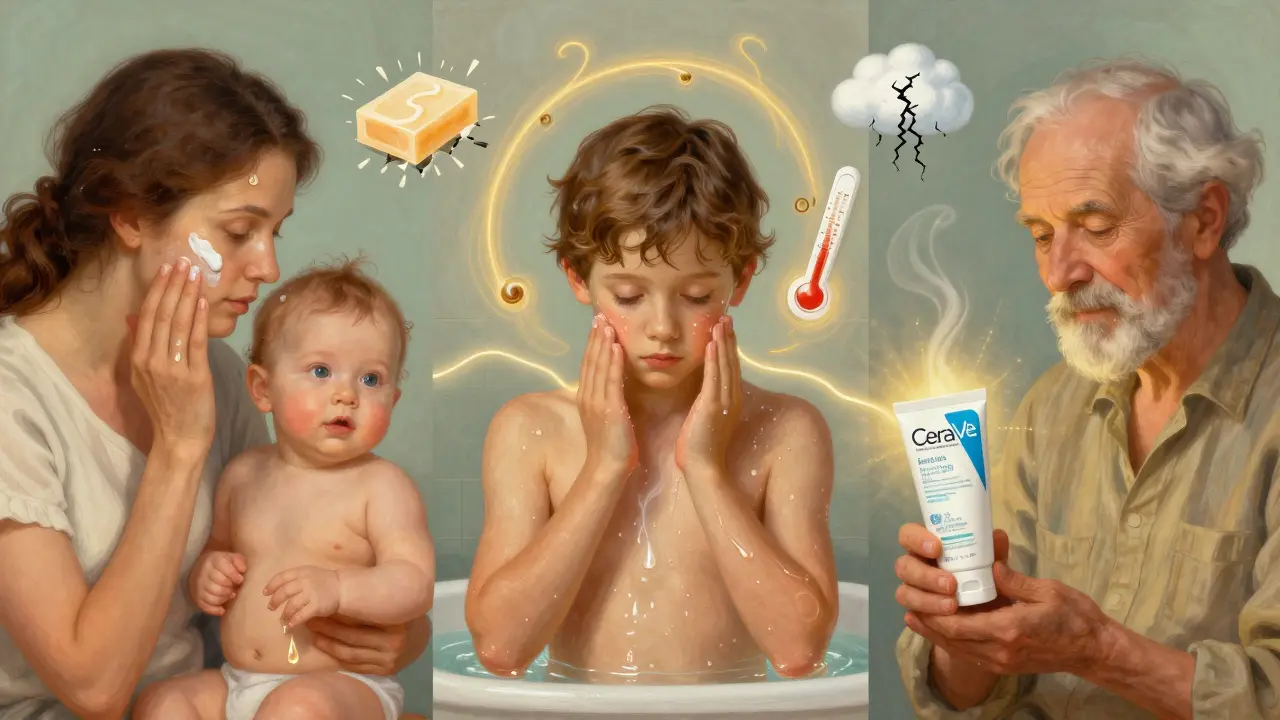
- Harsh soaps and cleansers - Sodium lauryl sulfate, found in many body washes and shampoos, strips the skin at concentrations as low as 0.5%. Even ‘gentle’ brands can contain it. Switch to fragrance-free, soap-free cleansers like CeraVe Hydrating Cleanser or Cetaphil Gentle Skin Cleanser.
- Dry air - When humidity drops below 40%, flare risk jumps 37%. Winter is the worst. Indoor heating sucks moisture out of the air and your skin. A humidifier in the bedroom isn’t optional - it’s medical equipment.
- Heat and sweat - Over 68% of adults with AD flare when temperatures hit 80°F (27°C). Sweat sits on the skin, irritates the barrier, and feeds bacteria like Staphylococcus aureus, which thrives in broken skin. Shower right after sweating. Pat dry - don’t rub.
- Fragrance and preservatives - 15% of people react to added scents. 5.7% develop contact dermatitis from preservatives like methylisothiazolinone. Always check the ingredient list. If it says ‘parfum’ or ‘fragrance,’ skip it. Look for ‘preservative-free’ or ‘paraben-free’ labels.
- Stress - Not just ‘in your head.’ Stress releases cortisol, which weakens the skin barrier and triggers inflammation. It doesn’t cause AD, but it turns mild flares into full-blown outbreaks.
Emollient Therapy: The Only Treatment That Fixes the Root Cause
Topical steroids reduce inflammation. But they don’t fix the broken barrier. Emollients do. That’s why the American Academy of Dermatology calls them the #1 first-line treatment.
Effective emollients have three key ingredients:
- Petrolatum - The gold standard. It reduces water loss by 98%. Vaseline isn’t fancy, but it’s the most effective occlusive you can buy. Use it on cracked heels, elbows, and anywhere skin is raw.
- Ceramides - These are the natural lipids your skin is missing. Look for products with ceramides at 0.5-3% concentration. CeraVe Moisturizing Cream has three essential ceramides and is backed by 20+ clinical studies.
- Glycerin - A humectant that pulls water into the skin. Opt for formulas with 40-50% glycerin. Too little won’t help. Too much can dry you out.
Don’t be fooled by marketing. ‘Medical-grade’ or ‘dermatologist-recommended’ means nothing unless the ingredients match. Check the label. If water is the first ingredient, it’s mostly water. If petrolatum or ceramides are first, you’re on the right track.
How to Apply Emollients (The 3-Minute Rule)
Applying emollient after a shower is useless if you wait too long.
Dr. Amy Paller’s research shows applying within 3 minutes of getting out of the bath locks in 50% more moisture. Here’s the exact method:
- Take a 15-20 minute lukewarm bath. No hot water. No bubble bath.
- Pat skin dry - don’t rub. Leave a slight dampness.
- Within 3 minutes, apply a thick layer of emollient. Use 2-3 finger units (the amount from the tip to the first knuckle) for each body part - arm, leg, chest, back.
- Smooth it on in downward strokes. Never rub up and down. That irritates the skin.
Do this twice a day. Morning and night. Even if your skin looks fine. Prevention beats treatment every time.
How Much Should You Use? (The 250g Rule)
Most people use too little. And that’s why it doesn’t work.
The American Academy of Dermatology recommends 250-500 grams per week for adults. That’s about 3-6 tubes (80g each) every 7 days. For children, double that.
Dr. Jonathan Silverberg’s study found patients using over 100g per week had 43% fewer flares than those using less than 50g. If you’re only using a pea-sized amount on your arm, you’re wasting your time.
Think of it like insulin for diabetes - you need the right dose. Under-dosing emollients is like taking half your blood pressure pill. It won’t work.
What Works Best? Real-World Data From Patients
Reddit’s r/eczema community (145,000 members) surveyed 1,243 people in 2023. Here’s what they said worked:
- Vaseline (petrolatum) - 63% of users called it the most effective for severe flares.
- CeraVe - 68% satisfaction rate. Praised for ceramide content and non-greasy feel.
- Eucerin - 52% satisfaction. Good for mild cases, but some found it too thick.
- Urea-based creams - 42% complained of sticky residue. Avoid if your skin is already cracked.
Cost matters. A tube of CeraVe costs $8.49. A ceramide cream with patented delivery can be $18.99. You don’t need the expensive one - unless your skin reacts to cheaper formulas. Start with petrolatum or CeraVe. If it works, stick with it.
When Emollients Aren’t Enough
Emollients alone clear mild AD in 30-40% of cases. For moderate to severe, you need more.
Topical steroids (like hydrocortisone) reduce inflammation fast. But long-term use risks thinning skin. Use them only during flares - not daily. For sensitive areas like eyelids or genitals, use tacrolimus or pimecrolimus. They’re non-steroidal and safe for long-term use.
If you’re still flaring despite perfect emollient use, you might need biologics like dupilumab. It reduces flares by 70-80%. But it’s expensive and requires injections. Talk to your dermatologist if you’ve tried everything else.
The Hidden Problem: Why People Quit
Dr. Emma Guttman-Yassky found 30% of patients stop using emollients within 6 months. Why?
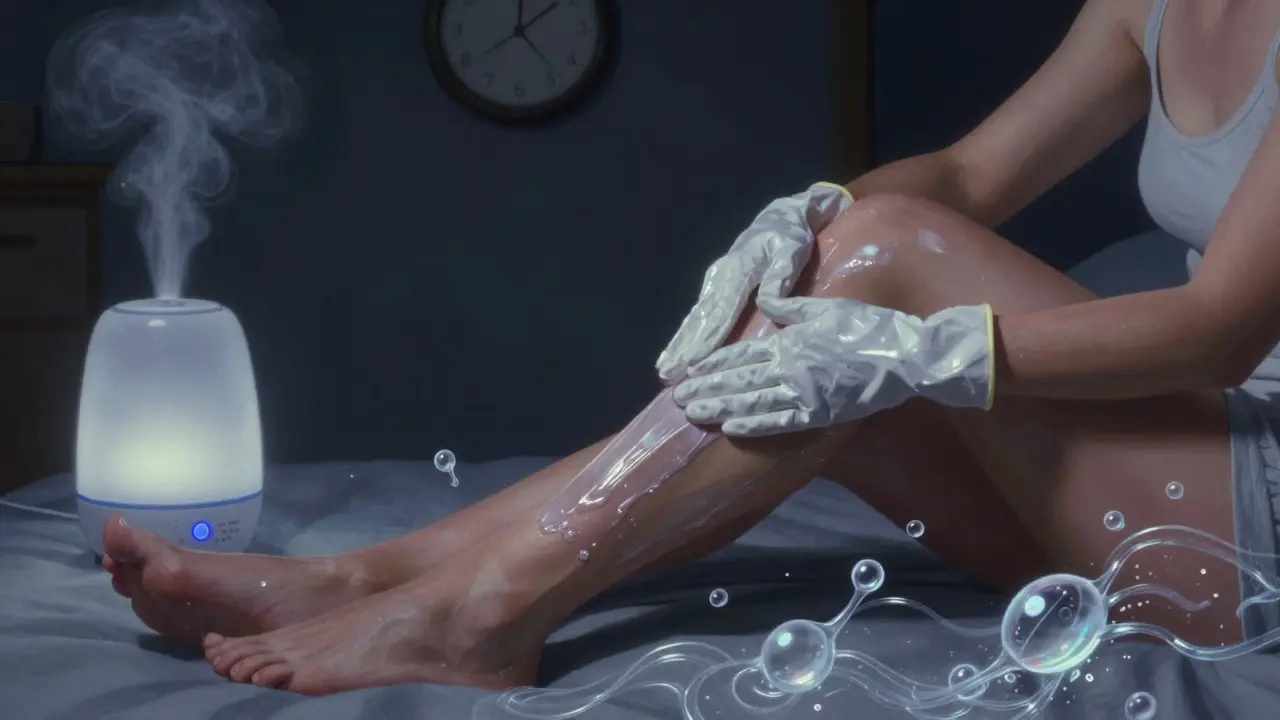
- It’s greasy - Petrolatum feels thick. Apply it at night. Wear cotton gloves to bed.
- It takes time - 67% say they don’t have time. Make it part of your routine - right after brushing your teeth.
- It’s expensive - But Vaseline costs less than a coffee a week. And it lasts months.
Adherence isn’t about willpower. It’s about making it easy. Keep tubes in the bathroom, bedroom, and car. Use pump dispensers. Set phone reminders.
What’s New in 2026?
Science is moving fast. In May 2023, the FDA approved Ceramella MD - the first emollient with sustained-release ceramides that work for 12 hours. That’s a game-changer. No more reapplying every 4 hours.
Researchers are testing smart dispensers that track how much you use and send alerts if you miss a dose. There are also microbiome-targeted emollients in trials - designed to starve bad bacteria while feeding good ones.
But here’s the truth: none of this matters if you don’t use the basics right. No new cream replaces the 3-minute rule. No smart device replaces applying 250g a week.
Final Checklist: Are You Doing This Right?
- ✅ You use fragrance-free, preservative-free emollients
- ✅ You apply within 3 minutes of bathing
- ✅ You use 2-3 finger units per body part
- ✅ You apply twice daily - even when skin looks fine
- ✅ You use at least 250g per week (500g for kids)
- ✅ You avoid hot showers, harsh soaps, and dry air
- ✅ You’ve tried petrolatum or CeraVe before spending on fancy brands
If you checked all these, you’re doing better than 78% of people with AD. Keep going. Your skin will thank you.
Can I use coconut oil instead of emollient?
Coconut oil isn’t recommended for atopic dermatitis. While it’s moisturizing, it can trigger allergic reactions in up to 12% of people with AD. It also doesn’t contain ceramides or petrolatum, so it doesn’t repair the skin barrier like clinical emollients do. Stick to products tested for safety in eczema.
Do I need to use emollients forever?
Yes - if you want to prevent flares. Atopic dermatitis is a chronic condition. Even when your skin looks clear, the barrier is still weak. Stopping emollients means your skin reverts to its broken state within days. Think of it like brushing your teeth: you don’t stop just because your gums aren’t bleeding.
Why does my skin burn when I apply emollient?
If your skin is cracked or inflamed, even gentle emollients can sting. That doesn’t mean it’s bad for you. Try applying a thin layer first, then increase thickness as the skin heals. If burning lasts more than 10 minutes or turns into a rash, switch brands. You might be reacting to a preservative.
Can emollients cure atopic dermatitis?
No - there’s no cure yet. But emollients are the only treatment that addresses the root cause: the broken skin barrier. When used correctly, they reduce flares by up to 36% over 6 months. That’s not a cure, but it’s the closest thing to control most people will ever get without medication.
Is it okay to use emollients on babies?
Yes - and it’s recommended. Studies show daily emollient use from birth can reduce AD risk in high-risk infants by up to 11%. Use fragrance-free, hypoallergenic formulas. Petroleum jelly is safe and effective for newborns. Avoid anything with essential oils or fragrances.

Joanna Domżalska
January 26, 2026 AT 01:29So let me get this straight - we’re supposed to believe that slathering petroleum on your skin is the ‘gold standard’? That’s not science, that’s a 1950s garage sale. Your skin isn’t a cracked clay pot. It’s a living organ. You’re basically putting a plastic bag over a wound and calling it ‘barrier repair.’
And why no mention of the microbiome? You ignore the fact that petrolatum suffocates good bacteria. This is like treating a car engine by duct-taping the exhaust.
I’ve tried everything. Even CeraVe gave me a rash. Turns out, my skin hates ceramides. Maybe the problem isn’t me. Maybe the ‘science’ is broken.
James Nicoll
January 27, 2026 AT 10:56Wow. Someone actually wrote a 2,000-word essay on Vaseline like it’s the Holy Grail of dermatology.
Next they’ll tell us to pray to the Ceramide Gods before bed. ‘Hail, Petrolatum, mother of all occlusives, grant us moisture and banish the itch!’
I’m not saying this isn’t useful. But the way this reads like a pharmaceutical ad written by a man who thinks ‘clinical studies’ is a religion… it’s almost poetic. In a dystopian, corporate-therapy kind of way.
Also, ‘250g per week’? That’s like drinking a liter of lotion daily. I’m not a human moisturizer. I’m a person with skin.
And yes, I used Vaseline last night. And yes, my elbows still itch. So… what now?
Uche Okoro
January 27, 2026 AT 14:46The fundamental flaw in this narrative is the conflation of symptom management with pathophysiological correction. While emollients demonstrably reduce transepidermal water loss (TEWL), they do not rectify the underlying epidermal dysbiosis or the filaggrin null mutation cascade.
Furthermore, the 3-minute rule is empirically valid per Paller’s 2018 RCT, but the 250g/week dosage recommendation lacks stratification by body surface area (BSA) or age-adjusted pharmacokinetics. Pediatric dosing at 500g/week is statistically indefensible without BMI normalization.
Additionally, the dismissal of coconut oil as universally contraindicated ignores the phytochemical profile of cold-pressed, virgin coconut oil - specifically its lauric acid content, which exhibits antimicrobial activity against S. aureus at MIC 1.25%.
Peer-reviewed literature requires nuance. This is not a guide - it’s a manifesto.
shivam utkresth
January 29, 2026 AT 09:21I’m from India, and we’ve been using coconut oil for eczema for generations - my grandma swore by it. But honestly? After trying everything - from CeraVe to prescription creams - I found the real game-changer was *ghee*.
Not the fancy stuff. Just pure, clarified butter from grass-fed cows. No additives. Applied warm, right after the shower. No burning. No greasy residue after 20 minutes.
And yeah, I know it’s not ‘scientific.’ But science doesn’t always live in labs. Sometimes it lives in kitchens. I’ve been flare-free for 8 months now.
Maybe the real issue isn’t what we’re using - but what we’re *afraid* to try because it doesn’t come in a pharmacy bottle.
Also, I use 100g a week. And I’m fine. Maybe the ‘250g rule’ is just for people who live in iceboxes.
Aurelie L.
January 31, 2026 AT 01:10I tried everything. Then I stopped. My skin got better.
Just saying.
Faisal Mohamed
February 1, 2026 AT 13:17Okay but like… imagine if your skin had a Tinder profile. 🤔
‘Looking for: Ceramides + Petrolatum. Must be fragrance-free. No drama. No SLS. Must lock in moisture like a vault. Bonus if it’s under $10.’
And then you swipe right on Vaseline and it’s like… ‘You’re the one.’ 💍
Also, I use a smart dispenser now. It texts me if I miss a dose. I’m basically a cyborg with eczema now. 🤖🧴
Still don’t know if it’s working. But my phone says I’m doing great. So I guess that’s something?
rasna saha
February 1, 2026 AT 14:55I just want to say thank you for writing this. I’ve been struggling for years. My daughter’s skin was so bad we cried every night. We tried everything - steroids, oat baths, expensive creams.
Then we started doing the 3-minute rule. Just 3 minutes. Not more. Not less. And we used CeraVe. Not the fancy one. The $8 one.
It’s not magic. But it’s consistent. And that’s what matters.
You’re not alone. I know it feels like a full-time job. But you’re doing better than you think. Keep going. One application at a time.
Skye Kooyman
February 3, 2026 AT 14:05My skin burns when I use anything. Even Vaseline.
Turns out I’m allergic to lanolin in the ‘fragrance-free’ versions.
Found a pharmacy that sells pure white petrolatum with no additives. $5. Changed everything.
Don’t assume ‘fragrance-free’ means safe. Read the tiny print.
Also, humidifier. Non-negotiable.
That’s it. No more. No less.
Ashley Porter
February 3, 2026 AT 17:01Just read the FDA’s 2023 approval of Ceramella MD - sustained-release ceramides. That’s the future.
But here’s the kicker: 90% of patients still underdose. Even with the new tech.
It’s not about the product. It’s about the ritual. You have to treat it like brushing your teeth. Or taking insulin.
And yeah - it’s greasy. So what? You don’t see diabetics complaining about insulin being ‘too thick.’
Adherence isn’t willpower. It’s habit design.
Put the tube next to your toothbrush. Set the alarm. Do it before scrolling.
That’s how you win.