
Absolute vs Relative Risk Calculator
Understand how absolute and relative risk differ with this calculator. Enter your baseline risk and see how it translates to absolute or relative risk values.
Baseline risk: 0%
Calculated risk: 0%
Absolute risk reduction: 0 percentage points
Relative risk reduction: 0%
Number Needed to Treat (NNT): N/A
Visual representation
When a drug ad says it "cuts your risk of heart attack in half," you might think you’re avoiding a major health crisis. But what if that "half" means going from a 2% chance to a 1% chance? That’s not a miracle-it’s a small shift. The difference between absolute risk and relative risk isn’t just math. It’s the difference between understanding what really matters for your health and being misled by numbers.
What Absolute Risk Really Means
Absolute risk tells you the actual chance something will happen to you. It’s simple: out of 100 people like you, how many will experience the side effect? Or how many will avoid a heart attack? This number doesn’t lie. It doesn’t inflate. It just states the truth.Let’s say 1 in 1,000 people on a certain blood pressure medication develop a serious muscle problem. That’s 0.1% absolute risk. If you’re one of those 1,000, your chance is 0.1%. If you’re not, it’s zero. No tricks. No spin.
Doctors and regulators use absolute risk to decide if a drug’s benefit outweighs its danger. If a drug reduces stroke risk from 5% to 4% in a group of older adults, that’s a 1 percentage point drop. That’s the absolute risk reduction. It’s small, but it’s real. And it’s the number that matters most when you’re deciding whether to take a pill every day for years.
Why Relative Risk Can Be Misleading
Relative risk compares two groups. It tells you how much more or less likely something is in one group versus another. It’s often used in ads because it sounds impressive. A drug that cuts heart attack risk from 2% to 1%? That’s a 50% relative risk reduction. Sounds huge, right?But here’s the catch: if your baseline risk was 0.1%, and the drug brings it down to 0.05%, you still have a 0.05% chance of having a heart attack. The relative risk reduction is 50% again. But the actual benefit? A 0.05 percentage point drop. That’s not life-changing-it’s barely noticeable.
Pharmaceutical companies know this. That’s why 78% of U.S. direct-to-consumer drug ads highlight relative risk reductions without ever mentioning the absolute numbers. A 90% reduction in cancer risk sounds terrifying until you learn the original risk was 0.75% and went to 1.25%. That’s a 0.5 percentage point increase. The relative number is scary. The absolute number? Not so much.
The Math Behind the Numbers
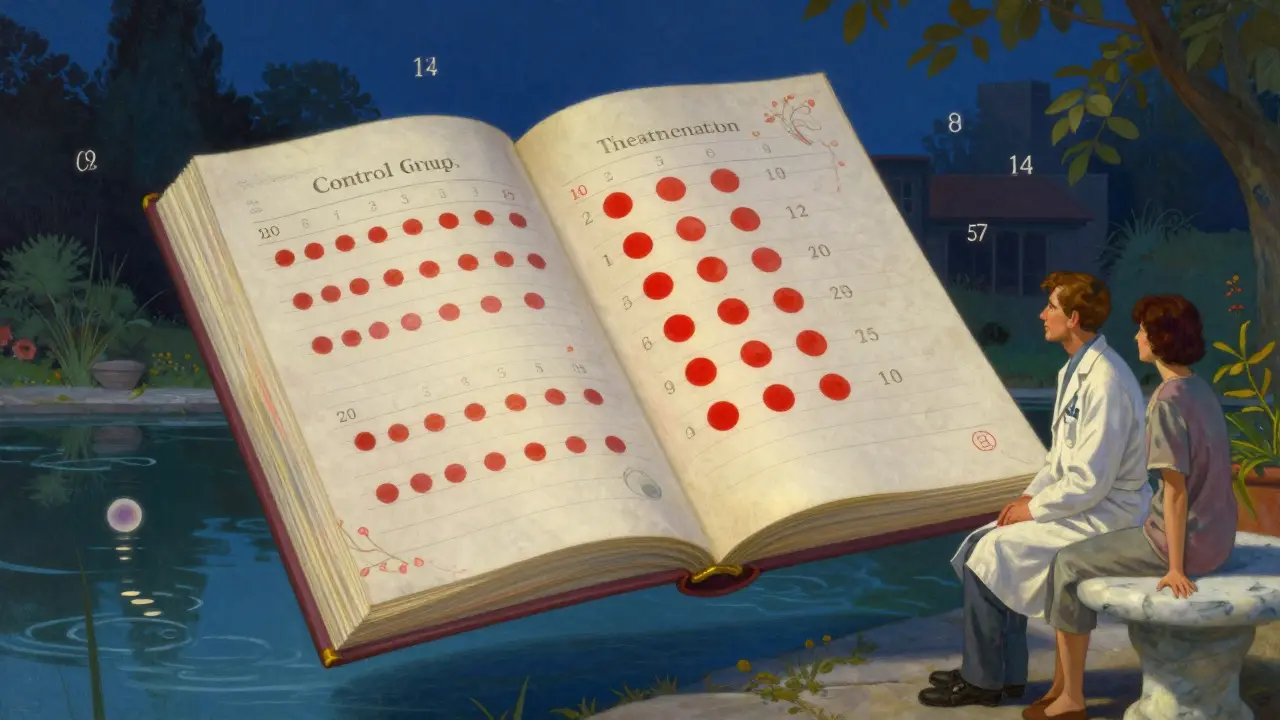
Here’s how the numbers break down:- Absolute Risk Reduction (ARR) = Risk in control group − Risk in treatment group
- Relative Risk Reduction (RRR) = (ARR ÷ Risk in control group) × 100%
Example: A drug reduces the chance of a bad reaction from 20% to 10%.
- ARR = 20% − 10% = 10 percentage points
- RRR = (10% ÷ 20%) × 100% = 50%
That means for every 10 people treated, one avoids the side effect. That’s the Number Needed to Treat (NNT): 10. You need to treat 10 people to help one. The rest get no benefit-and may still have side effects.
Now flip it: if a drug increases the risk of nausea from 5% to 10%, the absolute increase is 5 percentage points. The relative increase? 100%. That’s the number you’ll see in the fine print: "Nausea risk doubled." But if you’re one of the 95% who didn’t have nausea before, doubling it still leaves you at a 10% chance. That’s not a dealbreaker-it’s a common, manageable side effect.
Why Both Numbers Matter
You can’t understand a drug’s real impact using just one number. Relative risk tells you how strong the effect is compared to nothing. Absolute risk tells you how meaningful it is in real life.Take statins. For someone with a 10% chance of a heart attack in 10 years, a statin might lower that to 8%. That’s a 20% relative risk reduction. Sounds good. But the absolute reduction? Just 2 percentage points. That means you need to treat 50 people for 10 years to prevent one heart attack. For someone with a 2% risk, the same drug reduces it to 1.6%. The relative reduction is still 20%. But now the absolute reduction is only 0.4%. That’s one in 250 people helped.
Doctors who explain both numbers see better patient decisions. A 2022 study in JAMA Internal Medicine found that 60% of doctors couldn’t convert relative risk to absolute terms. Patients? Even worse. One Reddit user shared that a patient refused statins because they thought "cutting heart attack risk in half" meant they’d avoid it entirely. That’s the danger of missing absolute risk.
What Patients Are Saying
On patient forums, frustration is common. One person wrote: "I thought "50% fewer heart attacks" meant half the people wouldn’t have them. I didn’t realize it meant my risk went from 2% to 1%." Another said they skipped a medication because the ad said "risk of stroke doubled"-but didn’t mention the original risk was 0.2%.These aren’t just misunderstandings. They’re failures in communication. When a drug’s side effect is "2.4 times more likely," patients hear "I’m almost three times more likely to get this." But if the original risk was 4%, and the drug raises it to 9.6%, that’s still a 5.6 percentage point increase. For most people, that’s a mild, temporary issue-not a reason to avoid a life-saving drug.
On the flip side, patients who understand absolute risk make better choices. One woman in a medical journal case study was ready to refuse a treatment because of a "70% increased cancer risk." When she learned the risk went from 0.75% to 1.25%, she changed her mind. The absolute increase was small. The benefit of the treatment was clear.

How to Protect Yourself
You don’t need a degree in statistics to interpret drug risks. Here’s how to ask the right questions:- What’s my baseline risk? Before any drug, ask: "What’s the chance this problem would happen to me without treatment?"
- What’s the absolute benefit? "How many fewer people have the bad outcome with this drug?"
- What’s the absolute risk of side effects? "How many people actually get this side effect?"
- How many people need to be treated for one to benefit? That’s the NNT. If it’s 50, you’re not the one being helped in most cases.
Ask for visuals. A picture of 100 people with some shaded in for side effects or benefits makes it real. Cochrane Reviews show this cuts confusion by more than half.
What’s Changing in the Industry
Regulators are catching on. In 2023, the FDA released draft rules requiring both absolute and relative risk in drug ads. The European Medicines Agency already requires both in patient leaflets. Some journals now use standardized templates for reporting trial results.Medical schools are teaching this too. Harvard added a required course on interpreting medical statistics in 2022. Why? Because 68% of graduating students couldn’t correctly explain what a 50% relative risk reduction meant.
But change is slow. The pharmaceutical industry still makes billions selling drugs with ads that emphasize relative risk. A 2021 study found drugs marketed with relative risk numbers get 23% more prescriptions at first. But patients stop taking them 15% more often when they realize the real benefit is tiny.
Final Takeaway
Numbers aren’t the enemy. Misleading numbers are. Absolute risk tells you what’s actually happening to you. Relative risk tells you how the drug compares to nothing. You need both.If a drug reduces your risk of something bad from 10% to 8%, that’s a 20% relative reduction. But it’s only a 2 percentage point absolute reduction. That’s a real benefit-but not a miracle. If it increases your chance of a headache from 5% to 10%, that’s a 100% relative increase. But it’s still only a 5 percentage point absolute increase. That’s a common side effect, not a disaster.
Always ask: "What’s the real chance this will affect me?" Don’t let a big percentage fool you. Your health isn’t a math puzzle. It’s your life. And you deserve to know what the numbers actually mean.
What’s the difference between absolute risk and relative risk?
Absolute risk tells you the actual chance of something happening to you-for example, a 1 in 100 chance of a side effect. Relative risk compares two groups and shows how much more or less likely something is in one group versus another-for example, a drug reducing risk by 50%. Absolute risk shows real-world impact; relative risk can make small changes sound big.
Why do drug ads use relative risk instead of absolute risk?
Relative risk numbers are usually larger and sound more impressive. A drug that cuts heart attack risk from 2% to 1% has a 50% relative risk reduction-easy to advertise. But the absolute reduction is just 1 percentage point. Ads use relative risk because it makes benefits look bigger and side effects seem smaller, even if the real impact is minimal.
How do I know if a drug’s benefit is worth the risk?
Ask for the absolute risk reduction and the Number Needed to Treat (NNT). If the NNT is 10, you need to treat 10 people for one to benefit. If the NNT is 50, most people won’t see any benefit. Also ask: "What’s my personal risk without the drug?" and "How common are the side effects?" If the benefit is small and side effects are common, the trade-off may not be worth it.
Can relative risk ever be misleading?
Yes, very often. A drug might reduce a rare side effect from 1 in 100,000 to 1 in 1,000,000-a 90% relative risk reduction. But the absolute reduction is only 0.099%. That’s not a meaningful benefit for most people. Relative risk makes small changes look huge, especially when the original risk is low.
What should I do if my doctor only talks about relative risk?
Politely ask for the absolute numbers. Say: "Can you tell me what my actual risk is without the drug and what it becomes with it?" Request a visual, like a chart showing 100 people with side effects shaded in. If they can’t or won’t provide it, consider getting a second opinion. Your understanding of risk is key to making the right choice.

Lily Steele
January 30, 2026 AT 18:39I used to think "cutting risk in half" meant I’d avoid a heart attack for sure. Then I found out my baseline was 2% and it dropped to 1%. I felt silly, but also way more informed. Now I always ask for the real numbers before taking anything.
Kelly Weinhold
January 30, 2026 AT 21:43OMG YES this is so important!! I had a friend who refused her blood thinner because the ad said "risk of stroke doubled" and she panicked-turns out her original risk was 0.3% and it went to 0.6%. That’s like flipping a coin once a year and hoping it lands tails. She started taking it after someone showed her a little grid of 100 people with two boxes shaded in. It made all the difference. We need more of this kind of clarity in medicine.
calanha nevin
February 1, 2026 AT 13:14The persistent use of relative risk in direct-to-consumer advertising constitutes a systemic failure in health communication. Regulatory bodies must enforce mandatory disclosure of absolute risk metrics and number needed to treat in all promotional materials. The current paradigm exploits cognitive biases and undermines informed consent. Medical education must prioritize statistical literacy at all levels to mitigate this public health concern.
Lisa McCluskey
February 2, 2026 AT 19:40Most people don’t realize how small the actual benefit is with statins unless they’re high risk. I work in a clinic and I show patients a 10x10 grid. One or two squares shaded. It’s not magic. It’s math. And that’s okay. Real health isn’t about miracles-it’s about consistent, small improvements.
Darren Gormley
February 3, 2026 AT 03:25LOL this is why I don't trust doctors or pharma. They're all just trying to sell you pills. "50% reduction!" Bro it's from 0.001% to 0.0005% 😂 You're literally getting a 0.0005% better chance of not dying from a meteor. Meanwhile I'm out here eating kale and lifting weights. 🤷♂️💊💥
Mike Rose
February 3, 2026 AT 13:46so like... if the risk was 2% and now its 1%... thats just half right? so why do they make it sound like a big deal? i mean its still kinda risky. why not just say it plainly? this whole thing is just confusing and feels like a scam.
Russ Kelemen
February 4, 2026 AT 13:25What’s interesting here isn’t just the math-it’s how deeply we’ve been trained to equate percentage changes with personal impact. We don’t think in absolute terms because our culture rewards dramatic stories, not quiet truths. A 50% reduction sounds heroic. A 0.4% drop sounds boring. But health isn’t about heroics. It’s about the quiet, daily choices that stack up over decades. The real courage isn’t taking the pill-it’s asking the hard question first. And then living with the answer, whatever it is.
Diksha Srivastava
February 5, 2026 AT 17:55I come from India where most people don’t even know what risk means in medicine. My uncle took a medicine because the ad said "90% less chance of cancer"-turned out his original risk was 0.8% and now it’s 0.08%. He was so scared before, now he’s calm. I showed him a picture of 100 people and we colored one dot. He said, "Oh, so it’s like winning a tiny lottery?" That’s when I knew-simple visuals change lives.